

A survival guide for raising your kids in a woke world.
America’s Youth Still Need Charlie Kirk
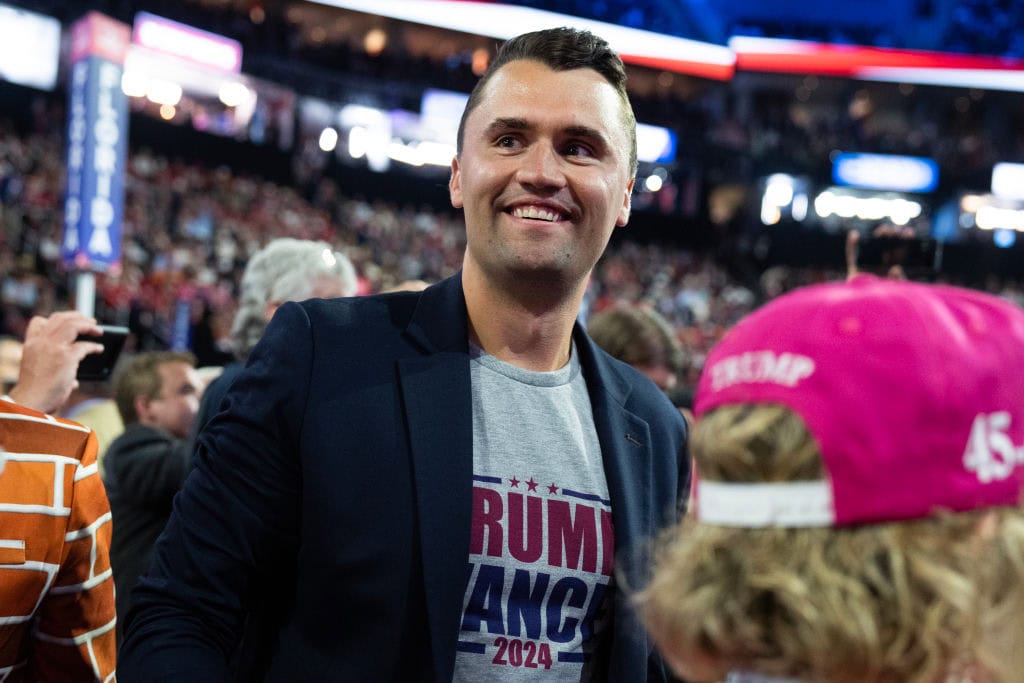
His greatest legacy is showing how faith, courage, and action can improve the nation.
One year ago today, America lost Charlie Kirk.
In some ways, it feels like only yesterday. At other times, it feels like a lifetime ago. Twelve months after that horrifying day, we have only begun to reckon with the scale of the loss for conservatism—and for America.
To someone who ignores politics, it can be hard to explain just why Charlie’s loss was so great. He had a popular podcast—but there are many of those. He did campus debates—but he didn’t have a monopoly on that concept. And of course, however deeply involved in politics he was, Charlie never held office himself.
And yet millions think that Charlie Kirk’s martyrdom leaves a tremendous void on the Right. Why?
What America lost one year ago on that dreadful September 10 was not merely a debater, a pundit, an activist, or even, as many speculated, a future president. What America lost was a true leader, the kind who comes along only a few times in a generation.
The American Way
In one of the most important passages in Democracy in America, Alexis de Tocqueville describes the tremendous capacity for self-organization among America’s citizens, in contrast to the torpor he saw among the people of Europe:
Anyone living in the United States learns from birth that he must rely upon himself to combat the ills and obstacles of life…. Should an obstacle appear on the public highway and the passage of traffic is halted, neighbors at once form a group to consider the matter…. [A]ssociations are born to resist enemies of an entirely ideological nature and to share the fight against social excesses. In the United States, associations aim to promote public safety, business, industry, morality, and religion. There is nothing the human will despairs of attaining through the free action of the combined power of individuals.
Any honest observer recognizes that the self-organizing energy Tocqueville describes has, to say the least, badly atrophied in modern America. Americans today are far less likely to join a club, attend church, start a family, or even date. They have fewer close real-life friends. Not only do they rarely participate in local government, but they typically have no idea how it works or who their elected officials are. A spirited public life has given way to atomization, smartphone addiction, and a passion for national politics at the expense of everything local. We love to beg Washington to solve our problems while many have never even met their neighbors.
But in Charlie’s own life, the old American way endured.
He hearkened back to America’s golden age, inspiring discouraged young people today. Read about the men who revolted against Britain, who conquered the West, who crushed Santa Anna at San Jacinto, or who charged up San Juan Hill. You will find Charlie over and over again: men with absolute confidence in the truth of the Christian Gospel, men with a fierce devotion to the United States of America as the greatest nation and greatest people in the world, men with no university degree but a lifetime hunger for learning, men of optimism who endured through one setback after another, men of self-reliance who raised armies and gambled fortunes to leave a worthy legacy to their posterity, men who would—and often did—lay down their lives for God and country.
Thomas Jefferson wrote the Declaration of Independence at 33. Alexander Hamilton played a decisive role in crafting the Constitution at 32. Buck Travis died leading the defenders of the Alamo at 26. Charlie Kirk, at just 31, ignited a conservative resurgence in the places it was deemed impossible—the American college campus—and swung a presidential race for good measure.
America’s present media ecosystem rewards emotional incontinence of the worst and most hysterical sort. Nothing attracts attention faster than screeching loudly, “We’ve been betrayed!” and howling that nothing has been accomplished. It is easy—and highly profitable—to be a charismatic complainer.
But it is far harder to be someone who fixes problems. And that was what Charlie did.
Few people believed more deeply in the power of his own disciplined efforts to change the world for the better. Charlie loved to recite the line from the Book of Isaiah: “Here I am, Lord. Send me.” When confronted with a crisis facing America, Charlie asked, “What can I do to help fix this?” This virtue drove his campus debates. If the youth were too liberal, why not be in the arena changing their minds?
But Charlie’s efforts went far beyond that. After poor early-voter turnout was a major contributor to the Republicans’ disappointing performance in the 2022 midterms, Charlie transformed Turning Point Action into an early-vote ballot-chasing operation with hundreds of employees. He fine-tuned the rhetoric to convince wary Republicans to come around on early voting. And for good measure, he wore a black “Vote Early” T-shirt while hosting his show to make sure the message got through. Come November, Charlie was deeply proud that of the seven major swing states, his home state of Arizona had shifted the most toward President Trump.
These efforts existed alongside recurring minor ones. After President Trump’s 2024 victory, Charlie moved to Mar-a-Lago for two months to help with the presidential transition. He did not seek a position for himself but worked to find promising hires to fill the new administration. When he learned that Nebraska’s oddball way of awarding electoral votes could hand the presidency to Democrats, Charlie organized a rally within a single week to change the law and made two visits to Nebraska to lobby for it. That particular effort failed, but it is still a testament to Charlie’s style—he always wanted to be where the work was most critical, and where he could have the greatest impact.
Charlie’s accomplishments followed the simplest strategy imaginable: identify a problem, search out a solution, and then do the work necessary to secure it. That is so basic it may sound like a joke, but it isn’t. The vast majority of us are content to spot a problem and whine as it persists. We send angry tweets and wait for someone to fix it. Charlie’s life was all about repeatedly taking the next step: becoming the solution.
Every day he attacked life, guided by a handful of questions written on a small sign he kept on his desk:
1. What can I do to help someone today?
2. What can I do to add value in the world today?
3. How can I honor God today?
This could easily be a trite message printed on a fridge magnet and then forgotten. But Charlie’s secret weapon was his earnestness: He asked himself those questions, found the answers, and followed through.
Walking the Walk
Charlie loved to call Turning Point USA the most important organization in America. When I first started working for him, hearing that phrase made me roll my eyes a little. But I was the fool, and Charlie was the great man: his total commitment and utter self-confidence made his words a reality.
If Charlie left all of us in his shadow, he did so with Christian humility. When success came, it was God’s doing, not his own. Politics is full of lip-service believers, but Charlie was the rare public Christian for whom faith clearly guided every decision and statement he ever made. He had a pastor’s knowledge of the Bible but always gave all the credit to the experts who taught him.
And even more than he loved talking about the importance of borders or explaining why he was pro-life, Charlie loved to talk about marriage, parenthood, and the transformative effects of family life. He liked to give dating and relationship advice because he earnestly wanted young men and women to experience God’s design for them. His final book, rather than an exhortation to political action, encouraged Christians to observe the Sabbath. Every time Charlie took a stage or stepped behind a microphone, he was showing America’s young people a better way that, once routine, is still available: Live the way I do, he said, and you can have the life I have.
As we pass the one-year mark without Charlie, this is the most important lesson to take from his life. None of his achievements required unnatural genius or physical prowess. Instead, they required tenacity, discipline, faith, and a readiness to put God and others first—virtues available to all of us, regardless of our innate talents.
On this September 10, the loss we feel remains immeasurable. But as Charlie understood better than most, the work continues. And as he would tell the staff of The Charlie Kirk Show every time the work seemed hard: “No blackpilling.” If we follow that simple lesson, we can carry on Charlie’s legacy and continue to build the country he devoted his life to saving.
The American Mind presents a range of perspectives. Views are writers’ own and do not necessarily represent those of The Claremont Institute.
The American Mind is a publication of the Claremont Institute, a non-profit 501(c)(3) organization, dedicated to restoring the principles of the American Founding to their rightful, preeminent authority in our national life. Interested in supporting our work? Gifts to the Claremont Institute are tax-deductible.
Suggested reading


Homemaking is a daily battle for self-governance in an increasingly hostile world.

Are legacy conservatives willing to move the ratchet in the other direction?

Elite universities have failed to produce elites.
The American people deserve honesty about who is at fault for the virus disaster.

The monthlong spectacle is over, and the taste of glitter is like ashes in our mouths.

