
The Sun Sets on Great Britain
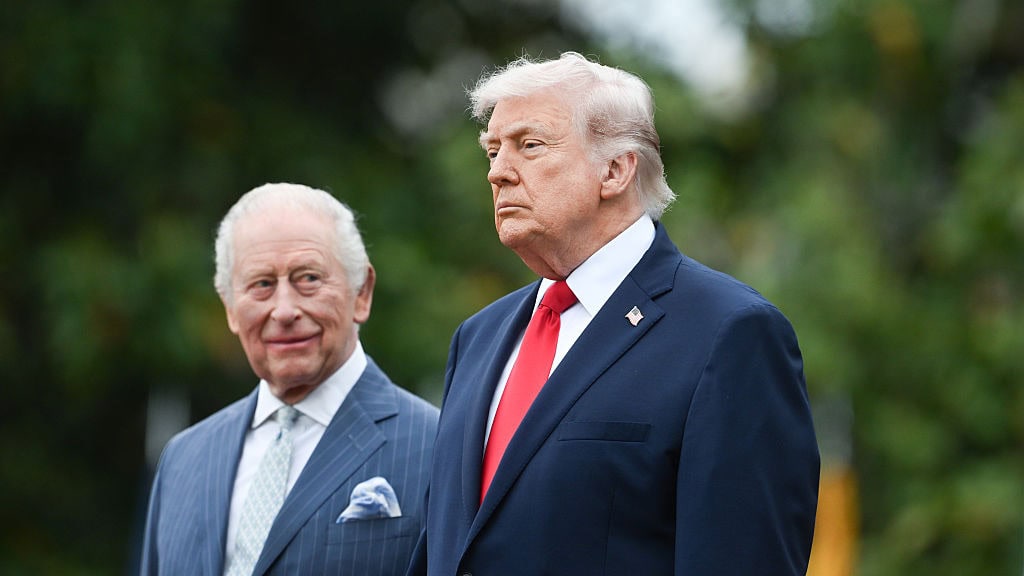
President Trump’s clever message to King Charles.
White House lawn speeches greeting foreign heads of state are usually sleepy pro-forma affairs, filled out with the clichés of long-standing ties and mutual interests. But President Trump’s speech welcoming King Charles was no mere boilerplate. It was a masterpiece of ironic and subtle mischief on multiple levels—triggering the Left, offering a ground of unity for the Right as we draw near to the 250th anniversary of the American Founding, and, for those who listened closely, a rebuke both to Britain and the rest of Europe for their supine and rapidly declining civilizations. Making all the “No Kings” protestors look silly was just a bonus.
As everyone knows—especially Pope Leo XIV—Trump is not typically known for subtle rebukes, so kudos are deserved for his speechwriting staff for crafting a succinct and enthymematic message worthy of Aristotle, though it was fully in accord with Trump’s main instincts and central purposes.
There were two notable aspects of Trump’s speech. First, while the old idea of “fusionism” is out of fashion among conservatives nowadays, Trump embraced a fusion of sorts between the “creedal” view of American identity (think Locke) emphasizing universal natural rights, and the historical school that sees the American Founding as a matter of continuity with the English (and Protestant) tradition rather than a clear break with or advance from it (think Burke).
These approaches to understanding America and the Declaration of Independence are stubbornly dug in, each with their strengths and weaknesses, and each reluctant to yield an inch to the other. Attempts to synthesize the universal aspects of political philosophy with their historically contingent realization, culminating in democratic constitutionalism, are rare. But even Harry Jaffa, usually celebrated (or attacked) for being a champion of a creedal understanding of the Founding, allowed that the great achievement of the American Founding might have been due ultimately to Divine Providence.
Hence, Trump said a lot in just a few words near the beginning of his remarks:
In recent years, we’ve often heard it said that America is merely an idea, but the cause of freedom did not simply appear as an intellectual invention of 1776…. Long before Americans had a nation or a constitution, we first had a culture, a character, and a creed…. Fate drew a long arc from the meadow at Runnymede to the streets of Philadelphia that ran through the lives of people born and bred on the British code “that no man should be denied either justice or right.”
These passages triggered the always trigger-happy Jonathan Chait at The Atlantic, who called Trump’s speech “disturbing” and worse:
Trump’s speech stamped his imprimatur on an ascendant view of American history and politics—one that is controversial even on the American right, and that walks up to the edge of white nationalism.
The analysis Trump endorsed is that America is defined not by its founding values but by its Anglo-Saxon cultural and genetic heritage. This idea has radical consequences, some of which have already manifested under the administration.
It would be amusing to watch Chait curl into a fetal position if he were asked whether he thinks we should repudiate the long arc from Magna Carta to the Bill of Rights.
But it was the second aspect of Trump’s speech that contained multiple layers and triggered the Left even more:
The American founding was the culmination of hundreds of years of thought, struggle, sweat, blood, and sacrifice on both sides of the Atlantic…. Before we ever proclaimed our independence, Americans carried within us the rarest of gifts: moral courage, and it came from a small but mighty kingdom from across the sea. For nearly two centuries before the revolution, this land was settled and forged by men, women who bore in their souls the blood and noble spirit of the British. Here on a wild and untamed continent, they set loose the ancient English love of liberty and Great Britain’s distinctive sense of glory, destiny, and pride, and that’s what it is: glory, destiny, and pride. The American patriots who pledged their lives to independence in 1776 were the heirs to this majestic inheritance.
A conspicuous lack of courage, “glory, destiny, and pride” marks Great Britain’s current retreat from its historic confidence and greatness, as Trump has candidly declared in other settings recently. While he referenced Churchill in this speech, surely some listeners had to recall his recent remarks that when it comes to Kier Starmer, “We aren’t dealing with Churchill anymore.”
His reference to Churchill and his close cooperation with FDR in World War II contained a subtle point that verges on the esoteric. After a typically Trumpian recollection of his mother, who came from “the very serious Scotland…where they had their greatest of warriors,” he circled back to King Charles, noting he had been the longest-serving Prince of Wales in British history. What few listeners likely remembered was that Churchill and FDR launched their World War II grand strategy on the decks of a British battleship, Prince of Wales.
Here, perhaps, only World War II history geeks will recall that the Prince of Wales was ignominiously sunk off Singapore in the earliest weeks of the Pacific theater, rolling over to port (that is, its left side) before slipping beneath the waves. Today, Britain is listing heavily to port and is in danger of drowning on account of its lack of courage.
For all of Trump’s polite generosity to King Charles in his remarks, the absence of any current examples of Anglo-American shared greatness and cooperation is telling. Trump added that “the bust of your great prime minister [Churchill] rests proudly again in the Oval Office. Very proud to bring it back. We brought it back.” (Trump missed the chance to remind the King and listeners that Churchill was half-American; the temptation for a zinger had to be strong.) Was Trump deliberately poking the British for their current ambivalence, if not hostility, to Churchill’s courageous example? The subtext that the legacy of British greatness and courage is now to be found in America is undeniable to any attentive listener.

The American Mind presents a range of perspectives. Views are writers’ own and do not necessarily represent those of The Claremont Institute.
The American Mind is a publication of the Claremont Institute, a non-profit 501(c)(3) organization, dedicated to restoring the principles of the American Founding to their rightful, preeminent authority in our national life. Interested in supporting our work? Gifts to the Claremont Institute are tax-deductible.

Time travel of every kind is madness.
The high cost of losing postmodern America’s political language games.
The hateful arrogance of our ruling class is an established fact—proceed accordingly.
Conservatives’ acceptance of viewpoint neutrality will only hasten America’s demise.

