

Social media campaigns should respect proportionality.
Nixon Is Back
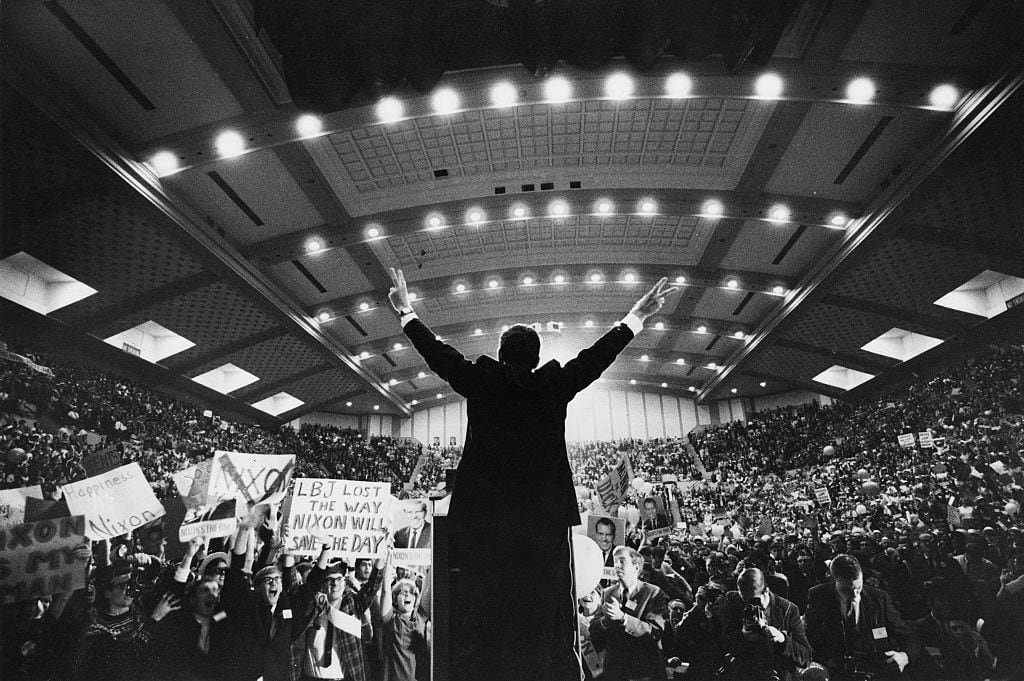
Why younger Americans are interested in the 37th president.
With the 52nd anniversary of Richard Nixon’s resignation, his reputation is experiencing a resurgence—especially among younger generations.
For example, in just the past month and a half, at least a half-dozen articles have examined Nixon’s legacy. There was Tim Rice’s Daily Wire article, “How The Kids Learned To Love Richard Nixon,” which ends with this sentence: “Maybe Nixon wasn’t a relic come too late, but a visionary come too early. Maybe his time is now.” Frontier Magazine published a cover story by Blaze Media Editor-in-Chief Christopher Bedford, “The Once and Future Nixon.” Then there was Philip Wegmann’s full-page Wall Street Journal feature, “Young Conservatives Have an Unlikely New Icon: Richard Nixon,” which characterizes me as “the main architect of modern Watergate revisionism.”
The biggest splash came from Vice President JD Vance’s remarks at the Nixon Library in June, where he said Nixon had always fascinated him and that Nixon was taken down by the deep state (comments that I agree with in full).
The underlying question for political junkies is this: Why the Nixon resurgence—and why now? Needless to say, as a Watergate insider, I have strong opinions.
Back to the Beginning
My own involvement with Watergate began when I served as Deputy Counsel to J. Fred Buzhardt, President Nixon’s lead lawyer. In that capacity, I transcribed the infamous White House tapes, ran the document rooms holding the seized files of Nixon’s top aides, and briefed presidential counselors on Watergate developments. I was the third person (after Nixon and Buzhardt) to listen to the June 23, 1972, tape, which I first characterized as the “smoking gun.” Because I produced certain documents for Watergate prosecutors, I testified at the Plumbers’ trial as a “chain of custody” witness and was subpoenaed for the same purpose in the cover-up trial.
Once Nixon resigned, I was essentially unemployable until I was able to secure from the special prosecutor a “clearance letter” stating that I was not, and never had been, the subject of any Watergate Special Prosecution Force investigation. My family and I then moved to Philadelphia, where I worked as corporate counsel for several major insurance companies.
Nearly 30 years later, around 2003, I decided to sift through the ashes and try to learn how everything in the Nixon Administration went so wrong, so fast. After all, his 1972 re-election was the largest popular-vote landslide in America’s history.
I have spent the past 20 years researching and writing about the judicial and prosecutorial wrongdoing I uncovered in the aftermath of the Watergate scandal. I’ve scoured the surviving internal WSPF files at the National Archives, the personal files of the top four Watergate prosecutors, and the infamous “Road Map,” the prosecutors’ secret “presentment” of grand jury evidence to the House Judiciary Committee, which was not unsealed until October 2018.
I have written three books, helped produce two documentaries and an off-Broadway stage play, authored over a hundred articles and essays, taped as many podcasts and live appearances, and maintained a website containing links to dozens of offending memos from the internal files of the WSPF.
With that recounting of my Watergate involvement, let us return to the issue at hand: Why now?
Nixon’s Legacy
Partly, Nixon’s resurgence is due to pent-up resentment at the uniformity with which liberalism controlled much of American political life in the mid-20th century. In Nixon’s era, the Democrats dominated both houses of Congress, and the media spoke with a single unified voice. There were only three networks (ABC, NBC, and CBS), two dominant weekly magazines (Time and Newsweek), and two dominant newspapers (The New York Times and The Washington Post). There was no talk radio; no Fox News, Newsmax, or NewsNation; no podcasts; and no social media. In short, the media environment is a whole lot different today—and is much more open to discussing formerly taboo subjects.
There is also the vast treasure trove of documents Nixon left from his long record of public service. He was on the national scene from his election to Congress in 1946 through his resignation from the presidency in 1974—a total of 28 years. Nixon either ran for president or vice president five out of the six national elections between 1952 and 1972. The documentary record from this period is substantial not only because he preferred to analyze and work from the written word, but also because there were no cell phones, email, or personal computers. Everything moved on paper. Plus, of course, we have some 3,600 hours of presidential tapes, most of which still need to be transcribed.
Nixon’s legacy has also been boosted through a strategic social media campaign. In 2023, the Nixon Foundation hired a young staffer named Chris Barber as Creative Director who was tasked with building Nixon’s social media presence. In 2025, he was promoted to head of marketing. Barber’s successes have been nothing short of extraordinary. To date, the Foundation’s social media postings have been viewed over 250 million times. The several articles cited at the beginning of this analysis detail the impact of Barber’s handiwork.
There is another important factor: the role President Trump has played as a catalyst in changing Nixon’s reputation. I chose this word deliberately. “Catalyst” is originally a chemistry term for a substance that induces or accelerates a chemical reaction without itself being chemically changed. This is significant because I believe Trump’s considerable impact on perceptions of Nixon’s reputation and Watergate has not changed Trump himself.
There are four terms bandied about today that were not part of the political vocabulary before the Watergate scandal: “deep state,” “fake news,” “false narrative,” and—most of all—“lawfare,” the misuse of the criminal law to destroy one’s political enemies. Trump supporters believe Democrats use this playbook to try to keep Trump off the ballot, to destroy his reputation, and to bankrupt him in any way possible.
Into this fiery mix, add Barber’s postings, frequently based on internal prosecutorial documents uncovered by my research, and you have the phenomenal (and surprising) reactions we are seeing today.
Nor can it be overlooked that Nixon had a very successful first term. In foreign affairs, it included his opening to China, détente with the Soviet Union, ending the Vietnam War with the signing of the Paris Peace Accords, bringing POWs home, and reasserting American influence in the Middle East, which included saving Israel in the Yom Kippur War. In domestic affairs, he ended the military draft, lowered the voting age to 18, restored the treaty rights to Native Americans, integrated the Southern schools, created the Environmental Protection Agency, broke the back of the inner-city heroin epidemic with the nationwide methadone maintenance program, launched the war on cancer, and quadrupled the number of women named to senior government positions.
In sum, Nixon is back. For many of us oldsters, he should never have left. For many succeeding generations, their discovery of Nixon is just beginning. As for the Nixon haters who have savored their victory for so long, they can no more stop the tide of Nixon fans than King Canute in days of old.
The American Mind presents a range of perspectives. Views are writers’ own and do not necessarily represent those of The Claremont Institute.
The American Mind is a publication of the Claremont Institute, a non-profit 501(c)(3) organization, dedicated to restoring the principles of the American Founding to their rightful, preeminent authority in our national life. Interested in supporting our work? Gifts to the Claremont Institute are tax-deductible.
Suggested reading

Social media algorithms reward the most extreme positions—at great cost.
Cutting the rising price of healthcare is a bipartisan issue.
Trump’s resounding populist mandate signals an enduring shift in our politics.
The “party of the people” doesn’t seem to know the people anymore.
The Fellowship of the Right Wing.

