

America’s unserious political class is totally unequipped to deal with the threat.
Night of the Living Woke
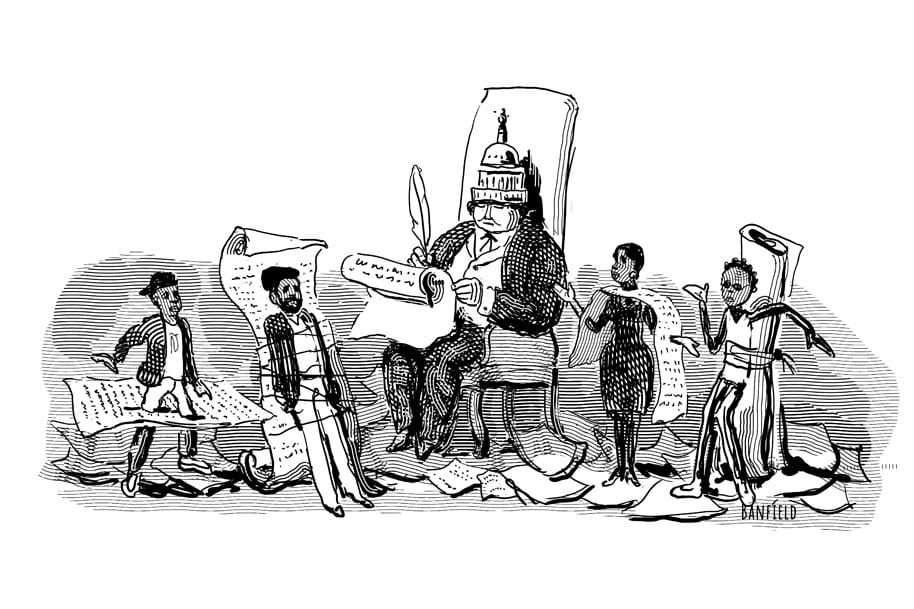
The Democratic Party’s center cannot hold.
Editors’ Note
What follows is an excerpt from William Voegeli’s essay, “Night of the Living Woke,” from the Spring 2026 issue of the Claremont Review of Books.
The New York Times columnists Ross Douthat and Ezra Klein disagree more often than they agree, which made it significant that just before the first anniversary of the 2024 election each arrived at, basically, the same explanation for Donald Trump’s victory. “It is completely obvious that the [Democratic] party lost in 2024 because it overcommitted to a range of unpopular left-wing positions,” Douthat wrote. Whatever else the 2024 election may have been, it “was also an ideological referendum, and progressivism lost.”
Klein’s explanation was even more detailed, making it a tougher read for his followers, who are more sympathetic to the Democratic cause than are Douthat’s. “From 2012 to 2024, Democrats moved sharply left on virtually every issue,” Klein observed, with electoral results that were precisely the opposite of those expected and intended.
Democrats became more uncompromising on immigration and lost support among Hispanic voters. They moved left on guns and student loans and climate, and lost ground with young voters. They moved left on race and lost ground with Black voters. They moved left on education and lost ground with Asian American voters. They moved left on economics and lost ground with working-class voters. The only major group in which Democrats saw improvement across that whole 12-year period was college-educated white voters.
The party not only became so dysfunctional that it committed the same errors across three full election cycles, Klein went on to note, but it remains so dysfunctional that it refuses to acknowledge its mistakes and learn from its defeats. Democrats, he lamented, “do not want to confront how much of the country disagrees with them.”
Correlation of Forces
Indeed, as the 2026 midterm elections come into focus, and the 2028 presidential election takes shape on the horizon, leftist Democrats are ascendant while moderates plead for the party to avoid past excesses. The election in 2025 of socialist mayors Zohran Mamdani in New York and Katie Wilson in Seattle, for example, was commonly treated as an anomaly because those cities’ electorates were so unlike the national one. But those cities may be outliers because they have large numbers of Democratic voters, not because those voters are far to the left of Democrats in general. An August 2025 Gallup poll found that 66% of self-identified Democrats had a positive image of socialism, while only 42% felt that way about capitalism. (Republicans favored capitalism over socialism by 74% to 14%; Independents by 51% to 38%.)
New Jersey’s 11th congressional district, in the state’s northern suburbs, is a lighter shade of blue than Seattle or New York. In 2024, it voted for Kamala Harris over Donald Trump by a margin of 53% to 45%. And yet, a Democratic primary earlier this year to nominate a candidate for a special congressional election in the 11th was won by Analilia Mejia, an activist and former Bernie Sanders campaign official, against a field that included more moderate and experienced candidates. Mejia’s campaign included pledges to “abolish ICE now,” without explaining what, if anything, would take the place of Immigration and Customs Enforcement; impeach Supreme Court justices Samuel Alito and Clarence Thomas; cancel all student loan debt; and raise the national minimum wage to $25 per hour.
Elections analyst Henry Olsen, writing at the end of last year in the Substack newsletter Liberal Patriot, doubts that Democrats can “escape the vise grip of progressive primary voters.” As recently as 2008, a slender majority of Democratic voters still identified as moderate or even conservative, rather than liberal, which nearly allowed Hillary Clinton to deny Barack Obama the party’s presidential nomination by running to his right. By 2024, however, “the share of Democrats calling themselves either liberal or very liberal hit record highs.” As a result, Olsen writes, intra-Democratic victories like those of Mamdani in New York or Mejia in New Jersey are increasingly likely to be the rule rather than the exception.
Even when moderates do emerge from the Democrats’ process of selecting nominees, a correlation of forces within the party combines with shrewd politicians’ flexibility of conviction to accelerate the leftward shift. In November 2025 Democrat Abigail Spanberger was elected governor of Virginia. She had previously served three terms in the U.S. House of Representatives, during which she emerged as a critic of her party’s left wing. After barely winning re-election to a second House term in 2020, Spanberger was, according to CNN, “yelling” in a meeting of the Democratic Congressional Caucus, imploring members, “Don’t say ‘socialism.’ Don’t say ‘defund the police’ when that’s not what we mean.” A year later, after poor results for Democrats in the 2021 off-year elections, Spanberger disparaged President Biden’s grandiose Build Back Better agenda. “Nobody elected him to be F.D.R.,” Spanberger told The New York Times. They “elected him to be normal and stop the chaos.”
Since Election Day 2025, however, Spanberger has failed, or refused, to consider the possibility that nobody elected her to be Virginia’s Joe Biden. Rather, like the president she once rebuked, Spanberger campaigned as a moderate before setting out in office to appease the Democrats’ progressive advocacy groups. Since being elected, Spanberger has canceled all cooperative agreements between ICE and Virginia’s state police and prisons. She stacked state universities’ boards with trustees committed to standing aside while administrators and faculty members reinvigorate Diversity, Equity, and Inclusion (DEI) programs. Spanberger’s choice for Virginia’s chief diversity officer, a Cabinet-level appointment, is Sesha Joi Moon, who previously served as “chief brand strategist” for Jasmine Crockett, the Democratic congresswoman from Texas whose brand is being a strident, foul-mouthed leftist. “I feel like DEI is just getting started,” Moon said on a 2025 podcast. “You can defund and dismantle all you want, but the work continues.”
Read the rest here.
The American Mind presents a range of perspectives. Views are writers’ own and do not necessarily represent those of The Claremont Institute.
The American Mind is a publication of the Claremont Institute, a non-profit 501(c)(3) organization, dedicated to restoring the principles of the American Founding to their rightful, preeminent authority in our national life. Interested in supporting our work? Gifts to the Claremont Institute are tax-deductible.
Suggested reading


It’s keeping young families from owning homes.
Only American citizens should decide who governs them.
The normalization of election tampering has perverted American politics.

And against killing babies.
Securing America’s interests should be the guiding principle of our nation’s foreign policy.

