

If they can’t have their way, they want to burn it down.
Con Law Man
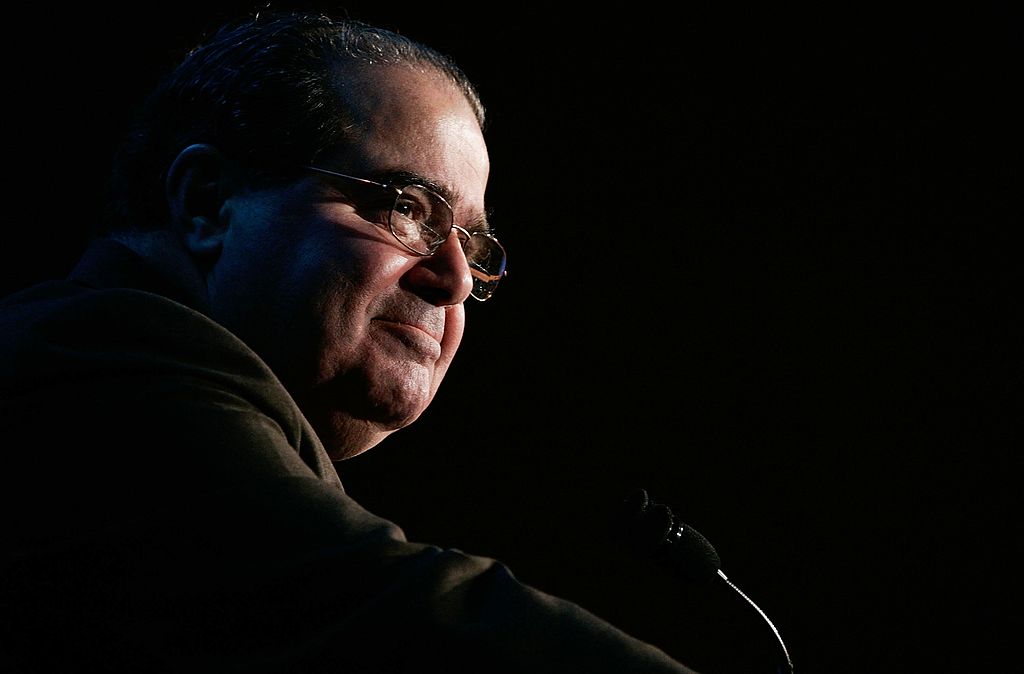
A story of frustration with conservatives who wouldn’t conserve.
Editors’ Note
What follows is an excerpt from Ilya Shapiro’s essay, “Con Law Man,” from the Fall 2026 issue of the Claremont Review of Books.
A dissent, Antonin Scalia once said, “is never a winner.” That’s a revealing line, not because Scalia disliked dissenting—no justice in modern memory did more to make dissent an art form—but because it reminds us how much of his Supreme Court career consisted of losing beautifully, usefully, and, in the end, not quite permanently.
James Rosen’s Scalia: Supreme Court Years, 1986–2001, the second installment of a projected three-volume biography, is thus largely not the story of Scalia triumphant but of Scalia frustrated: by colleagues who wouldn’t argue, conservatives who wouldn’t conserve, friends who wouldn’t follow, reporters who wouldn’t understand, and precedents that wouldn’t die. The first volume—which I also reviewed in these pages (“Nino the Great,” Fall 2023)—carried Nino from Queens to the Marble Temple. Volume two shows what happened when he got inside and discovered that the place was not, in fact, a seminar room.
Rosen, a historian and chief Washington correspondent for Newsmax, catches the initial shock well. The work was great, Scalia told a friend, but sometimes like being “locked up in a vault.” He had loved the D.C. Circuit’s intellectual give-and-take, the casual drop-ins, the drafting exchanges, the sense that judges were engaged in a common enterprise even when they disagreed. The Supreme Court was different. Conference wasn’t a conference so much as a sequential unveiling of priors. Scalia fumed that the justices did nothing but “vote, vote, vote! It’s like being in a parliament!”
That may be the most characteristic complaint imaginable. Other men dream of power and wake disappointed to find responsibility. Scalia got the power but wanted more argument.
***
The book’s best early chapters aren’t about famous cases, but institutional culture. Rosen is very good on the anthropology of the Supreme Court: the rituals, the memos, the clerks, the cert pool, the dining room, the handshakes, the silently circulating drafts, the way judicial personalities survive through marginalia. The courtroom itself almost becomes a character: mahogany, crimson curtains, Roman numerals, and enough solemnity to make a whisper feel like a violation of Article III.
Into this world came Scalia, not as a bomb thrower exactly, but as a man who believed that if lawyers were assembled in a room to discuss legal questions, somebody ought to discuss them. His first oral argument was a takings case (Hodel v. Irving, decided in 1987) obscure enough to prove the man’s seriousness. He kept pressing standing until the government’s position began to wobble. Justice Lewis Powell, watching the new justice pursue a point, leaned toward Justice Thurgood Marshall and wondered whether Scalia knew the rest of them were there.
That’s both funny and clarifying. Scalia’s arrival wasn’t merely ideological. It was temperamental. He was loud in the way a clarinet is loud in an elevator: not necessarily wrong, but impossible to ignore. Rosen’s great service is to show that the standard story—Scalia as bullying, coalition-destroying egoist—is too facile (and wrong). Yes, he could be cutting. Yes, he could overdo it. Yes, he was often incapable of leaving bad reasoning undisturbed merely because good manners recommended silence. But he wasn’t trying to make himself more conservative than everyone else, or more colorful. He was trying to make judging more legal.
That’s why Scalia’s relationship with Justice William Brennan is so revealing. Personally, Scalia adored the old liberal master. But when Brennan’s clerks laid out a trail of placards marking his greatest opinions as part of a birthday celebration, Scalia followed behind and delivered the perfect tribute-insult: “My Lord, Bill, have you got a lot to answer for!” Brennan represented everything Scalia had come to undo: legislative history, elastic rights, opinion-bargaining, the pragmatic jurist as genial ward boss. Rosen nicely captures the asymmetry. Scalia could admire Brennan personally while rejecting his judicial method root and branch. Brennan, for his part, seems to have understood that the cheerful Italian-American wasn’t merely a colleague but a counterrevolutionary.
Scalia’s explanation of why he couldn’t play Brennan’s game is devastating: “I have nothing to trade.” A living constitutionalist like Brennan can haggle over how far an invented principle should extend. A textualist can’t give away half the text and call the result statesmanship. That was the source of Scalia’s power—and his limitation. He could persuade, sting, inspire, clarify, and expose. But he couldn’t barter.
Read the rest here.
The American Mind presents a range of perspectives. Views are writers’ own and do not necessarily represent those of The Claremont Institute.
The American Mind is a publication of the Claremont Institute, a non-profit 501(c)(3) organization, dedicated to restoring the principles of the American Founding to their rightful, preeminent authority in our national life. Interested in supporting our work? Gifts to the Claremont Institute are tax-deductible.
Suggested reading


Officer selection and training cannot be placed at the service of the diversity regime.

This Supreme Court term could be consequential.

Laws against its distribution are still on the books.

Every nation is shaped by its canon. It’s time to shape America’s.
Any conservative worth his salt should defend senators against baseless and dictatorial attacks.

