

The divide between church and state doesn’t separate religion from public education.
The Supreme Court’s Welcome Blow Against the Administrative State
A qualified victory for republicanism in its removal power decisions.
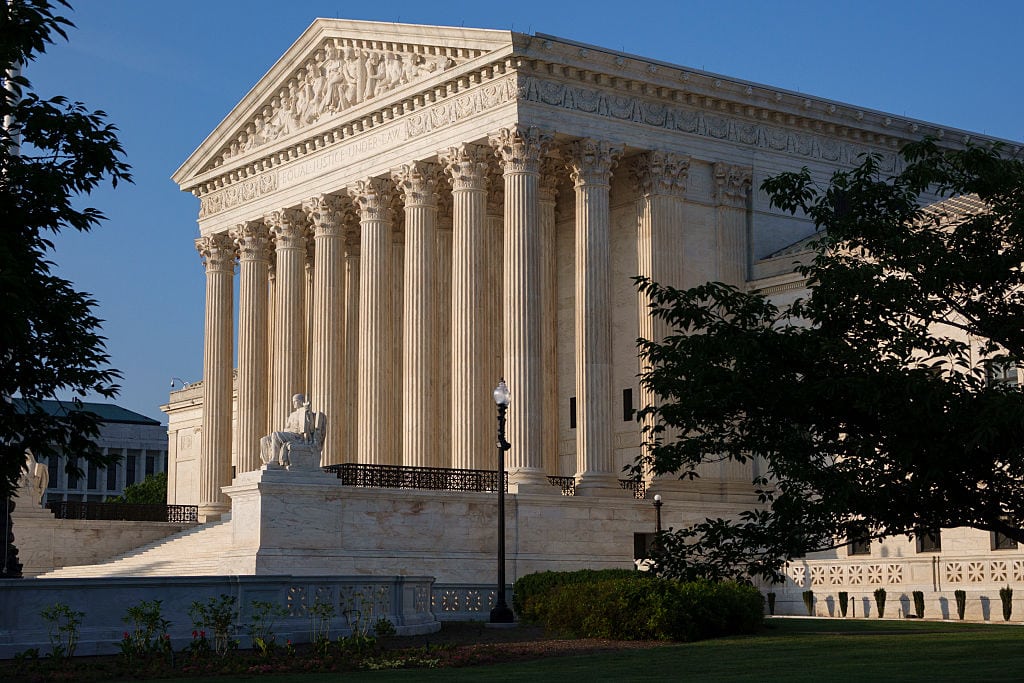
With all of the justifiable disappointment in the Supreme Court’s term-concluding decisions on birthright citizenship and mail-in ballots, one could be forgiven for overlooking the significance of the blow it dealt to the administrative state. While there are some important qualifications which I will go on to explain, the Court in Trump v. Slaughter strongly embraced the American Founders’ principle of unity in the executive branch. It repudiated the idea that parts of the federal bureaucracy should be free to wield executive power independent of the president and the voters who elect him.
The Court’s ruling in Slaughter and in a series of related cases leading up to it marks a restoration of democracy, not an assault on it. After all, how can it be an assault on “our democracy” to take power from those who are unaccountable to voters and give it, instead, to the only official for whom the entire nation votes?
The Slaughter decision rejected the appeal of Rebecca Slaughter, a now-former commissioner of the Federal Trade Commission (FTC) whom President Trump terminated last year. Trump did not cite any specific “cause,” even though the governing statute insulates commissioners from at-will removal by the president. Congress’s purpose in structuring the FTC and many similar “independent regulatory commissions” in this manner was to keep them free from presidential influence and allow them to rely instead on their alleged neutrality and expertise.
While defenders of this structure contend that it keeps political considerations out of the decision-making process, by the very same principle it also insulates such commissions and agencies from voters. This is a problem in a republic, particularly in one whose constitution vests all the executive power in the president. Accountability to the sovereign people was one major reason the founders gave for having a unitary executive, as Alexander Hamilton clearly explained in Federalist 70.
There is no constitutional or republican legitimacy, in other words, for “independent” agencies that are free from presidential direction and whose leaders are insulated from removal. In Slaughter, the Supreme Court rightly came to the same conclusion, one that was a long time in coming—91 years, to be precise.
Rise and Fall
In Humphrey’s Executor v. U.S. (1935), the Supreme Court allowed Congress to create agencies in the executive branch (where else, constitutionally, could they be?) and to shield them from presidential control by restricting the president’s power to remove top agency officials. Without the threat of being fired, agency commissioners were free to disregard the policy goals of the elected chief executive and of the voters who put him in office.
The Humphrey’s court turned its back on the lion’s share of more than a century of practice, and on its own recent precedent from Myers v. U.S., in which, just nine years earlier, it had affirmed the necessity of the president’s removal power on grounds drawn from Federalist 70 and from the early removal power debates in the First Congress.
The Court effected this revolution by doubling down on constitutional errors. It contended that the FTC could be insulated from presidential control precisely because its power was not so much executive as it was “quasi-legislative” and “quasi-judicial.”
Yet the premise of this carve-out emanated from an even worse constitutional error, whereby the Court acknowledged—and blessed—the fact that Congress unconstitutionally delegated legislative and judicial powers to an executive agency. Protection of “independent” agencies within the executive, in other words, requires that they be understood as exercising powers which—according to the Constitution’s separation-of-powers principle—they are not permitted to exercise in the first place.
For a number of decades after Humphrey’s, the Court persisted in this error. This culminated in Morrison v. Olson (1988), a decision that allowed Congress to shield a federal prosecutor from presidential removal, thereby dropping all pretense of preserving presidential control over purely executive personnel. The majority opinion prompted Justice Scalia to write one of his best lines in dissent: “One can hardly grieve for the shoddy treatment given today to Humphrey’s Executor…. But one must grieve for the Constitution.” While the majority opinion in Slaughter doesn’t admit it, its logic strongly reflects that of Scalia’s dissent in Morrison—a fact strongly implied in Justice Sonia Sotomayor’s heavy reliance on the Morrison majority in her dissent.
Yet in hindsight, Morrison proved to be the zenith of the Court’s tolerance of independence for agencies in what came to be known as the extra-constitutional fourth branch.
The Return of the Separation of Powers
In recent decades, the Supreme Court has been beating a steady though incremental retreat. It invalidated removal-power protections for the Public Company Accounting Oversight Board (an agency created by the Sarbanes-Oxley Act) in 2010, and for the Consumer Financial Protection Bureau in 2020. While the Court in these cases emphasized the constitutional necessity of presidential control over executive officials, it still refused to overrule Humphrey’s. Instead, it narrowed its application, contending that the particular agencies at issue were outside the scope of the exemption that Humphrey’s had created for the FTC.
That left it to the second Trump Administration to force the issue head-on, which it did by firing FTC Commissioner Rebecca Slaughter. Doing so put Humphrey’s unavoidably in play, leaving the incrementally minded Chief Justice Roberts with nowhere to hide from issuing a ruling that directly addressed that decision.
In his opinion for the Court in Slaughter, Roberts finally affirmed that the Court had made an error in 1935, declaring that “If anything more is left of Humphrey’s, we overrule it.” Relying on the logic of The Federalist, the First Congress, and the Myers decision, the Court restored the unitary executive to its rightful place over the whole of the executive branch:
To vest “the whole executive power” in just one person was not to suggest that he could execute the laws alone and unaided. But it was to establish a hierarchy—a “Chief Magistrate” with whom the buck stops, and below him various “assistants or deputies” who “derive their offices from his appointment” and remain “subject to his superintendence.” To remain accountable to the President, those officers must be removable by the President.
When combined with other recent developments in administrative law, Slaughter marks an important step in reining in an unaccountable administrative state.
In 2024 the Court eliminated another pillar of independent bureaucratic power, overruling so-called “Chevron deference,” where agencies had essentially been made the judges of the extent of their own powers. That same year it also put agencies on notice when seeking civil penalties against defendants. An agency is now generally required to bring its case in the first instance to an independent Article III court, where defendants can avail themselves of their Seventh Amendment right to a jury trial in civil cases, rather than before the agency’s own in-house adjudicators, where a jury is not afforded to defendants and its own judge finds the facts.
As momentous as these legal developments are, they merely provide opportunities that our elected leaders must now seize. And of course these decisions did not come without qualifications and limitations.
One Step Back, Two Steps Forward
The biggest disappointment came in a decision closely related to Slaughter that was handed down on the same day: Trump v. Cook, which concerns the president’s removal of Federal Reserve Governor Lisa Cook. At first blush, one could be forgiven for thinking that the result here would follow Slaughter’s logic. But it did not.
The Board of Governors of the Federal Reserve System (the “Fed”) is a federal entity exercising considerable power that is neither in the legislative nor the judicial branch, presumably making it part of the executive. The Court just told us in Slaughter that the president must have removal power over officials in such entities. But even a year ago, while siding with the president on a preliminary removal power case (Trump v. Wilcox), the Court went out of its way to indicate that it might feel differently about the Fed. And the Trump Administration was paying attention.
When it fired Cook, the administration did not seek to defy the “for cause” removal protections as it had for FTC commissioner Slaughter. Instead, claiming to abide by the statutory protection for Fed governors, the president announced he was firing Cook “for cause”—pointing out that she is under investigation for mortgage fraud. This claim was not sufficient to satisfy the Supreme Court, which concluded that when a president wishes to remove a Fed governor “for cause,” it must be established on something more than the president’s say-so, and that such a removal is judicially reviewable to ensure the adequacy of procedural protections.
The Court could have stopped there in overturning the president’s removal of Cook, especially since the Trump Administration was not arguing that the statute’s for-cause removal protections were unconstitutional. But in an unusual step for the Roberts Court, it went beyond the bare minimum needed to resolve the case.
It made a broad and clear statement that the statute protecting the Fed from at-will presidential removal is constitutional, notwithstanding the Slaughter decision it had handed down on the same day. In other words, the Fed constitutes an exception to the Court’s otherwise broad defense of presidential removal power in Slaughter.
This is an exception for which the Court had left itself some wiggle room in the Slaughter opinion: in the part that Justice Thomas refused to join, the Court left open the possibility that Congress could create offices outside the executive branch, and thus outside the reach of the president’s removal power. Chief Justice Roberts concluded in Slaughter that “not all offices created by Congress necessarily come with executive or even sovereign power attached.” But at least one major part of the Fed’s duties involves executive power: its regulatory authority over financial institutions, where it very much acts like many other executive agencies.
The big disappointment is that in situating the Fed entirely outside the bounds of executive power, the Court did not distinguish between the Fed’s regulatory role and its responsibility for setting monetary policy. The latter could arguably provide a basis for independence, but the former is much harder to justify.
In making the case for the Fed’s independence, the Court drew on the history of central banking in the United States, connecting the Fed to the First and Second Banks of the United States, where the statesmen of the founding and the early republic had sought to insulate monetary policy from presidential influence. But the Court played fast and loose with its history, and this section of the opinion is shockingly brief for such a consequential and complicated historical argument. This appears to be one reason why several of the dissenters accuse the Court of rushing to defend the constitutionality of the Fed’s independence from presidential removal, even when that question wasn’t being contested and resolving it wasn’t necessary to decide the case.
The better and more thorough historical analysis came, unsurprisingly, in Justice Thomas’s dissent. While conceding that the early central banks did enjoy some independence in making monetary policy, Thomas pointed out that those banks were distinct in fundamental ways from the Fed and thus stand as poor justifications for the Court’s conclusion. And Thomas’s historical analysis, unlike the Court’s, is substantial, leading him to make the following assessment:
The Court’s constitutional reasoning depends entirely on an ahistorical analogy between the Board and the First and Second Banks of the United States. The problem for the Court is that the First and Second Banks were banks with no executive power, whereas the Board is unquestionably a federal agency that wields considerable executive power. The Board does not follow in “our Nation’s tradition of central banking” at all. It is not a “bank,” but a novel “federal agency” with “broad powers affecting the entire banking and currency system.”
In addition to the considerable historical analysis that Justice Thomas brought to bear, he also understood the novel political principles that inspired the creation of the Fed, the whole point of which was to depart from the political principles of the regime that had created the First and Second Banks. The Court completely ignored this conscious departure in its threadbare attempt to connect the Fed to the older American tradition.
Thomas, by contrast, correctly connected the vision for the new Fed to the principles of American progressivism, showing how the Fed’s architects deliberately rejected the principles of American republicanism and aimed to adopt the German model of centralized state administration. This turn away from American constitutionalism in favor of anti-democratic German political philosophy was characteristic of the most important Progressives, most of whom were either educated in Germany or had German-educated teachers. Such was the vision and the intellectual pedigree of Woodrow Wilson, whom Thomas cited in explaining how the then-president not only endorsed the novel plan for the Fed but also insisted upon it being granted even more robust regulatory and enforcement power. This history exposes the shoddiness of the Court’s half-hearted attempt to portray the Fed as a natural development from the First and Second Banks.
The Court’s protection of the Fed from presidential oversight should be seen for what it is: a practical concession to the political and economic pressures of the day, the legal and historical cover for which is thin gruel. But this practical concession will no doubt be welcome even to many on the Right, and at least it seems to have given the Court the courage it needed to restore presidential and democratic control over the bulk of the administrative state.
While Cook is a disappointing exception, it was entirely predictable—but it should not obscure the significance of Slaughter. Unfettered presidential removal power is now the rule for the administrative state, and that’s a hugely important win for our republican principles.
The American Mind presents a range of perspectives. Views are writers’ own and do not necessarily represent those of The Claremont Institute.
The American Mind is a publication of the Claremont Institute, a non-profit 501(c)(3) organization, dedicated to restoring the principles of the American Founding to their rightful, preeminent authority in our national life. Interested in supporting our work? Gifts to the Claremont Institute are tax-deductible.
Suggested reading

We can’t count on the Supreme Court.

Civic formation in an era of unlimited birthright citizenship.
The official Republican vision of political power is so constrained that you have to wonder why they want it.
The Democratic Party’s center cannot hold.

Our trusted experts are neither trustworthy nor competent.

