

America’s unserious political class is totally unequipped to deal with the threat.
The $40 Trillion Hole
Time to revisit the Constitution’s Spending Clause limits.
The national debt of the United States just crossed $40 trillion.
That number is so large that it risks becoming meaningless. But consider this: the federal government did not reach $30 trillion in debt until January 2022. It added the next $10 trillion in just four and a half years. As of August 18, the Treasury reported gross federal debt of approximately $40.05 trillion—$32.27 trillion held by the public and another $7.78 trillion owed within the government itself.
The conventional debate over our fiscal catastrophe is familiar. Democrats blame Republican tax cuts. Republicans blame Democratic spending. Budget experts correctly point to Social Security, Medicare, defense spending, pandemic relief, and now the staggering cost of servicing the debt itself.
But there is another cause of our fiscal predicament that almost no one in Washington is willing to discuss: the federal government spends enormous sums of money on things the Constitution never authorized it to fund.
The chart below tells a remarkable story. At the founding, the federal debt was below 40% of the nation’s economic output, largely the legacy of the Revolutionary War. Successive administrations paid it down. After the War of 1812, it rose again and then fell. By 1835, President Andrew Jackson’s administration had essentially extinguished the national debt.
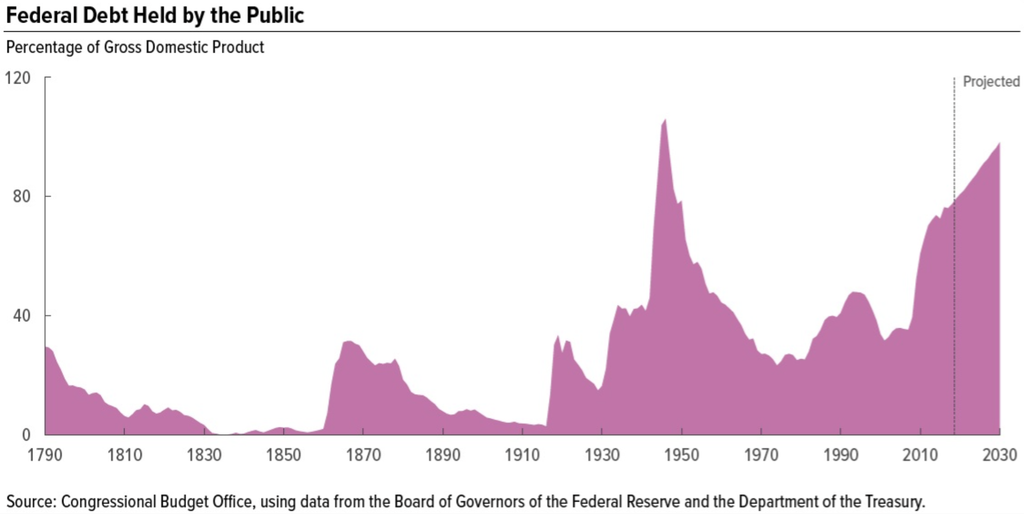
The pattern repeated after the Civil War and World War I. Even the enormous debt accumulated to win World War II—more than 100% of GDP—was steadily reduced relative to the size of the economy over the ensuing generation.
Something fundamentally changed in the late 20th century. Federal debt began rising even in peacetime. The financial crisis accelerated the trend. COVID sent it soaring. Today, debt held by the public alone is roughly equal to our annual GDP.
But Washington’s fiscal indiscipline followed an earlier abandonment of constitutional limits.
Article I gives Congress power to tax “to pay the Debts and provide for the common Defence and general Welfare of the United States.” The word “general” was not surplusage.
Even Alexander Hamilton—the great advocate of a comparatively broad federal spending power—insisted that the object of federal spending “must be general, and not local,” extending throughout the Union rather than being confined to one place. The disagreement between Hamilton and James Madison was substantial: Madison believed spending generally had to be tied specifically to Congress’s other enumerated powers, while Hamilton recognized a broader spending authority. But neither understood “general Welfare” to mean that Congress could simply collect money from taxpayers throughout the country and spend it on whatever local project a congressional majority happened to favor.
Madison made the point in his final act as president. On March 3, 1817, he vetoed the so-called Bonus Bill, which would have devoted federal funds to roads and canals. However useful such projects might be, Madison concluded that the Constitution did not give Congress a general power to fund them.
Andrew Jackson stated the principle particularly clearly when he vetoed federal funding for the Maysville Road in Kentucky in 1830: such improvements had traditionally been defended only when they were “of a general, not local, national, not State” character. The road before him, Jackson concluded, was “purely local.” If such a project could be called national, he warned, “there can be no local interest that may not with equal propriety be denominated national.”
That warning proved prophetic.
From National Government to National Checkbook
Today the federal government routinely finances projects whose benefits are overwhelmingly local: municipal transit stations, bicycle paths, pedestrian improvements, streetscapes, parks, community development projects, local environmental programs, and countless other projects traditionally financed by states, cities, counties, or private parties.
A project in Albuquerque, New Mexico, is almost too perfect an illustration.
The city is building a 7.5-mile loop through its downtown called the Albuquerque Rail Trail. The city describes it as a pedestrian and bicycle trail that will connect neighborhoods, encourage downtown development, increase property values, and provide recreational and transportation opportunities for Albuquerque residents.
It may be a wonderful project. But why should a plumber in Alabama, a rancher in Wyoming, or a waitress in Florida borrow money through the Treasury to build it?
The Biden Administration awarded Albuquerque an $11.5 million federal RAISE grant toward the trail. The Trump Department of Transportation subsequently withdrew the award, explaining that it was redirecting transportation priorities toward projects promoting vehicular travel. Albuquerque sued. City of Albuquerque v. Duffy remains pending in federal court; at the end of July, the court denied the government’s motion to dismiss.
The city’s own complaint clearly illustrates the constitutional problem. Albuquerque says the trail will reduce transportation and housing costs for residents, stimulate as much as $270 million in development along the trail corridor, strengthen Downtown Albuquerque’s entertainment and arts district, and encourage local businesses.
Those may all be excellent reasons for Albuquerque to build the trail. They are also good reasons for Albuquerque residents to pay for it.
Albuquerque is hardly alone.
The Trump Administration’s effort to terminate federal grants for local projects has generated litigation across the country. And those lawsuits are revealing just how far the federal spending power has drifted from its constitutional moorings.
Colorado, for example, is litigating over terminated transportation and energy grants. One involves approximately $10.7 million for a new transit station in Fort Collins under the same BUILD/RAISE program used for the Albuquerque trail. Colorado’s own complaint explains that the statutory program funds surface-transportation projects having “significant local or regional impact” and acknowledges that the federal government has awarded nearly 1,000 such grants, many for local transit stations and hubs.
Congress has essentially created a federal spending program whose statutory purpose expressly encompasses projects notable precisely because their benefits are local.
Chicago is separately litigating over billions of dollars in federal funding, including a 5.3-mile extension of the Red Line on the city’s South Side. Other suits challenge the termination of environmental, agricultural, research, energy, and community grants. In The Sustainability Institute v. Trump, the Fourth Circuit earlier this year vacated injunctions that had required the administration to restore a collection of suspended environmental and agricultural grants, remanding for further proceedings. But in June the district court ordered the government to restore approximately $1 billion in grants for those local projects.
There are serious statutory and administrative-law questions in these cases. Once Congress appropriates money and an agency makes a binding grant, a president cannot necessarily cancel it merely because he dislikes Congress’s policy. The Take Care Clause does not give the president a line-item veto. And grant recipients can make legitimate arguments based on statutory commands, the Administrative Procedure Act, contractual commitments, and separation of powers.
But those arguments assume a logically prior proposition: Did Congress have constitutional authority to spend the money in the first place?
That question has largely disappeared from modern litigation, but it should return.
Supreme Irresponsibility
Modern Spending Clause doctrine generally begins with United States v. Butler and, more recently, South Dakota v. Dole. In ruling that the Agricultural Adjustment Act violated the Constitution, the Supreme Court in Butler adopted Hamilton’s broader understanding that Congress’s spending power is not confined strictly to implementing its other enumerated powers. And Dole upheld Congress’s ability to condition federal highway funds on states adopting a minimum drinking age.
Indeed, Dole properly described the Constitution’s limitation on the spending power as the requirement that the expenditure be “in pursuit of the general welfare.” The Court has subsequently treated that limitation with extraordinary deference, but constitutional text does not disappear simply because courts have neglected to enforce it.
The Albuquerque case therefore raises an important constitutional question. Suppose the city is correct that Congress instructed the Department of Transportation to give it $11.5 million. Suppose further that ordinary administrative-law principles constrain the executive’s ability to rescind that award.
But there is a much more important question: What provision of the Constitution authorized Congress to tax people in 49 other states—or, given our deficits, borrow money that their children and grandchildren will have to repay—to construct a bicycle and pedestrian trail through downtown Albuquerque?
Calling it “transportation infrastructure” does not answer the question. Virtually every road, sidewalk, sewer, school, police station, library, and public park could be described as infrastructure. And every worthwhile local project has some indirect effect on interstate commerce or the national economy.
Andrew Jackson anticipated this argument nearly two centuries ago. If a purely local improvement could be characterized as national merely because it was useful, “there can be no local interest” that could not be nationalized.
That is where we are today.
Returning to the Constitution
Restoring the original meaning of the Spending Clause would not magically erase $40 trillion of debt overnight. Social Security and Medicare present enormous fiscal challenges, defense is unquestionably a national responsibility, and interest on existing debt must be paid.
Nor is every infrastructure expenditure unconstitutional. An interstate highway, a national port, a military installation, or infrastructure genuinely and directly facilitating interstate commerce raises a very different constitutional question from that presented by a municipal bicycle trail.
The principle is that the level of government constitutionally responsible for a project should pay for it. When Albuquerque residents decide whether an $11.5 million contribution to a bicycle trail is worth the cost, they can weigh its benefits against the taxes required to finance it. But when Washington pays, Albuquerque receives the benefit while taxpayers nationwide bear the cost. Every locality consequently has an incentive to obtain as much federal money as possible.
Multiply that incentive by thousands of cities, counties, agencies, universities, transit authorities, nonprofits, and state governments, and federal spending ceases to be a mechanism for providing for the “general Welfare of the United States.” It becomes a national competition for somebody else’s money.
Except that increasingly it isn’t somebody else’s money—it is our own.
President Trump’s grant cancellations are being challenged on the theory that the executive must spend money Congress has appropriated. In many instances, that may present a serious separation-of-powers argument. But the litigation also creates an opportunity to ask the question courts have largely avoided for generations: whether Congress itself exceeded its constitutional authority by appropriating federal money for projects whose welfare is local rather than general.
At $40 trillion in debt, that distinction matters more than ever.
The American Mind presents a range of perspectives. Views are writers’ own and do not necessarily represent those of The Claremont Institute.
The American Mind is a publication of the Claremont Institute, a non-profit 501(c)(3) organization, dedicated to restoring the principles of the American Founding to their rightful, preeminent authority in our national life. Interested in supporting our work? Gifts to the Claremont Institute are tax-deductible.
Suggested reading


It’s keeping young families from owning homes.
Only American citizens should decide who governs them.
Despite hostility from the Biden Administration, the report stands as a guiding light for future generations.
Jack Smith’s case against Trump regarding his documents is unconstitutional.

The president should make up to five prospective nominations in the first 100 days.

