

At the National Conservative Conference, a vision of Christian humanism.
1776 and 1789: A Tale of Two Revolutions
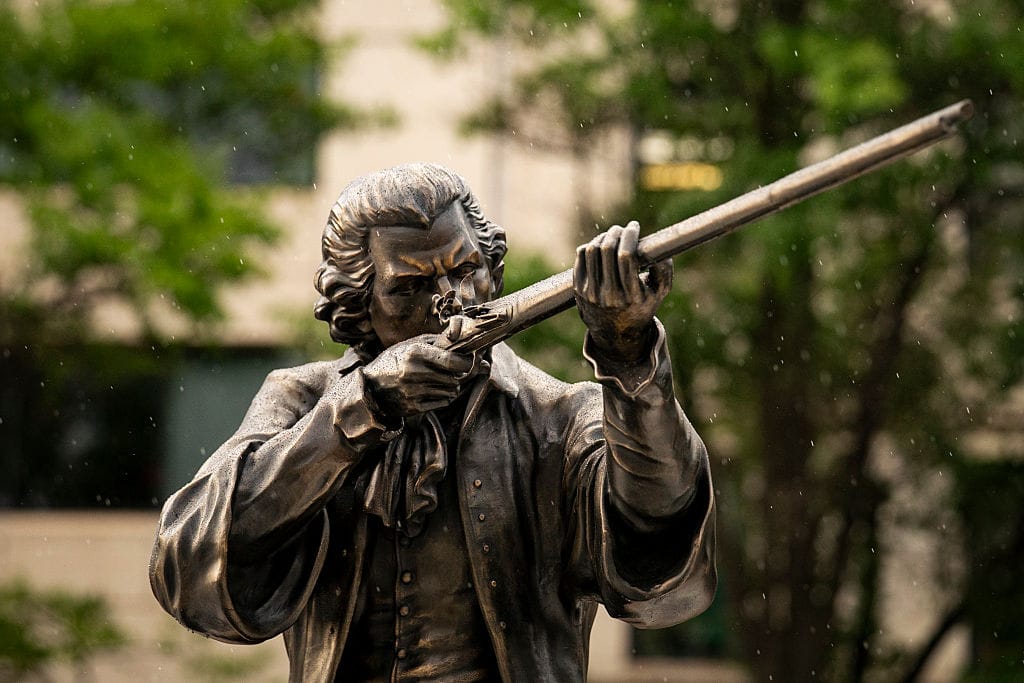
The ongoing debate between inheritance and radical emancipation.
On November 10, 1793, the Cathedral of Notre-Dame ceased to be a church. The high altar where the Holy Mass had been celebrated for centuries was made into a stage, and on it, a woman was enthroned as the Goddess of Reason. The French Revolutionaries believed they were liberating France from a faith and a tradition they thought had unjustly shackled mankind. In speech, policy, and action, they sought to overturn the Christian religion that had shaped European civilization for nearly 15 centuries.
About two decades before the French Revolution, another revolution began across the Atlantic: the American colonists rose up against British rule. Yet their goal was neither a triumph of “reason above God” nor a severing of liberty from the moral order that had birthed it. The American Revolutionaries achieved a miracle, establishing the first enduring constitutional republic of the modern age. They secured the rule of law on a vast scale with a robust representative government.
Both revolutions transformed Western civilization’s understanding of authority, man, and God—the American Revolution for good, but the French Revolution for ill. They carried distinctly different anthropological messages about the nature of man, the sources of authority, and the purposes of political life.
The American Way of Life
Russell Kirk observed that the American Revolution was fundamentally conservative in character in the sense that it was not an attempt to create a new order ex nihilo, but to preserve inherited liberties that had originated with God. The colonists understood themselves as heirs of the English constitutional tradition, which had for centuries already rejected the divine right of kings. Understood in this way, it was “a revolution not made, but prevented.”
This continuity between European ways of thinking and the earliest Americans is often left out of school textbooks that cover the American Revolution. For all its Enlightenment and Masonic influences, the American Founding was deeply shaped by natural law reasoning, a biblical moral imagination, and the conviction that liberty required virtue. The Mayflower Compact, which begins with “In the name of God, Amen,” situates life within a vision of society ordered toward God and the advancement of the faith. The founders understood rights to be pre-political realities grounded in the laws of nature and nature’s God, which government ought to respect.
In Democracy in America, Alexis de Tocqueville observed that even democratic societies retain habits of aristocracy—American and otherwise. The American Revolutionaries preserved reverence for religion, family, and institutions. They reserved a place for natural aristocracy in governance, with the Senate made up of educated, wise leaders. They did not see equality as the only principle worth preserving, as important as it was for the founders, nor did they seek to abolish all inequalities. They established a prudent, republican hierarchy that was inspired by moral discipline within a Christian civic culture.
Liberté, Égalité, Fraternité
The French Revolution represents a very different horizon, and its divergence from the American Revolution is revealed in studying what it overcame to achieve its ends.
In 1793, the counterrevolutionary rebellions began when Catholics in the Vendée and other rural areas rose to defend their priests, churches, and way of life. After the revolutionary government suppressed the church, executed King Louis XVI, and imposed mass conscription, Catholics in the region could no longer acquiesce.
The revolutionary fight was deeply ideological—far more than an effort to dismantle a temporary political figure or government. In the name of “liberty, fraternity, and equality,” entire villages were destroyed, prisoners were executed en masse, and Catholic symbols were targeted for eradication. The French Revolutionary fighters placed “Liberté, Égalité, Fraternité” over all other aims, particularly those of Christian love and justice.
The French Revolutionaries did not merely execute a king—they saw man as being made in the image of man rather than God. For centuries, Christian political thought had held that authority ultimately derives from God. Kings and magistrates were not absolute sovereigns but ministers of a higher moral order, imperfect as they might have been. The ruler’s primary responsibility was the administration of justice in accordance with that order. The French Revolution inverted this framework, insisting that sovereignty no longer resided in God, nor in tradition, but exclusively in the will of “the people.” Authority ceased to be received and became self-constituted, resulting in some of the most heinous executions committed in the name of “justice” perpetrated in the Reign of Terror and the Paris Commune.
Closely tied to this was the French Revolution’s direct assault on the Catholic Church. The clergy was not just subordinated to the state: bishops were shot in the street, and nuns were executed, as told in Bernanos’s Dialogues of the Carmelites. The Revolution first attempted to subordinate the church to political power, then to separate church and state entirely, laying the groundwork for the later development of militant secularism. The church was framed as the enemy of human achievement and progress.
The 1793 Festival of Reason in Notre-Dame became symbolic of a deeper philosophical claim: that human reason, detached from revelation, could serve as the foundation of a new order.
The French Revolutionaries even attempted to remake fundamental things like time itself. The Gregorian calendar was abolished, weeks were lengthened into ten-day cycles to eliminate the Christian Sunday, churches were renamed “Temples of Reason,” and Christian feast days disappeared from public life.
Pandora’s Box
Some today claim that revolutionary strains of thought born of the French Revolution are part of our American civilizational inheritance rather than heresies that arose against it. But the natural law tradition that shaped the West held to a classical and Christian understanding that rights are grounded in the objective nature of the human person as created by God. An ideology that insists they are merely expressions of will rather than transcendent order is alien to the ideals that built Europe and the faith that led to Christian triumphs over the barbarians and the Ottomans. This was the same faith the Pilgrims held to from the moment they began their voyage to the New World.
Unfortunately, the French Revolution was not an isolated historical rupture but the inauguration of a continuing process that prefigured the Communist revolutions of the 20th century, the sexual revolution, and contemporary expressive individualism, all of which share the anthropological basis that human beings are self-creating agents rather than recipients of a given moral and ontological order. It is a rebellion against, rather than a building upon, the hills of Jerusalem, Athens, and Rome.
The revolutionary imagination repeatedly returns to the past not as inheritance but as an obstacle. Whether in the destruction of churches, the suppression of religious orders, or modern anti-Christian sentiment, the logic is consistent: the inherited civilization becomes something to be dismantled rather than respected and built on.
For over a millennium, Europe understood itself as Christendom: a civilization whose law, education, universities, hospitals, architecture, art, and political imagination were all nourished by a faith. The church and its institutions, which the Revolutionaries repudiated, served as the principal architect of European civilization.
The American Revolution remained largely within the horizon of that inheritance, while the French Revolution deliberately broke from it. Consistent with the Western tradition, the Founding Fathers asked who should govern. The French Revolution asked what man is.
The debate between 1776 and 1789 remains unfinished. In America and nearly every European nation, the civilizational issues come down to the two rival conceptions of freedom. One understands liberty as the freedom to pursue the good within an inherited moral order. The other understands liberty as emancipation from every inherited authority, whether family, church, nature, or even human nature itself. The future of Western civilization may well depend upon which of these revolutions proves, in the end, to have the final word.
The American Mind presents a range of perspectives. Views are writers’ own and do not necessarily represent those of The Claremont Institute.
The American Mind is a publication of the Claremont Institute, a non-profit 501(c)(3) organization, dedicated to restoring the principles of the American Founding to their rightful, preeminent authority in our national life. Interested in supporting our work? Gifts to the Claremont Institute are tax-deductible.
Suggested reading

How our nation can once more be a beacon of freedom.
Resurgent national sovereignty movements are back and validated by expanding electoral mandates.

Volker Türk is the face of everything that has gone wrong in international affairs.
An Advent reflection.
Catholics can—and should—support both.

