

America established the New World Order, and America can dismantle it.
Two Cheers for JD Vance’s Economic Realism
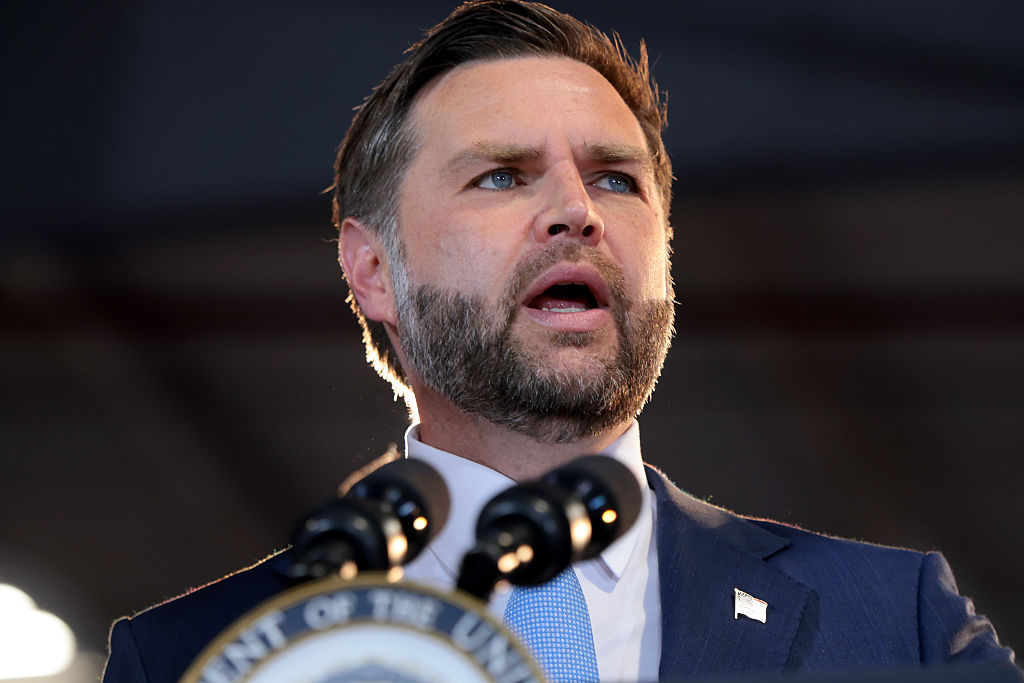
Cheap imports are not the only measure of a healthy economy.
Vice President JD Vance recently drew criticism for questioning the benefits of the dollar’s reserve currency status. In a 2023 interview, he argued that it encourages Americans to consume too much, describing it as a “resource curse.”
If you’ve followed Vance during his time in Congress, these comments are not particularly surprising. He has been one of the biggest proponents of rebalancing America’s relationship with the global economy through targeted industrial policy, much to the chagrin of the GOP establishment.
Naturally, the response from Vance’s free-trade critics was immediate and severe. They argued that cheap imports increase consumers’ purchasing power, while an economy organized around offering high-value services is not necessarily a sign of economic weakness. In their eyes, what Vance proposed amounts to a command-and-control economy, snuffing out economic opportunity and raising prices at a time when families can least afford it.
Contrary to his critics, Vance had the right general diagnosis, even if his prescription risks creating problems of its own.
The dollar’s reserve-currency status means that every country on earth wants to hold dollars, mainly to facilitate international commerce and to buy Treasury bonds as a safe place to store its money. That demand keeps the dollar’s value higher than it would be otherwise. A stronger dollar, in turn, means cheaper imported goods for Americans, but it makes U.S.-made goods less competitive, both at home and abroad. This is one of the major reasons America stopped making so many things.
And it’s why Donald Trump’s longstanding emphasis on targeted tariffs and reindustrialization remains crucial today. An economy too dependent on foreign products can threaten national security and a country’s long-term health.
As demonstrated by the vehemence of Vance’s critics, the Trump Administration’s economic refocus has elicited strong pushback. Libertarian dogma has dominated the Republican Party since the Reagan era, elevating consumer choice and being “free to choose” as the highest economic goods. The dominant theory before Trump’s 2016 presidential candidacy was that greater economic freedom broadly spreads prosperity and raises living standards.
But that view captures only part of what an economy is supposed to accomplish. Economic freedom ultimately depends on the prudent use of national power. A nation that lacks the capacity to build ships, aircraft, energy infrastructure, and advanced technology—a nation that can easily have its supply chains interrupted, as we saw during COVID—cannot maintain freedom for itself or adequately protect its allies.
Sufficient industrial capacity gives a nation options in a crisis; dependence on foreign powers—especially China, our main adversary—is a path to decline and ruin.
History shows this to be the case.
For almost 200 years, Great Britain protected its shipping and textile industries before becoming one of the world’s leading advocates of free trade. It dropped its own tariffs in 1846 only after it became the most powerful industrial and naval power on earth. By then, British manufacturers were in a far stronger position to compete in an increasingly global market.
The United States followed the same path. In his Report on Manufactures, Alexander Hamilton pushed the nation to industrialize rapidly rather than remain dependent on European powers for goods. Had the country followed Thomas Jefferson’s vision of a more agrarian-based economy, America would have likely become a vassal state of a far stronger country for the foreseeable future.
For nearly two centuries after the founding, tariffs were a key component of America’s industrial growth, alongside plentiful natural resources, geographic advantages, hemispheric hegemony, and a rapidly expanding population. Only after two World Wars left American factories standing while much of the rest of the world lay in ruins did Washington establish the framework for a global free-market economy, backed by a military and an industrial base nobody else could match.
Free trade became a key Cold War strategy. Lower trade barriers let the U.S. pull more nations into its orbit than the Soviet Union ever managed. But Washington paid a price, accepting a hit to its own industrial base to win the fight against Communism.
A persistently strong dollar tends to make foreign goods cheaper for Americans to buy while making American exports more expensive for everyone else. Following that playbook for four decades, even after the Soviet Union’s defeat, led to exactly the economic problem that Trump and Vance now have to contend with: the decline of domestic manufacturing and the hollowing out of the American heartland. The result is a service-based economy heavily dependent on consumption, with a much-diminished industrial capacity and a working class that has borne the brunt of American economic statecraft.
The consequences are clear in shipbuilding, as the United States produces fewer than a dozen commercial ships a year while China turns out more than a thousand. China controls around 60% of the world’s shipbuilding market, with a total capacity more than 200 times ours.
China isn’t the second most powerful country in the world because it practices free trade. It has rapidly developed industries that strengthen its national power while taking advantage of the United States’s determination that more open trade would encourage political liberalization in Beijing. China is a blatant currency manipulator, artificially lowering the price of its exports while maintaining state control over its economy. For these reasons, the Trump Administration was right in principle to begin imposing tariffs on China to counter its blatant abuses while reinvigorating U.S. domestic manufacturing.
The United States must maintain demand for our $40 trillion in debt, and there is no reason to risk that demand drying up, forcing us to pay higher interest rates or, in the worst-case scenario, default.
But America should take the core of JD Vance’s prescription seriously. Invest deliberately in building real, finished goods again. Use targeted tariffs to encourage that rebuilding. And yes, let the dollar’s value come down some as a result.
The American Mind presents a range of perspectives. Views are writers’ own and do not necessarily represent those of The Claremont Institute.
The American Mind is a publication of the Claremont Institute, a non-profit 501(c)(3) organization, dedicated to restoring the principles of the American Founding to their rightful, preeminent authority in our national life. Interested in supporting our work? Gifts to the Claremont Institute are tax-deductible.
Suggested reading

Raising Boys in the Shadow of Endless War

How did we get here—and how will it end?

Trump won in Miami because he was just too much fun to resist.
The indictments of Donald Trump are tissue thin and intended only to harass him and disrupt the 2024 election.
They can bankrupt or jail their enemies, but that will never legitimate their corrupt regime.

