

Trump’s approach to peacemaking has its origins in the Reagan era.
The War in Iran Is a Mistake
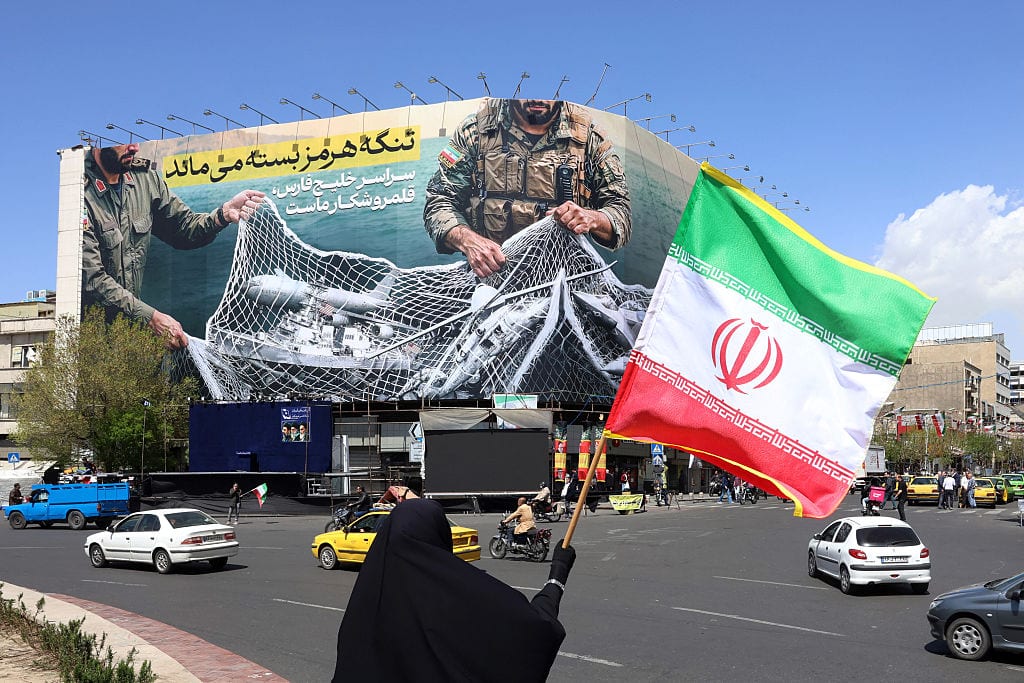
How Trump can make the best of an increasingly bad situation.
Editors’ Note
Since the Right is divided over the U.S.’s ongoing war in Iran, The American Mind is presenting the best cases for and against the war. Nothing in this piece should be construed as reflecting the official position of The Claremont Institute.
No mere politician in modern history has had a wartime general’s capacity for decision-making amid chaos like President Trump. His force of character (“Fight! Fight! Fight!”) and his appeal to the everyman (with the boorishness thereof) reveal an instinctual giant who is at his best while disorder surrounds him.
However, one who thrives in chaos often rejects the peace and order of civilization and tends to gravitate to the home turf of mayhem. Consequently, Trump may still pull a rabbit out of the hat in Iran. But the odds continue to stack against him.
The American people voted for him multiple times on his assurance of peace and promises of foreign adventurism to be a thing of the past. As Trump repeatedly noted on the campaign trail, American blood and treasure had been treated far too cheaply by both Presidents Bush and Obama. He vowed to stop that bipartisan trend.
Yet the ongoing military operation in Iran tells a different—and unfortunately all-too familiar—story. The current cost estimates of the war, north of $25 billion, are piling up at $1-2 billion a day. There have been over 300 American casualties, and 13 service members have been killed so far. We have lost more than 15 MQ-9 Reaper drones (which can cost up to $56 million per unit) and four F-15E Strike Eagles (of 133 flying airframes). Seven KC-135s have been either destroyed or damaged. Now we learn that two of the specialized MC-130J Commando II airframes and two MH-6 Little Bird helicopters were destroyed during an intensive search and rescue operation over the weekend.
How did we get here?
Iran’s Rise
Since the Shah’s ousting in 1979 and the rise of the radical Shia leadership, Iran has been a thorn in the side of the West. It has funded terrorist groups that hound Israel and leftist groups in countries such as South Africa. The regime’s rhetoric has been extreme. “Death to America” doesn’t exactly invoke a warm, fuzzy feeling. Hezbollah, the largest recipient of Iranian funds, has used its resources to attack Israel with missiles. Hamas and the Palestinian Islamic Jihad received Iranian funding and training for their attack on Israel on October 7, 2023. Iran supplied the Houthis in Yemen with missiles, drones, and advisement, and it supported Iraqi Shia militias in their attacks on U.S. and coalition forces.
Going back farther, the horrific Iran-funded Beirut bombings of 1983 killed 63 embassy workers and 241 U.S. military personnel. Iran was also all but certainly behind the Buenos Aires bombings in the mid-90s and the Khobar Towers bombing in Saudi Arabia that killed 19 U.S. servicemen. Iran was ultimately responsible for the proliferation of IEDs and other rat-line munitions that killed at least 1,000 American soldiers in Iraq and Afghanistan. (Qasem Soleimani, whom the administration took out in a drone strike in 2020, was linked to the deaths of at least 600 American service members in Iraq since 2003.)
Iran has been an agent of death for decades. Yet, the practical impact on the American homeland has been minimal. One might argue that if we weren’t in the Middle East, none of this would have happened.
The rational question follows: Why are we in Iran—and the Middle East more broadly? The answer is straightforward: oil. Before the discovery of oil, there was no U.S. “Middle East strategy.” There was missionary interest, but there was no military footprint, no alliance system, and no doctrine of regional dominance. The United States let the Brits and the French deal with Iran while we were mainly concerned with freedom of navigation. The area was perhaps less important than the South China Sea.
Only oil changed that, with America’s participation in ARAMCO, the national oil company of Saudi Arabia. The U.S. concluded that either we would protect the oil supply and ensure that it got to market, or an enemy would. Once that happened, representation at home began to compete with management abroad.
Twenty percent of the world’s oil output runs through the Strait of Hormuz, which Iran controls via its long southeastern shore. However, this leaves out one important fact: the U.S. is now the world’s largest oil producer. As late as 2008, the U.S. supplied only 8% of the world’s oil production, but due to technological advancements and the shale oil boom, we now sit above the Saudis and the Russians—and far above the Iranians.
Together with Canada and our new friend Venezuela (which has the world’s largest proven reserves), the U.S. currently has little strategic oil interest in the region. At least on the surface. While crude oil is in theory a fungible commodity, the reality is that production and shipping costs vary greatly. This makes for a multidimensional playground with differing levels, and the Gulf producers own the low-cost global footprint, which makes the strategic picture a game of chess rather than checkers.
With that reality in mind, our greatest interest lies in Gulf oil being transacted in dollars, and in the continuance of the cost structure within which Gulf producers operate. Such transactions increase demand for dollar-denominated assets and obligations, as all those U.S. Treasuries that we must issue to finance our astronomical debt must be absorbed somewhere. If bought here only, interest rates increase, and dollar inflation isn’t exported. The benefits of a reserve currency include helping to pay the interest on the national credit card.
But the war with Iran puts this strategic interest in jeopardy.
In one respect, monetary theory doesn’t seem to have the moral weight of good guys and bad guys. But it does when your own citizens have to use money meant for food, clothing, and shelter to pay for gasoline to get to work.
The Israelis must live with these constant threats. Would they lessen if the U.S. were to exit the region? Perhaps yes, but probably not. If we did leave and cease our foreign aid to Israel and Egypt (the second-largest recipient of U.S. largesse), the tensions would soon boil to the surface. The Israeli Right has suggested just such an end of American aid. To the south, Egypt cannot feed its massive population and uses U.S. dollars to buy grain (traditionally from Ukraine, and officially the funds are for military aid, but dollars are fungible). If that were to end, and without our presence, one could foresee a scenario where tanks roll across what remains of Gaza to the breadbasket of the Middle East, Israel. The 1973 Yom Kippur War is a precedent.
Furthermore, the U.S. is home to the largest number of Jews in the world. Even though they represent only 2.5% of the population, one cannot imagine a political scenario where we wouldn’t intervene if that conflict were to arise.
Consequently, all arguments that “we just shouldn’t be there” tend to be reductionistic, unrealistic, and born of fantasy. Although I disagree with the current war with Iran (I argued last year in these pages that we should not go to war with Iran), simply ignoring this part of the world is neither a rational nor a realistic possibility. As a global power, the U.S. has a vested interest in peace and prosperity throughout the world, but that goal must always be seen in light of how it benefits Americans first.
Finding that balance is part of the answer, a quest Nixon pursued when the Shah was in power. Nixon treated Israel as a friend, but he also sought to balance that friendship with close working relations with Iran and Pakistan. Currently, we are friends with the Gulf oil-producing states, which choose to offshore their defense to the U.S. in exchange for our military dominance of the area. Now that dominance comes into stark question as our radar installations have been damaged or destroyed by cheap Iranian ordnance.
This Hobbesian trade of loyalty for protection might be in question as the capable (yet expensive and fragile) systems these states host are now shown to be quite vulnerable to the cheaper and plentiful systems produced by the Iranians. Stalin had a point when he quipped that “quantity has a quality all its own.”
We are allied with Turkey via NATO, driven in large part by the strategic need to control access through the Turkish Straits and monitor Soviet activity in the Black Sea. Though we did not install Syria’s current leadership, we helped shape the conditions under which it emerged, survived, and ultimately consolidated power, a questionable situation at best. The ostensible U.S. goal in the Middle East is stability via a balance of regional powers. And that has worked at the cost of Israel getting bombarded by Hezbollah’s and Hamas’s short-range and very limited rockets. But what if that threat became greater? What if Iran were to construct much more destructive weapons? What about the nuclear threat to the Middle East, to Israel, and possibly Europe?
Nuclear Ambitions?
Iran has more than 400 kilograms of 60% enriched uranium in the form of uranium hexafluoride, which, when heated, forms the gas used in the enrichment centrifuges you have heard about. Uranium-238 is heavier than the fissionable uranium-235, and so spinning up the gas causes the heavier isotope to be separated, a little at a time. (U-238 is fissile only in the tamper of a uranium device, depending on the reflector used, adding a small amount to the yield.) Some of this 400 kg of material is possibly inaccessible due to the U.S. strikes last summer, but it is difficult to know for certain. With the equipment Iran has, this material could be theoretically enriched to 90% within a month or two (losing some mass in the process) if its centrifuges remain operable.
Iran could then theoretically build several gun-type nuclear weapons, a weapon utilizing a design like the device the U.S. used on Hiroshima. These weapons are, relatively speaking, not difficult to make. In simple terms, a barrel (hence the “gun” designation) is used to slam two subcritical masses of uranium-235 together to create a now supercritical mass, which produces a chain reaction and an explosion.
The barrel of this gun device is much heavier than the couple of hundred pounds of nuclear material. In addition, to guarantee a full yield and not a “fizzle,” a neutron reflector must surround the point at which the two masses come together. This will make sure only a few neutrons are lost, as they are the propagators of the chain reaction that releases the massive fission energy—the subatomic particles splitting the subsequent uranium atoms.
This is all extremely heavy and large, which matters because a gun-type nuclear device is by definition not deliverable without a heavy bomber force—which Iran doesn’t have. It cannot be put on a ballistic missile unless it is massive. (An orbital launch vehicle like the Falcon Heavy, the Long March 5, or the like would be necessary.) Iran has nothing like this, and even so, gun-type devices do not lend themselves to this type of delivery. It would be possible to deliver by train or boat, but that is much easier to police.
Meanwhile, an implosion device is orders of magnitude harder to assemble and harder to source materials for than a gun-type device, including the necessary sophisticated timing triggers. An advanced, miniaturized, hardened device that is small enough to place on top of a short-range ballistic missile, or possibly an intermediate-range ballistic missile, is incredibly difficult without outside help (like the North Koreans got) and out of view of the watching world. (Iran appears to have converted two of its orbital launch vehicles if the reports of the attack on Diego Garcia are accurate.) Iran is decades away from being able to build a weapon like this.
In reality, plutonium is used in modern nuclear weapons, but the production of that material is possible only within a breeder reactor, which Iran does not possess. But even using a highly enriched uranium pit, these more advanced implosion devices would necessitate testing, something that is easily monitored.
The supposed eminent threat of a deliverable weapon was an overstated reason to go to war at best, and more likely specious. Honest intelligence analysts have agreed with this assessment both on background and openly (see the several interviews Joe Kent has given since resigning from his post at the National Counterterrorism Center).
Iran cannot deliver a nuclear weapon via a missile, and it is not close to having that capability.
Difficult Questions
Why, then, did Trump decide to go to war with Iran?
Secretary of State Marco Rubio transparently gave the watching world a glimpse into the Magic 8 Ball: the Israelis informed the U.S. they were going with or without us. First off, an attack not of our choosing would unnecessarily expose our in-theater service members to outsized risk. This raises the question of whether the Israelis would be willing to give us time to evacuate if we were firm in our decision not to engage the Iranians, with whom we were in active negotiations.
The second point to ponder is the easy-to-forecast way any sustained conflict with Iran would go for Israel without our help. The answer: not well. The U.S. likely has no practical assurances from the IDF that if the proceedings went poorly enough, they wouldn’t use their supposedly nonexistent nuclear stockpile against the Iranians.
This would be, for obvious reasons, wholly unacceptable. Setting aside the self-incriminating humanitarian concerns, the usage of any sort of nuclear device would immediately call into question the doctrine of mutually assured destruction, which has been the stable standoff for the past 70 years. Upsetting that applecart should be avoided at almost any cost. But why do the Israelis act as though they can make these types of decisions unilaterally, even if they go against the U.S. national interest?
The last point to ponder is that the Israeli decapitation strike was timed (much like the strikes last summer) to take out every decision-maker the U.S. was negotiating with. To the outsider, this looks like manipulation. And if it wasn’t, it was treachery, which will make further negotiations much more difficult. Either way, the U.S. national interest is disregarded.
Reporting has suggested that CIA and FBI officials convinced the president that he and his family were in imminent risk of assassination. That is something the National Counterterrorism Center should have the lead in. (Joe Kent resigned shortly after the president made his decision to go to war.) Would Iran love to kill the U.S. president? I could be easily convinced. But has this threat decreased because of the U.S.’s war with Iran? This seems laughable.
And what is the U.S.’s endgame? Was the president convinced that taking out the top layers of control and hitting an unarmed naval vessel would cause the people to go to the streets in revolutionary zeal? Killing the Ayatollah’s entire family ended any glimmer of that unrealistic hope. Human nature is such that people get more nationalistic when attacked, not less. Simply remember the ubiquitous American flags flying and the cheers for George W. Bush at Yankee Stadium shortly after 9/11. This dynamic has been born out time and time again in our attempts to bring a Starbucks to every corner in the Middle East.
It was also easy to see from the beginning that this war could lapse into an escalation spiral, which would lead to carpet bombing of civilian infrastructure and boots on the ground. This should give us pause, but this is the bitter fruit of trusting in the tactical superiority of the last conflict rather than the strategic dominance of what stands before us. Demanding “unconditional surrender,” a novel way to end warfare until the nastiness of the 20th century, also exacerbates this dive into the abyss.
Complicating matters is that the negotiations have been led not by diplomatic statesmen but by cronies, a fact that belies understanding when sitting across from apocalyptic Shia. Unless they are successful, we are looking to island hop, Pacific Theater WWII-style, toward Kharg Island, which is Iran’s central hub for crude storage and staging for tankers. Taking it would cripple the Iranian oil industry. Others suggest we could drop in Tier 1 groups to prepare the island’s airport on the northeastern shore for a massive aerial land operation since naval incursion into the northern Persian Gulf is impossible.
However, this too raises serious questions.
The Iranians maintain a vast capacity to rain down missiles and drones. A light assault landing cannot establish a means to counter this threat. There is, in military terms, no “blocking force.” That is, there is no way to get support ships to that part of the Gulf without a vast campaign, which would result in hulls on the bottom of the Gulf and thousands of sailors and Marines dead.
There are rumors of the normally very self-assured members of the military being very circumspect about all of this for very good reason. The U.S. is very good at commando warfare, but we haven’t stormed beaches in an asymmetric threat environment in a very long time—and the last time we did it was at the cost of many thousands dead.
The American People First
Whatever the president decides going forward, I hope and pray we succeed. I wish for the well-being of our soldiers, sailors, and Marines. I want our president to do the same, with the identical focus with which he campaigned.
Any solution must put the needs and well-being of U.S. citizens in the homeland above all other considerations, and that includes the marginal safety of our colleagues in Israel and the Gulf states. That does not mean abandonment, however. We can work toward a resolution that decreases Iran’s need to pursue nuclear weapons and offensive missile capabilities, but that probably means a level of prosperity for Iran that would make some in Israel uncomfortable.
Additionally, the Strait of Hormuz must reopen. Oil must be transacted in U.S. dollars. Decreasing sanctions, admitting full IAEA inspections, and banning enrichment past that necessary for nuclear power are all achievable. But that will not happen if the goal is “unconditional surrender” or turning Iran into another Syria or Libya. A balkanized Iran means that many more factions would be able to control the Strait, which would be strategic foolishness.
In the medium-to-longer term, it behooves the U.S. to look for ways to extract ourselves from the Middle East and return to a stance more reflective of an earlier time. Conflict of some type seems inevitable in a region where Turkey wants to be the hegemonic power, Israel speaks openly of increasing its borders (and treating its Muslim citizens and detainees) in a manner most find unacceptable, where Egypt struggles to feed its people, and the tensions between Sunni and Shia are ever-present.
A realist approach to these issues would suggest forging better relations with Russia, something some officials find untenable for questionable and anachronistic reasons. But the status quo is economically and politically intolerable—something must give.
In his address to the American people last week, Donald Trump sought to project resolve and control, but his remarks lacked the strategic clarity such a moment requires. The tone suggested confidence, yet the substance did little to articulate a coherent end state or explain how present actions translate into a durable political outcome. Assertions of strength, absent a clearly defined objective, risk sounding more declarative than persuasive. What was needed was not simply reassurance, but a disciplined accounting of aims, costs, and limits. Without that, the speech leaves the impression that tactical momentum is driving events more than settled strategy—a dynamic that rarely resolves in our favor.
Donald Trump was not elected as a sovereign but as a representative. His authority does not ultimately rest on strength, charisma, or necessity but on a claim far more fragile and far more demanding: the consent of the American people. Sadly, the decision to enter into this war violated that claim. The difficulty in extrication will determine much of his legacy.
The American Mind presents a range of perspectives. Views are writers’ own and do not necessarily represent those of The Claremont Institute.
The American Mind is a publication of the Claremont Institute, a non-profit 501(c)(3) organization, dedicated to restoring the principles of the American Founding to their rightful, preeminent authority in our national life. Interested in supporting our work? Gifts to the Claremont Institute are tax-deductible.
Suggested reading

American school districts ought to ban the promotion of terrorism in the classroom.
Is California turning on its Jews?

President Trump is already engaged in an old war—and he wants to make sure the U.S. wins it.

Democrats are laying the groundwork for revolution right in front of our eyes.

America’s decline is not irreversible.

