

U.S. foreign policy leaders have become addicted to outsourcing atrocities.
The Trump Administration’s Heroic Work in South Africa
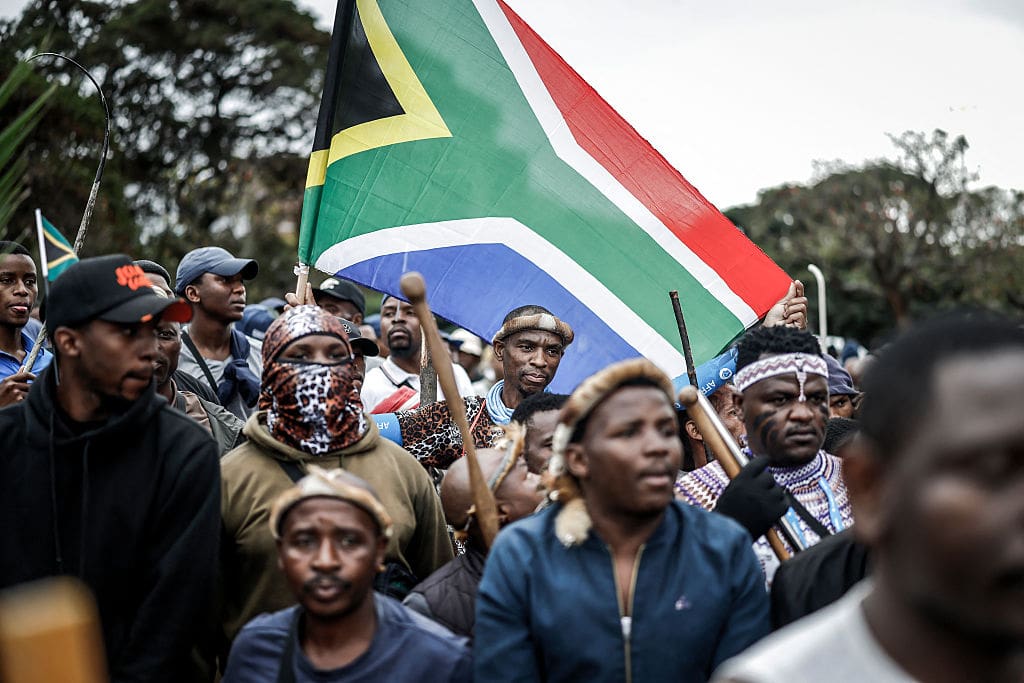
It’s the linchpin in the fight against anti-white policies worldwide.
Eric Weinstein, the former managing director of Thiel Capital, recently explained the philanthropic vision Peter Thiel presented to him when they first joined forces:
I don’t want to do the good work that is seen as good. That work can be done by people richer, weaker and more needy of approval than we are. I want us to do only the work that is *deeply* good but somehow confused for being evil, because that is the work of the courageous and the strong.
This statement could easily apply to the Trump Administration’s willingness to take on politically unpopular yet nonetheless just causes. One particularly relevant example is its brave policy toward South Africa, some of the fruits of which I had the opportunity to witness during a recent visit hosted by Sakeliga, a leading Western-oriented business group in the country. I had read a tremendous amount about South Africa, a country of endless fascination to anyone interested in race and politics. But it is one thing to read about it and another thing to see it up close.
South Africa has considerable symbolic and strategic importance for the United States. It represents the only substantial European population and civilization in Africa. Even after extensive white emigration, there are still at least 4.5 million white South Africans, more than the population of countries such as Lithuania, Georgia, and Croatia, and far more whites than exist in every other African country combined. The story of the Afrikaners’ exploration and settlement of South Africa strongly resembles the American pioneer story, in both its heroic moments and its failings.
But South Africa’s importance for America goes beyond mere symbols. The Cape of Good Hope is the only straightforward, reliable route for the largest ships traveling from Europe and the Americas to Asia. And when the Suez Canal is threatened or blocked, as has happened several times in the past several decades, or when Persian Gulf shipping is threatened by the Houthis, as has happened in the current war with Iran, the Cape’s strategic importance soars.
South Africa is Africa’s largest economy, with the most developed Western institutions, including several world-class universities, and features the continent’s largest stock market and the largest number of major regional corporate headquarters. As Africa rises from 13% to an estimated 32% of the global core working-age (25-54) population in the next 50 years, the continent will become increasingly economically and strategically important, and South Africa already provides an ideal base for business and power projection.
The country has historically been the world’s largest gold supplier and diamond producer, and it is also becoming an important source of rare earth minerals. With respect to immigration, a healthy South Africa acts as a magnet for population and stability throughout sub-Saharan Africa, keeping migrants from other parts of Southern and Central Africa from heading to Europe (or America) by offering first-world amenities and professional opportunities.
If South Africa becomes a failed state, all of this is at risk.
The Trump Administration is trying to prevent that possibility through its unprecedented advocacy for the rights of white South Africans, and in particular the rights of Afrikaners, the descendants of Dutch settlers (supplemented by Germans, French Huguenots, and others) who first settled there in 1652. The administration realizes that without fair and equal treatment of white South Africans, the state is likely to collapse. This likelihood has steadily increased since the African National Congress (ANC) took power in 1994, as almost 15% of white South Africans have left the country since then.
South Africans themselves may be taking a step back from the brink, at least in part because the Trump Administration’s aggressive approach—including pulling South Africa from the African Growth and Opportunity Act (AGOA) trade deal—has prompted some domestic South African commentators to push back far more aggressively on the ANC’s legacy of failure.
In last week’s elections for state and local government, the once seemingly invincible ANC took less than 31% of the vote. This was down dramatically from the 46% it won in the previous local elections in 2021, and just half the share it received in the same elections 15 years earlier. For the first time, the ANC and other parties with roots in far-left revolutionary politics and anti-white agitation, often with significant and explicit Communist influence, took approximately half or less of the vote. In previous elections, these parties had never collectively taken less than 60%.
While South Africa’s messy coalition politics still needs to play out to determine what parties will actually govern where, the opposition center-left Democratic Alliance became the largest party in South Africa’s three most important cities, and most of the significant secondary cities as well. These cities set the overall economic and cultural tone for the country.
While the window of opportunity for South Africa to choose a different direction is narrow, South Africa may for the first time in its history have a chance to change course and become a nation where service delivery and governance, rather than pure racial politics, are the most important factors in determining election outcomes. The Trump Administration’s pressure campaign has contributed substantially to this change.
The administration’s actions in South Africa are hugely significant because defending the rights of white South Africans is the linchpin of pushing back against anti-white policies worldwide. No group of whites in the world has received less sympathy—and arguably, since they voluntarily relinquished political power to the black majority in 1994, no group of whites has suffered as severely.
After 32 years of ANC governance, South Africa today features rolling blackouts in some of its largest cities. The ANC inherited Eskom, which was one of the world’s best power companies, and proceeded to loot it. When I visited the country’s largest bookstore in Johannesburg, only a humming generator kept the flickering lights on. South Africa’s water supply has also become inconsistent. Cape Town, South Africa’s tourist capital, almost became the first major world city to run out of water a few years back. Johannesburg, once the most advanced city on the African continent, saw its water delivery almost completely collapse just days before the elections.
South Africa also suffers from sky-high crime. Several South African cities are regularly ranked among the world’s most dangerous, and anyone with anything worth protecting relies on a substantial private security force that dwarfs the combined numbers of army and police personnel. Corruption is rampant, as is the looting of companies by the politically connected. So-called Black Economic Empowerment (BEE), which is designed in theory to spread more of South Africa’s wealth broadly, has unsurprisingly benefited only those who are allied with the regime. And the country’s borders are wide open to illegal immigration, which has become an increasingly potent issue in South African domestic politics.
Critics call South Africa a failing state on its way to full failure, and despite many attractive, highly functional enclaves for those with enough money or connections, they are not far off the mark. If one were simply to compare the functionality of the state under apartheid with that of today’s South Africa, there is no question that there has been a dramatic reduction in state capacity. Yet serious attempts to address the implications of this reality remain taboo.
Civil Rights Redux?
South Africa’s white population, and in particular its Afrikaner population, is associated with apartheid, which means “apartness” or “separation” in Afrikaans. This system of government ruled South Africa from the National Party’s first victory in 1948 until 1994, making the country arguably the world’s biggest pariah state in the global system.
As a former senior career U.S. diplomat recently posted on X,
In dealing with South Africa back then, we viewed it as some sort of replay of our own civil rights struggle and fight against Jim Crow. That, of course, was nonsense, but few of us had the knowledge or courage to say so…. So, evil apartheid was destroyed; Mandela and his ANC took power, and—Surprise!—South Africa has become a hellish place for everybody, black, white, Zulu, Boer, Anglo, Asian, etc.
The apartheid system enabled numerous injustices and crimes—you can learn all about them (though in a sometimes tendentious and propagandistic fashion) at the impressive Apartheid Museum in Johannesburg. The ruthless categorization and segregation of every South African by race, race-based economic discrimination, the disenfranchisement of the majority population, and state-sanctioned violence and murder—the old system had no shortage of horrors.
Yet it did not arise because of arbitrary cruelty. Apartheid was an attempt, no matter how ill-fated or misguided, to make a country of several wildly disparate groups into a functioning, modern society (one can get a good non-cartoonish account of the thinking behind it in liberal South African historian Hermann Giliomee’s book, The Last Afrikaner Leaders).
Legendary anti-apartheid activist and South African writer Alan Paton, author of Cry, the Beloved Country, a critique of apartheid widely considered to be the greatest South African novel of the 20th century, wrote of the “tragic dilemma” of the situation of white South Africans:
A man is caught on the face of a cliff. As he sees it, he cannot go up and he cannot go down; if he stays where he is, he will die. All those who stand watching have pity for him. But the analogy, alas, is obviously incomplete, for the world’s spectators of our drama are seldom pitiful; they are more often reproachful. From their point of vantage they can see which way we ought to go, but they see us taking some other way which will lead us to our destruction. And the world looks at us in astonishment, wondering what madness has possessed us.
Paton would later co-found South Africa’s Liberal Party, which strenuously opposed apartheid, but he understood that white South Africans, entering a century that prized racial egalitarianism and popular democracy over almost all other political considerations, did not have good choices before them.
And one cannot help but wonder, as the diplomat quoted above did, about the unique obsession that the global Left and the “international community,” in particular, had with South Africa. The country was relentlessly boycotted, banned from the Olympics and other sporting events, and repeatedly condemned at the U.N., which established a special committee against apartheid. Anti-apartheid campaigns were at the center of campus activism at virtually any university in America or Europe worth its salt.
All of which is strange, because for all of apartheid’s genuine horrors, South Africa was nonetheless a magnet for black Africans from other countries, with a million (legally and otherwise) crossing the border to take advantage of better conditions than what they had at home. And the numerous African countries with far more murderous and oppressive records than South Africa could have ever contemplated were treated with kid gloves, or even celebrated, by the “international community” in those same years. It is almost as if the world had one standard of behavior for whites and another for everyone else, most especially black Africans.
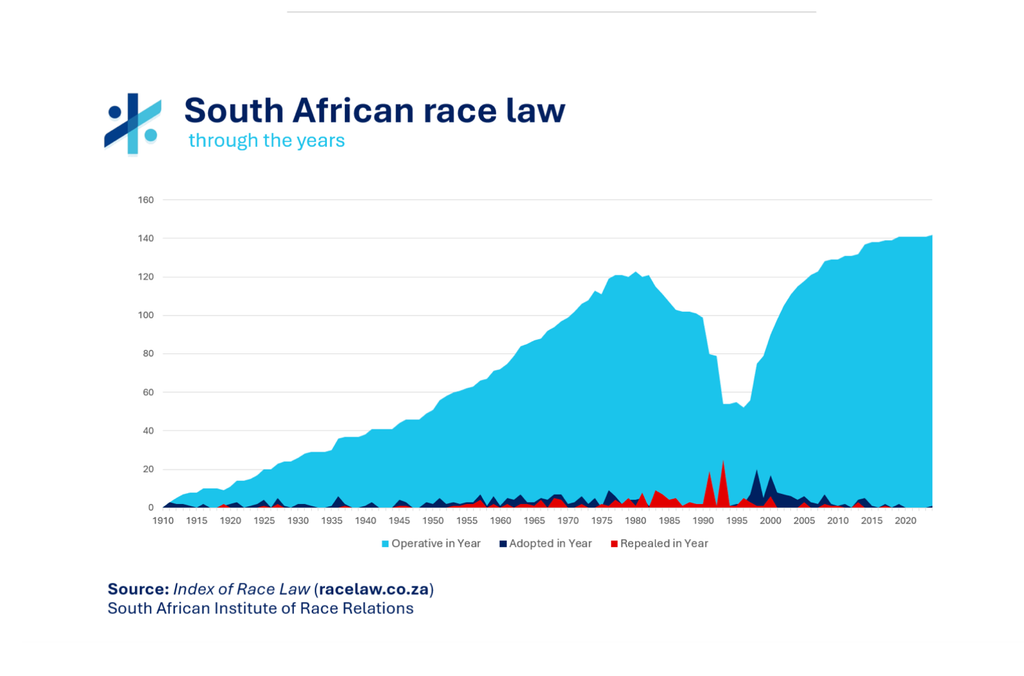
Indeed, while South Africa’s race laws hit their peak in the early 1970s, more than two decades before apartheid’s official demise, and began declining rapidly in the early 1980s, its new anti-white race laws have grown dramatically after the ratification of its new constitution in 1996. The number of these almost uniformly anti-white laws has exceeded the number of race laws at the peak of apartheid, according to information from South Africa’s prestigious nonpartisan Institute of Race Relations, which were fierce critics of the old apartheid system. And yet, outside of the Trump Administration, there are almost no calls from the “international community” to hold South Africa to account.
In response to South Africa’s continued decline, the Trump Administration has made five requests of the country’s political leadership:
(1) Address the murder of farmers, who are disproportionately white and are often targeted for racial reasons, and rural violence more generally, by declaring it a priority crime.
(2) Condemn as hate speech the “Kill the Boer [Afrikaner] kill the farmer” chants that have been defended by South Africa’s president and are popular with some on the South African Left, including members of parliament.
(3) Ban land expropriation—almost invariably from white South Africans—without appropriate compensation.
(4) Remove or alter certain racially discriminatory black economic empowerment programs that demand black equity ownership stakes in white-owned companies, especially with respect to U.S. companies operating in South Africa.
(5) Demonstrate true political non-alignment by distancing from U.S. adversaries.
Such requests are eminently reasonable—but the South African regime has been haughtily dismissive, leading to the Trump Administration’s initial travel-related and other sanctions against the regime and its leading figures, which it has promised to escalate if the country’s leaders do not change course.
The Conditions of Civilization
Underlying the Trump Administration’s approach to South Africa is a cautionary tale from Zimbabwe.
Then known as Rhodesia in the 1960s and 1970s, the country had a white population of 300,000 before cratering to less than 17,000 in 2017, an almost 95% drop in the final year of dictator Robert Mugabe’s misrule. (Mugabe was a violent revolutionary who became the first president of independent Zimbabwe from its founding in 1980 until his ouster in 2017.) Rhodesia faced tremendous international pressure—even from South Africa—as well as a brutal guerrilla war aimed at removing its non-democratic government, which did not have explicit racial qualifications but had property and educational qualifications that still led to an overwhelmingly (90% or so) white electorate despite whites not being more than 8% of the population.
Then-Rhodesian leader Ian Smith repeatedly warned world leaders that imposing one-man-one-vote democracy in countries whose communities had dramatically different cultures and levels of development was a recipe for civil strife and collapse. Such a country would be “a kind of banana republic where the country would in no time be bankrupt,” Smith accurately predicted. It was a scarcely fashionable message at the time: anti-colonialism and Third-Worldism were rampant, and Smith’s warning remains hardly more palatable to fashionable opinion today. But the transition to “democracy” under Mugabe—championed by then President Jimmy Carter and virtually all European leaders—proved disastrous for almost everyone in Zimbabwe, white and black. And it failed just as Smith had predicted.
This history is what makes the Trump Administration’s stand for white South Africans heroic, fully worthy of the Thielian hero. It was deeply unpopular to stand with white Rhodesians in the 1970s because people cared more about looking good than being good. Almost everyone in what became Zimbabwe suffered horrifically for decades, because no major world political leaders were willing to take the public relations hit of reforming rather than leveling the existing system.
What were the results of bringing “democracy” to Zimbabwe? A decade after “land reforms” of the type currently being contemplated in South Africa, food production plummeted 60%, turning what had once been the “breadbasket of Africa” into a basket case, requiring foreign food aid. Industrial production decreased by more than 10%, export earnings collapsed, and foreign direct investment fell to under $4 million.
By 2008, Zimbabwe’s GDP per capita hit a level that it had not been since 1952, and a massive cholera epidemic broke out. The Bulawayo Railroad Depot, the largest engineering hub in Sub-Saharan Africa under Rhodesian rule, capable of producing and repairing some of the most advanced railway components and locomotives in the world, was dilapidated, stripped, and looted. Highways were wrecked, serious commercial activity almost ceased, and a massive emigration crisis ensued, with millions of Zimbabweans fleeing the country, most to South Africa.
A Policy of Moral Seriousness
The Trump Administration is well aware of what happened in Rhodesia, and it is determined to avoid a similar collapse in South Africa, knowing that supporting the rights of white South Africans is not necessarily popular, especially in third-world bastions such as the U.N. or among European capitals. Or among the Democrats. Influential Democratic congressman Jamie Raskin recently vilified Afrikaners as being “unreconstructed racists,” even though no white South African under 50 years of age has an adult memory of apartheid, and South African culture and society have changed enormously since then.
But the Trump Administration is unwilling to let a country as strategically important as South Africa—far more so than Zimbabwe ever was—collapse under the weight of political correctness. It recognizes that avoiding this outcome means helping protect the rights of white South Africans, who remain a linchpin of the country’s economy and its closest cultural link to the West.
Of course, the means of implementing these necessary reforms to secure the rights of South Africans of all racial backgrounds are not straightforward. In addition to U.S. pressure, Professor Koos Malan, a South African expert in constitutionalism, has offered one intriguing possibility for reforming South Africa. He has critiqued the American tradition of “statist individualist constitutionalism” (at least in the South African context) and argued in There is No Supreme Constitution for a constitution that would give much more explicit weight to the rights of South Africa’s many diverse communities rather than solely focus on individual rights as the American Constitution does. This could lead to greater communal self-governance (community federalism) and less opportunity for dysfunctional state looting.
***
While in South Africa, I spent a couple of days with a friend, an Afrikaner whose wife was expecting their first child. Shortly after I returned to the U.S., his wife gave birth to the 10th generation of his family in Africa. If we are to maintain the ludicrous position (floated implicitly and at times explicitly by some South African politicians) that this man’s family does not have a place in Africa, then certainly there is no justification for a foreigner of non-European descent to be in America (with the exception of American descendants of slaves). Since that is most certainly not in the cards, unapologetically vindicating the rights of white South Africans is morally right and serves America’s vital regional interests.
In taking on an unloved but strategically critical action in standing up for the white South African community, and Afrikaners in particular, the Trump Administration is not only dramatically strengthening its long-term interests and improving the welfare of all 65 million South Africans, but it is proving that it has far more genuine moral seriousness in its foreign policy than its politically fashionable critics will ever muster.
The American Mind presents a range of perspectives. Views are writers’ own and do not necessarily represent those of The Claremont Institute.
The American Mind is a publication of the Claremont Institute, a non-profit 501(c)(3) organization, dedicated to restoring the principles of the American Founding to their rightful, preeminent authority in our national life. Interested in supporting our work? Gifts to the Claremont Institute are tax-deductible.
Suggested reading
Zelensky’s position is getting more untenable by the day.

It’ll be hard for the administration to resist supporting strikes.
NVIDIA CEO Jensen Huang shouldn’t try to run U.S. foreign policy.

Helping our allies without wanting them to salute.
All racism is bad, but some racism is more racist than others.

