

To spot a would-be autocrat, look for someone who undermines language.
Steel, Ships, and American Power
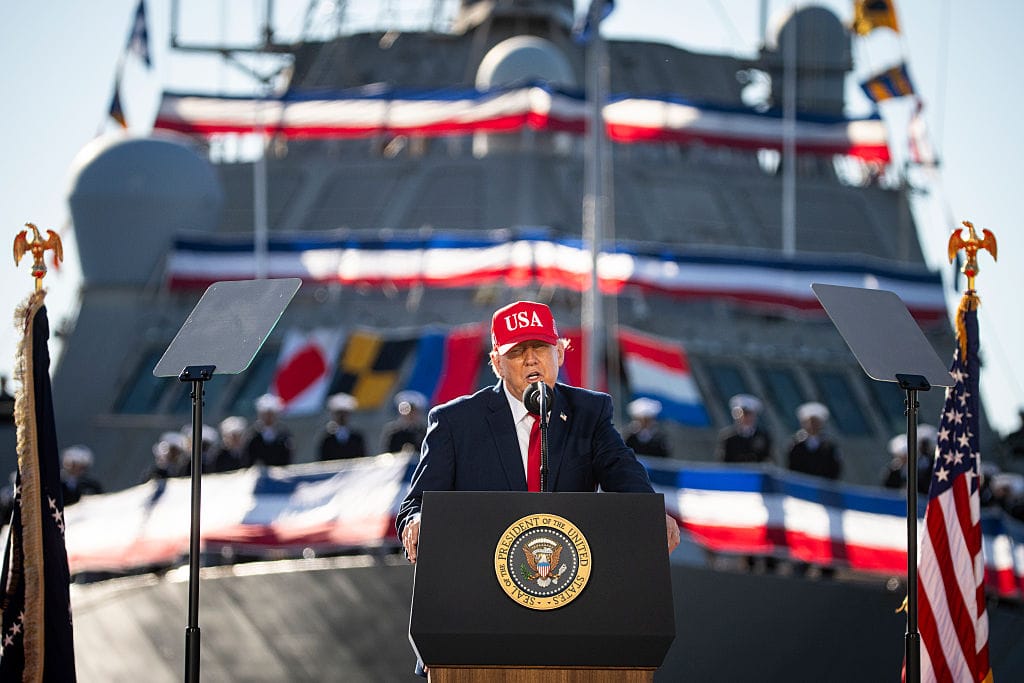
Rebuilding America’s industrial base is essential to restoring its military capacity.
In early October, President Trump stood in Sparrows Point, Maryland, where Bethlehem Steel once built the ships that powered America’s naval dominance. In its shadow, the president, alongside Secretary of War Pete Hegseth, announced plans to construct a new shipyard in which the U.S. government would hold a 40% stake.
Anduril, a defense tech firm that makes autonomous weapons, will commit $3.7 billion of its own money to build the yard, known as Arsenal-2. According to the Department of War, “The shipyard is expected to be the largest of its kind in the United States and will be designed to produce submarines, submarine components and autonomous underwater vessels.”
American shipyards currently build one and a third nuclear-powered Virginia-class attack submarines a year. The Navy wants to increase the production rate to two. Virginia-class submarines are built to hunt enemy subs and ships and strike land targets. They also gather intelligence, which is critical for maintaining U.S. power in the Pacific. This capability is another reason why our production shortfall against China matters.
China’s navy is larger than ours, with more than 370 vessels compared to America’s 290 battle force ships, though we still lead in aircraft carriers and nuclear submarines. Its shipyards are extensive, as is its commercial fleet. China accounts for more than half of the world’s commercial shipbuilding, while the U.S. has fallen behind to less than 1%. A deep-water navy isn’t only crucial to America’s military dominance but is also a cornerstone of our industrial base. The shipbuilding industry affects countless other industries and sectors, with second-order effects such as technological advances.
When the government has taken direct action in certain industries (contrary to the free market’s “invisible hand”), the technological advancements have been considerable:
- The internet
- GPS
- Microwave ovens
- Commercial jet aviation
- Siri and voice assistants
- Semiconductors
- Nuclear power
- Weather and communications satellites
- Drones
- Duct tape
- mRNA vaccines
This isn’t to say that private development doesn’t play an immense and necessary role. But targeting specific industries for development and protecting them from foreign competitors has served America’s interests well, particularly its national security needs. This was standard bipartisan policy for most of American history.
In this vein, President Trump announced the Golden Fleet last December, a massive rebuilding of the U.S. Navy, including a new class of large surface warships and dozens of supporting vessels. Its long-term future is uncertain given Congress’s willingness to maintain funding, and it would likely be imperiled if a Democratic president were to win in 2028.
But regardless of what happens with the Golden Fleet, the Trump Administration is championing two new projects—the shipyard in Maryland and a massive new steel mill in Iowa—that could help rebuild the industrial base needed to sustain America’s military strength.
Rebuilding our military cannot happen without rebuilding America’s capacity to make steel. Mesabi Metallics, an Indian company working closely with the administration, is planning to build a $15 billion integrated steel mill in Iowa. If completed, it would be a massive boon for American industry and a source of job creation. Of course, the Foxconn project President Trump announced in 2017 turned out to be a bust. But the steel mill project already has a $2.5 billion iron-ore mine in Minnesota to supply it, and the finished product will be protected in the domestic market by 50% tariffs.
Domestic steel production is key to America’s naval success, since every submarine hull, destroyer, and carrier relies on high-quality steel. Buying these materials from adversarial nations, as we do for a shockingly high number of components for our aircraft and other military tech, is irresponsible and undermines America’s national security. After World War II, the U.S. made about half the world’s steel, but by making poor economic decisions, we’ve ceded that ground to China. As our world becomes increasingly multipolar and China’s soft power influences more of the globe, onshoring industries like steel becomes a crucial national security priority.
While conventional, globalist economic thinking claims that power resides in the ability to trade freely and optimize profit, the reality is that projecting power depends upon metal, ships, and guns.
The U.S. Navy hasn’t been rebuilt at scale since the Reagan Administration. Domestic steel means the ships at Sparrows Point and the Golden Fleet can be built without relying on Beijing or its allies. Every mill, shipyard, and mine that returns to America makes the country stronger and ultimately more sovereign.
Credit is due across the aisle, too. The Biden Administration’s CHIPS and Science Act put federal money and direction behind domestic semiconductor plants. As Taiwan, a critical semiconductor supplier, faces China’s increasing threats to take over the island, the U.S. will need to increase its own production. Elon Musk’s planned Terafab project could further advance this realignment. If completed, Musk’s semiconductor fabrication complex will be the largest building on earth by a significant margin.
The Trump Administration is making good progress in rebuilding domestic manufacturing and upgrading our military to meet our national security needs. The freedom we enjoy as Americans is possible only by projecting power. That power is projected by ships and steel and sustained by a formidable industrial capacity, which allows us to remain free and sovereign by keeping our enemies at bay.
The American Mind presents a range of perspectives. Views are writers’ own and do not necessarily represent those of The Claremont Institute.
The American Mind is a publication of the Claremont Institute, a non-profit 501(c)(3) organization, dedicated to restoring the principles of the American Founding to their rightful, preeminent authority in our national life. Interested in supporting our work? Gifts to the Claremont Institute are tax-deductible.
Suggested reading

How globalization became sinicization

Critiquing Samuel Huntington’s famous thesis in 2024.

America should officially recognize it as an independent state.

U.S. foreign policy leaders have become addicted to outsourcing atrocities.

A recent publicity photo from the Navy tells us more than we wanted to know about military readiness.

