

The speech heard ‘round the world.
The State Department’s War on Far-Left Terrorism
A much-needed new counterterrorism strategy.
The obituary for the Trump State Department’s efforts against “Far-Left Terrorism” (FLT) may have been premature. The Washington Post—from its lofty position as stenographer for the federal bureaucracy—declared the State Department’s Ministerial on the Resurgence of Political Terrorism a flop before it even began. Anonymous sources lined up to chortle that it was a waste of time and was intended only as public spectacle. According to the credentialed experts popular with the Post, the threat of far-left violence exists only in the minds of the president and his supporters.
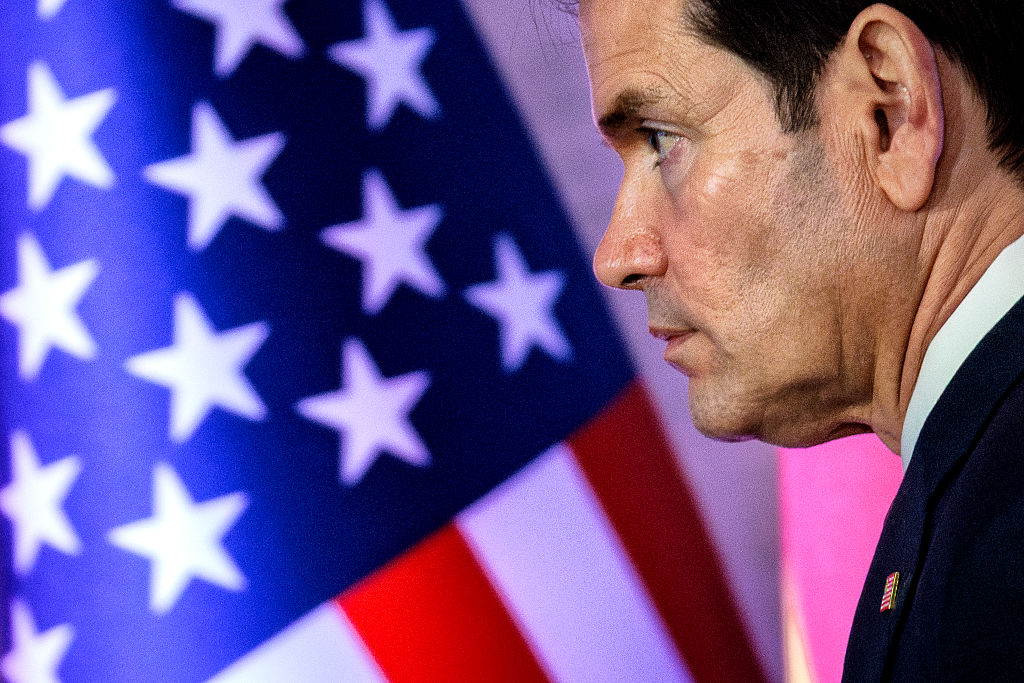
But the “Antifa summit”—itself a misnomer—demonstrated precisely the opposite: the State Department has approached a critical issue for the future of the West with the seriousness it deserves. In the summit’s public session, Secretary Rubio offered an oblique but sharp rebuke to these critics as he laid out the bloody history of left-wing terrorism, both in the United States and across the Western world:
All of you here from Europe remember. You remember the machine-gun massacres of Italy’s Red Brigades, which held the five-time prime minister captive for fifty-five days before subjecting him to a revolutionary so-called “people’s trial” and executing him in 1978. You remember the Red Army Faction’s nearly three-decade campaign of bombings, kidnappings, and assassinations in Germany, murdering dozens and injuring hundreds more. You remember the November 17 organization in Greece, the Marxist extremists that terrorized Athens for more than a quarter century, including, by the way, shooting my country’s CIA station chief dead outside of his home in front of his wife as they were returning home from a Christmas party.
And here in America, we remember…. In one eighteen-month period between 1971 and 1972, the FBI counted some 2,500 bombings on American soil—a rate of nearly five a day. The overwhelming share of that violence came from left-wing extremists. Between 1970 and 1980, 93% of terrorist attacks in the West came from the far extremist left.
Rubio called attention to the fact that this same form of historic terrorism, using the same methods, has again resurfaced. And the statistics bear this out. Left-wing extremism in Germany, for example, jumped by 40%; 80% of violent extremism in Greece originates on the Left.
Rubio also emphasized the human cost—a CEO executed on a city street, a grandmother burned alive, a city plunged into darkness. These were all real attacks, with real victims who were killed or had their lives permanently altered. But for the majority of “Countering Violent Extremism” experts, a caste the Obama Administration formed in 2009 and was subsequently lavishly funded by government grants and academic sinecures, these victims simply do not exist.
Rubio had some harsh words for these “experts”: they rightly see a “bomb planted by a neo-Nazi group” as “a nefarious and murderous act of evil,” but view one set by Marxist revolutionaries as simply “a tragic excess of idealism.”
It’s against this backdrop—a growing threat that much of our modern extremism expert class refuses to acknowledge—that the summit’s real goal was advanced.
The Gathering Threat
I spoke to a State Department official about what went on behind the scenes at the ministerial to get a better sense of how Secretary Rubio’s bold words are being put into action.
The program wasn’t just a meet-and-greet. It was designed to bring diplomats and counterterrorism practitioners together to discuss shared concerns and best practices among countries dealing with the scourge of Far-Left Terrorism.
During the summit’s closed panels, participants identified four key “verticals” of shared concern. They were:
- The role of FLT in economic sabotage and attacks on critical infrastructure.
- The convergence of grievances and the issue of FLT foreign fighters.
- The use of Far-Left Terrorists by foreign actors to conduct attacks with plausible deniability.
- The growing trend of targeted FLT attacks against high-profile individuals.
The State Department official called the use of economic sabotage and attacks on critical infrastructure the “calling card” of FLT. Such groups target power grids, data centers, and parts of the military-industrial supply chain. Far-Left Terrorists who support Palestinian terror groups, for example, have attacked segments of the military supply chain purportedly linked to Israel.
“We’re currently engaged in a military conflict in the Middle East. The convergence of groups united by anti-American, anti-colonialist, anti-capitalist ideologies to target our military infrastructure, or our partners’ aircraft, can exhibit a significant cost at a key moment,” the official warned.
While not named by the official, the U.K.’s designation of Palestine Action as a terrorist group, recently upheld by a British court following its June 2025 attack on a British Royal Air Force base, is an obvious example of this growing threat. The U.S. government recently requested that the Spanish government extradite Fergie Chambers, the millionaire far-left funder of Palestine Action, and the leaders of similar “Actionist” groups that are known for targeting the military supply chains of the U.S. and its European allies.
The State Department official also noted the grave concern among partner countries related to the growing convergence of multiple threats across the Far-Left Extremism space. These include environmentalist, anti-Zionist, and anti-capitalist groups, along with an expanding contingent of far-left “Internationalist” foreign fighters and a blossoming transnational network among far-left actors.
“It’s a localized group coordinating with other actors across borders,” the official said. “So there’s a transnational network aspect. Our partners have brought up the use of networking through digital platforms and digital tools, which are difficult for them to address using law enforcement tools. These are areas where Far-Left Terrorism is distinct.”
This has included increased cooperation between FLT networks and groups operating out of the Middle East. A recent intelligence report by the German Ministry of the Interior noted the growing influence of the Kurdish PKK and expressed concern regarding returning Internationalist fighters operating in Northern Syria.
For students of counterterrorism history, the increased focus on the role of foreign adversaries in using far-left groups as terror proxies is particularly intriguing.
During the 1970s and 1980s, there was a marked refusal by most Western intelligence agencies to publicly acknowledge or take seriously the role of Soviet Bloc support for Western far-left terror groups, including the Red Army Faction, the Red Brigades, and the Weather Underground. For a considerable period, focus on this problem was confined to a fairly narrow academic interest, culminating in vital works such as Hydra of Carnage (1986) and Claire Sterling’s The Terror Network (1981).
Seen in this light, official government recognition of the threat posed by the foreign backing of Far-Left Terrorism is an important success.
Terrorism Close to Home
Released shortly after the ministerial summit, the State Department’s report, Cuba: The Capital of 21st Century Communism, was well-timed to take advantage of this sea change. The report covered both the historic Cuban role in supporting terrorist proxies and its ongoing subversive activities that promote Far-Left Extremism in the United States. This includes the Cuban government’s close association with the Singham Network, the principal funder of the Party for Socialism and Liberation (PSL). A former PSL member, Elias Rodriguez, murdered two Israeli embassy staffers in Washington, D.C., in May of 2025.
As the State Department official I spoke to noted, the success of these efforts by Far-Left Extremists cannot be measured solely by the number of attacks committed, but rather by the potential for hostile foreign actors “to destabilize our societies through these groups.”
This is what has been called “armed subversion,” where foreign adversaries use domestic radicals as proxies to conduct attacks and to destabilize the internal political situation. Armed subversion may not be unique to FLT, but it is instrumental in accurately understanding it. That the Trump Administration has embraced the concept is a welcome relief.
The deliberate targeting of high-profile individuals, and especially domestic political opponents, is perhaps the “vertical” most closely associated with the activities of Antifa. One of four far-left terror groups designated by the State Department was the Germany-based Antifa Ost, best known for targeting political opponents for violent assaults, and even attempted murders using hammers and other blunt objects.
The role of targeted violence is particularly salient for American audiences following the assassination of Charlie Kirk, which Rubio mentioned during his presentation. The recognition that this kind of selectively targeted violence is vital to FLT activity helps begin to undo the Countering Violent Extremism industry’s obsessive emphasis on counting attacks and plots as the only important metric. The CVE “experts” have largely failed to appreciate that much of the political success of leftist terrorism comes not from mass-casualty incidents, but from calculated strikes designed to intimidate law-abiding citizens and encourage more attacks.
The shift in approach is evident in the State Department’s use of “Political Terrorism” as a category. While seemingly redundant, the phrase helps to refocus attention on the fundamental nature of terrorism as a political tool. This is a subtle rebuke to the Countering Violent Extremism school of thought, which emphasizes psychosocial or “root cause” analysis of terrorism.
Regarding the lackluster quality of statistics, the State Department official acknowledged the struggle to address poor data hygiene in American private-sector counterterrorism databases and studies. He pointed out that partner nations are coordinating to help address this gap. They are beginning to share information about far-left attacks in ways that have helped inform the State Department’s internal understanding, even when these attacks don’t make the front page.
One hopeful takeaway from the ministerial, he stressed, is that recognition of Far-Left Terrorism as a concern for the U.S. and other governments will help establish it as a legitimate line of inquiry for private-sector experts and academics.
As for next steps, the State Department official called the summit “a milestone but not a capstone,” emphasizing that additional action, including further terrorism designations and the implementation of new visa restrictions, would follow. He also noted the announcement of a follow-up law-enforcement workshop to be hosted by the German government, contradicting much of the media coverage that sought to minimize foreign partner cooperation. This level of participation is particularly noteworthy due to the German government’s long experience with and struggle against Far-Left Extremism.
Responding to media coverage, the official stated,
There will always be people who shoot from the hip and make assumptions about the way other countries will perceive these issues. We’ve had many conversations with partners across the world, and that is the basis of this effort. The insights we’re getting from partners are helping us become more effective at dealing with this threat. If you ask me, this ministerial was a major success.
The Trump State Department is moving forward on the FLT portfolio in a measured but aggressive manner. Public-facing presentations by Rubio and other Trump cabinet luminaries certainly provided a level of fan service for the president’s base. But they also stressed that the United States takes the developing threat of Far-Left Terrorism seriously and is prepared to use its influence and authority on the world stage to lead an international response. This indicates that Washington recognizes it needs foreign partners to successfully counter a sophisticated transnational network like FLT. It’s a realization that we have something to learn from other nations, many of whom are glad to see the United States awakening to a challenge they’ve been addressing quietly for some time.
The American Mind presents a range of perspectives. Views are writers’ own and do not necessarily represent those of The Claremont Institute.
The American Mind is a publication of the Claremont Institute, a non-profit 501(c)(3) organization, dedicated to restoring the principles of the American Founding to their rightful, preeminent authority in our national life. Interested in supporting our work? Gifts to the Claremont Institute are tax-deductible.
Suggested reading

There’s no comparison between the president’s flaws and the goals and tactics of the Democratic Party.
Our premier federal law enforcement agency can’t be trusted to investigate major crimes.

How Trump can retaliate against the Honduran president’s threats.

Historian Samuel Flagg Bemis can help us assess our national interest.

NVIDIA CEO Jensen Huang shouldn’t try to run U.S. foreign policy.

