

The U.S. and Europe are the new sick men of the world.
The Midterms’ Two Defining Issues
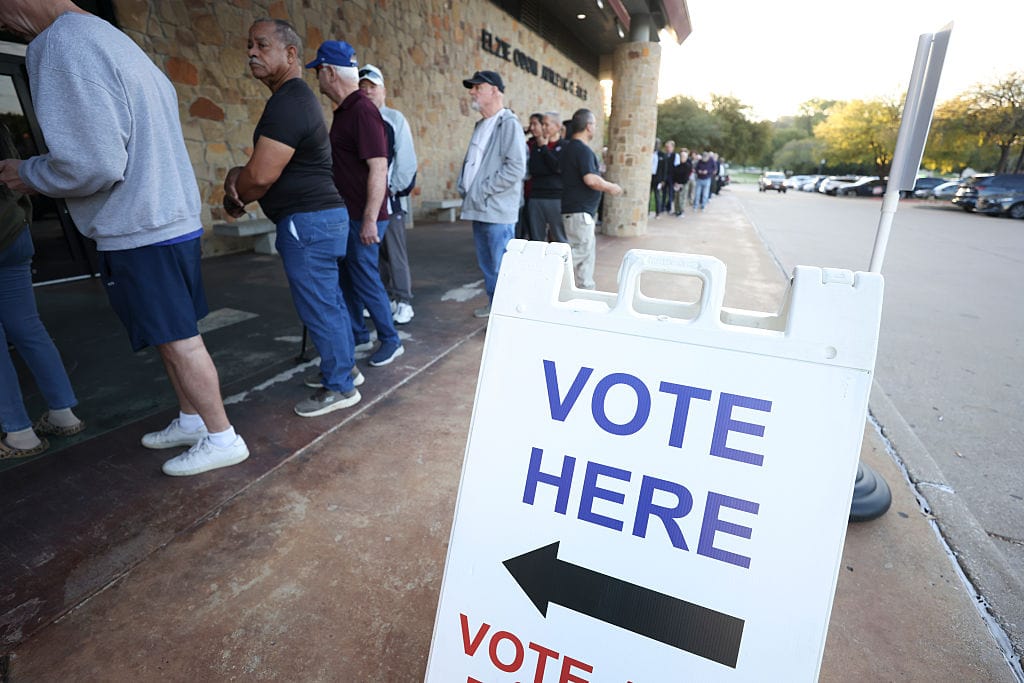
Democrats are using the Iran War and AI to boost their electoral prospects.
With the midterm elections just around the corner, Americans are gearing up to vote on an entirely different set of issues than in the 2024 general election. Rather than weighing the merits of a potential Kamala Harris administration, voters are now assessing the record of a second Trump term, defined by the rise of AI and military operations in Iran.
Around three weeks before the midterms, AP-NORC queried potential voters’ issue saliency. Economic concerns led at 85%, followed closely by cost-of-living concerns at 84%. Then came the Iran War at 64%, which ranked ahead of immigration and crime, the very issues that carried Donald Trump back to the White House in 2024.
Americans are often said not to vote on foreign policy, but survey findings suggest otherwise. Researchers David Karol and Edward Miguel found that Iraq casualties measurably depressed George W. Bush’s vote share in 2004; absent the war, they estimate Bush would have won 52.3% of the national vote and 366 electoral votes. Two years later, Pew called the Iraq War the central issue of the 2006 midterms, and the national exit poll showed voters who disapproved of the war breaking overwhelmingly for Democrats, who took back the House. This cycle, Fox News finds that six in ten voters oppose military action against Iran—and that those voters favor Democratic congressional candidates by 56 points.
Issue saliency changes with events and with what the president does, so the shift itself is no surprise. Nor have Democrats misread it. The war is unpopular, and their polling tells them so.
Pew finds 65% of Americans disapprove of the president’s handling of the conflict, compared with 33% who approve. The decline in support for the Iran War came almost entirely from Republicans, whose approval slipped from 69% to 63% over the fall, while Democrats remained steady at 9%. Those Republicans did not turn on the war because of gas; asked about their concerns, those citing fuel prices barely moved, from 59% to 61%. Instead, these Republicans turned against it because it seemed to have no clear objectives. Fox News finds 71% of voters believe the administration has no plan to end the war, which includes a good share of the president’s own party, and six in ten now say military action was the wrong decision.
Democrats have an electorate, including a growing slice of Republicans, that judges the war on its merits and finds it wanting. But they have declined to argue the merits. What changed for Democrats was not opposition to the war, but the reason given for it. The share of Democratic respondents citing fuel prices rose from 79% to 85% over the same period. The party’s voters were absorbing a frame their leaders had picked for them.
That framing shows up across the Democrats’ messaging. Senator Chuck Schumer’s six-month statement on the Iran War opened by listing the 18 American service members killed and then turned to fuel prices. In rallies in Ohio and Michigan, Barack Obama blamed the war for oil and diesel costs. A Wisconsin ad against Representative Derrick Van Orden ties his war vote to rising grocery prices and utility bills. Opposition that once centered on the absence of congressional authorization, the lack of a strategy, and the question of whether the war was worth 18 American lives has been repackaged as a complaint about the pump. It conveniently slots into the affordability message the Democrats have closed in on, and it spares them from ever saying what they would do about Iran.
AI is another defining issue in the 2026 midterms. Fox News polling in September found a 71% majority opposed to building AI data centers in their area, with Democrats leading by at least 19 points among those opponents and holding a 14-point edge on which party would better handle the issue. Fox’s own Republican pollster called it a wedge issue and predicted that campaigns mapping tech anxiety onto their coalitions would shape the midterm narrative. Democrats have incorporated concerns about job displacement into that strategy. Senator Chris Murphy revealed the strategy’s true intent in an interview with Axios last week, urging Democrats to make the AI industry’s capital and data centers central issues in order to stoke negative sentiment.
In October 2025, Senator Bernie Sanders released a report through the Senate HELP Committee claiming AI would eliminate almost 100 million American jobs within a decade. The composite estimates listed projections including 89% of fast-food workers, 64% of accountants, and 47% of truck drivers. The report also blamed a Trump Administration policy for incentivizing automation and weakening unions. The irony lies in how the figures were derived: the 97 million potential job loss claim likely originated from a ChatGPT-based model. Sanders quite literally asked the model how many jobs AI would eliminate and then published the answer as a “finding.”
Although AI is getting rid of some jobs, its observable impact differs wildly from the claims Sanders and his colleagues cited. Economists at Stanford who track ADP records found that young workers aged 22 to 25 in the most AI-exposed fields were employed at a rate approximately 19% below their peers in less-exposed occupations. The effect is noticeable but appears confined to a narrow age group and an even smaller cohort of the workforce where AI is being heavily used. Concerns about future job disruption are real, but the gap between 100 million jobs at risk and observable reality highlights how desperate Democrats are to turn anxiety over a new technological epoch into a destructive political force.
This is political theater, not policymaking. The Yale Budget Lab reported in its October 14 update that AI had not yet caused any noticeable changes in the labor market. Job turnover, unemployment among workers in AI-exposed occupations, and AI use all remained relatively stable and within historical norms. Similarly, a Gallup survey asked laid-off workers why they lost their jobs—only 1% reported that AI or automation was the cause.
Voters’ concerns about occupational disruption are not irrational: Gallup finds that 27% of American workers fear new technology will make their occupations obsolete (the highest level since Gallup first asked the question in 2017), with the figure rising to 34% among those under 45. Furthermore, 71% of Americans think AI adoption will result in fewer employment opportunities over the next 20 years, up from 64% in 2024.
It would be both poor political strategy and dishonest to dismiss these concerns outright. The objection is not to Democrats addressing them but to the posture they have chosen. They have inflated genuine issues by orders of magnitude during a high-stakes election. When a sitting senator presents the median voter with a number generated by a chatbot, it falls to more sober voices to separate theatrics from data. Likewise, opposition to another war in the Middle East can be perfectly genuine, and voters have punished unpopular wars before. But reducing that opposition to gas prices leaves out the reasons the country went in at all. On both issues, Democrats have settled on the framing that polls best rather than the more honest account.
The American Mind presents a range of perspectives. Views are writers’ own and do not necessarily represent those of The Claremont Institute.
The American Mind is a publication of the Claremont Institute, a non-profit 501(c)(3) organization, dedicated to restoring the principles of the American Founding to their rightful, preeminent authority in our national life. Interested in supporting our work? Gifts to the Claremont Institute are tax-deductible.
Suggested reading


Remembering the life of a great man.
Self-government requires a real choice in elections.

Our client states are becoming our politicians’ main constituency.

The moral task of American statecraft in our time.

A career-ending backfire.

