

The U.S. and Europe are the new sick men of the world.
The Lamps Are Going Out
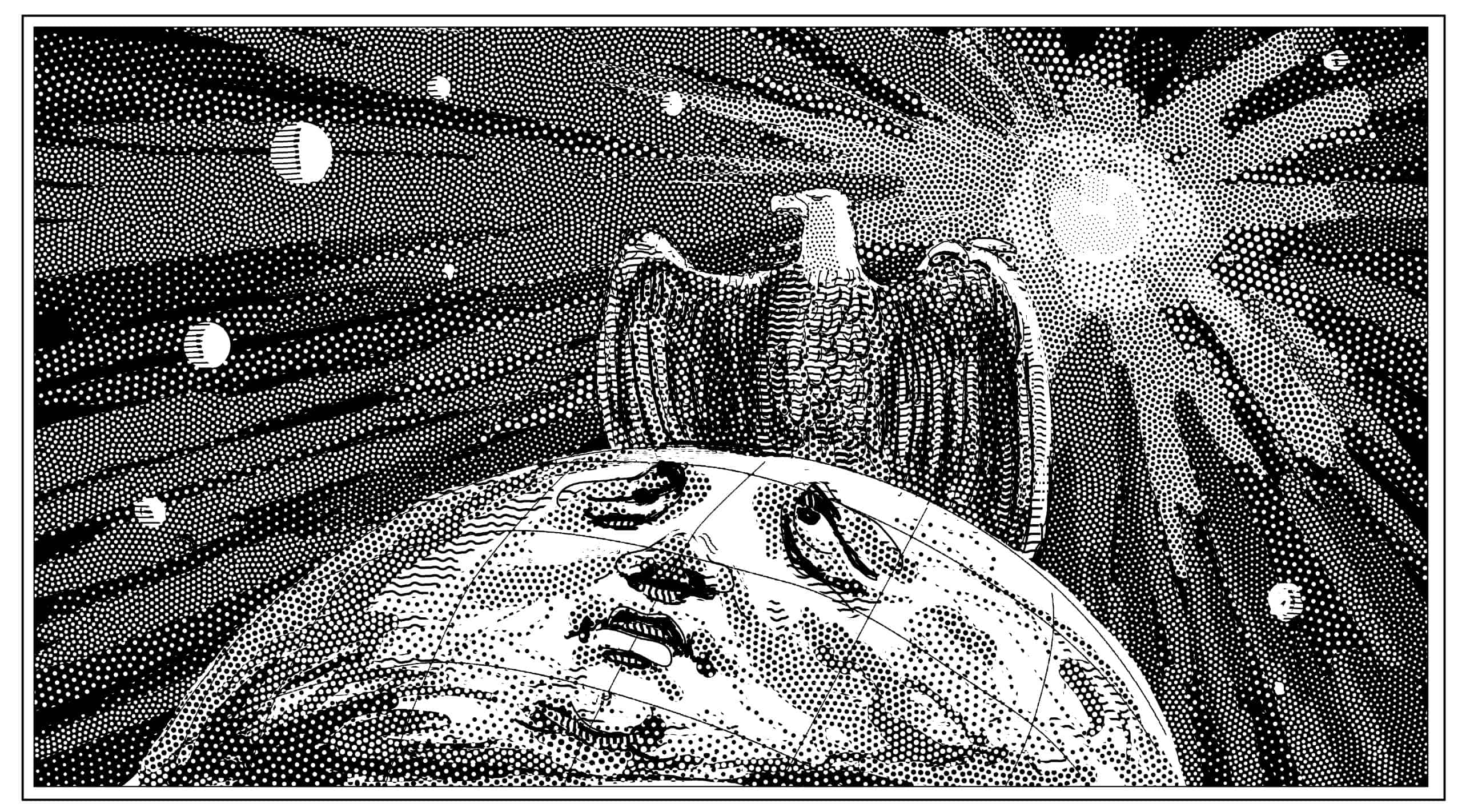
Leaders who assume it would be better to fight today than tomorrow are making a calamitous miscalculation.
Editors’ Note
What follows is an excerpt from Christopher Caldwell’s book review, “The Lamps Are Going Out,” from the Spring 2026 issue of the Claremont Review of Books.
In 2011, when U.S. Navy Seals blew open the front door of Osama bin Laden’s fortified compound in Pakistan, stormed up the stairs, and shot him dead, they found more than a loaded AK-47 in his room. Bin Laden had been reading the Yale historian Paul Kennedy’s The Rise and Fall of the Great Powers (1987), which told the story of military conflict since the 15th century. Kennedy’s argument was as dismaying to his fellow countrymen as it must have been heartening to bin Laden: the American empire, too, was mortal, and “imperial overstretch” was bringing inevitable decline. Kennedy wrote with such brio that his book climbed The New York Times bestseller list, peaking in March 1988 at number two, topped only by a real-estate mogul’s ghost-written memoir called Trump: The Art of the Deal.
This year, just days after President Trump committed the United States to join Benjamin Netanyahu’s Israel in bombing Iran into regime change, another Yale historian, Odd Arne Westad, published a book that also warns of relative decline and imperial overstretch. Westad, a Norwegian-born expert on Asia and the author of the highly regarded The Cold War: A World History (2017), focuses on the turn of the 20th century, when Europe’s Great Powers—prosperous, complacent, and at peace—lurched into civilizational catastrophe.
The world that World War I brought to a close has powerful resemblances to our own, Westad warns, adding, “We take an immense risk by engaging in large-scale warfare.” He did not predict the new Iranian war, of course, but he does point clearly to the Israeli-Iranian breach as one into which Great Powers risked getting drawn if they were not careful. “Having stateless peoples at the center of an already volatile region is a recipe for disaster,” he observes, noting both Israel’s Palestinians and Iran’s Kurds. “The greater danger in an era of intensified Great Power competition is that the Palestinian conflict with Israel, and the conflict between Israel and its neighbors, could come together with other clashes and lead to a larger conflagration.”
***
Comparing the run-up to World War I with whatever it is we’re entering into now, Westad finds parallels between the nations that, in each era, knit the world together through their institutions—pre-1914 Britain, with its empire; post-Cold War America, with its alliances. Each seemed to be a new and exceptional kind of power. “Britain,” Westad writes, “was a hegemon that carried its role lightly.” But each faced an upstart challenger that seemed to have come out of nowhere.
Germany hadn’t even been a nation-state until Otto von Bismarck unified it after the Franco-Prussian War of 1870. By the 20th century, taking advantage of the free-trade system that Englishmen had designed, Germany was outcompeting Britain and driving it out of one manufacturing market after another. Nor was it always scrupulous about respecting British patents. Britain’s share of global manufacturing fell from 23% in 1890 to 13.5% in 1913. Britain, unrivaled on the oceans until then, now discovered that Germany’s shipbuilders had learned to make advanced battleships.
Mismanagement compounded the problem, as Britain found itself beset by internal strife. In 1912 it underwent a wave of strikes. The 40 million workdays lost that year, Westad notes, were 20 times as many as in any previous year. The problem had begun at the turn of the century, when Britain embarked on a series of foolish, expensive wars for ill-defined reasons. Soon, an important part of the public was mesmerized by a businessman-turned-politician—in this case, Joseph Chamberlain, father of the future prime minister, Neville. The elder Chamberlain began arguing for tariffs, of all things, on the grounds that the money wealthy people saved on their goods from abroad was actually coming from the low foreign wages against which working-class Britons now had to compete. The parallels to 21st-century America are too obvious to need drawing: Britain was a country that had gained the world and (perhaps thereby) lost its domestic tranquility.
Read the rest here.
The American Mind presents a range of perspectives. Views are writers’ own and do not necessarily represent those of The Claremont Institute.
The American Mind is a publication of the Claremont Institute, a non-profit 501(c)(3) organization, dedicated to restoring the principles of the American Founding to their rightful, preeminent authority in our national life. Interested in supporting our work? Gifts to the Claremont Institute are tax-deductible.
Suggested reading

Scares and scars from the Oscars stars.
America’s ideals are worth defending against two-bit impostors.

How elite negligence is killing American innocents.

What’s the Rogan controversy really about?

