

It’s Coming.
Sacred Honor
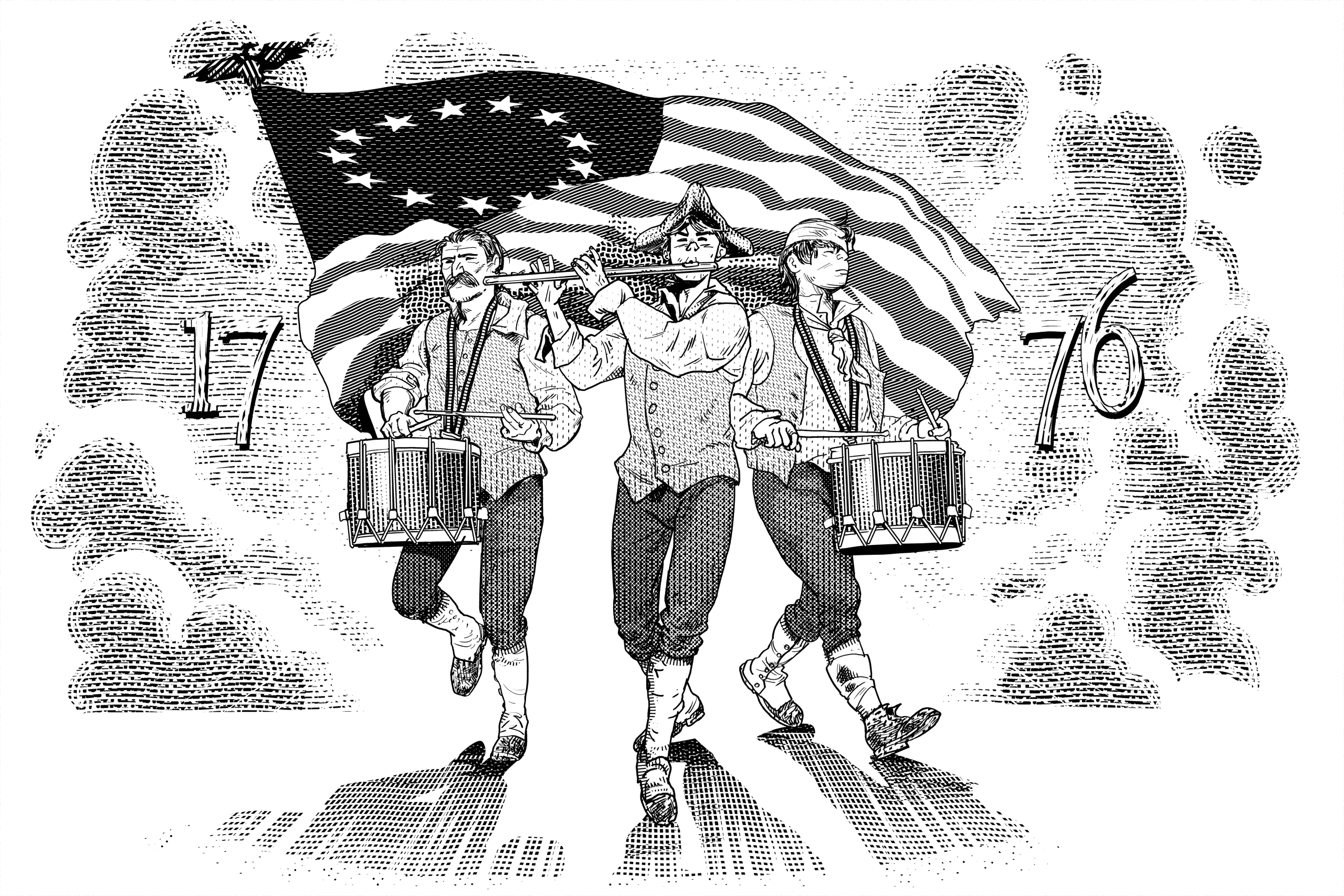
A tale of the heroic deeds of old from men of renown.
Editors’ Note
What follows is an excerpt from Justin Dyer’s book review, “Sacred Honor,” from the Summer 2026 issue of the Claremont Review of Books.
At two o’clock in the afternoon on August 17, 1858, Abraham Lincoln rose to address a crowd gathered at the Fulton County Courthouse in Lewistown, Illinois. He came to answer Senator Stephen Douglas, who had given a speech in Lewistown the day before. According to newspaper reports, Lincoln spoke for two and a half hours and had more listeners at the end of his remarks than when he began. The speech he delivered was not simply part of a campaign to challenge Douglas for the U.S. Senate seat. It was an act of recovery—an effort to recall the meaning of the American Founding at a moment when its principles were contested and under strain.
Lincoln spoke on that occasion of the evil of slavery existing in the American colonies when the Second Continental Congress adopted the Declaration of Independence in 1776. “These communities, by their representatives in Old Independence Hall,” he recounted,
said to the whole world of men: “We hold these truths to be self-evident: that all men are created equal; that they are endowed by their Creator with certain unalienable rights; that among these are life, liberty and the pursuit of happiness.” This was their majestic interpretation of the economy of the Universe. This was their lofty, and wise, and noble understanding of the justice of the Creator to His creatures. Yes, gentlemen, to all His creatures, to the whole great family of man. In their enlightened belief, nothing stamped with the Divine image and likeness was sent into the world to be trodden on, and degraded, and imbruted by its fellows.
***
A long excerpt from Lincoln’s speech at Lewistown supplies the epigraph for Matthew Spalding’s The Making of the American Mind: The Story of Our Declaration of Independence. The choice is apt. Written on the eve of the nation’s Semiquincentennial, Spalding’s book is itself an extended act of recovery, offering a wise, accessible account of the origins, meaning, and continuing significance of America’s founding document.
A longtime student of the founding and now Kirby Professor in Constitutional Government and Dean of the Van Andel Graduate School of Government at Hillsdale College, Spalding is clear about his undertaking. The Declaration, he argues, is the founding’s central act, articulating the principles that give the American experiment its coherence and legitimacy. Spalding’s project flows not just from love of country but from a conviction that “America is a good country, even a great country, perhaps the greatest, not because it is perfect—it is made up of imperfect human beings with original sin and their share of reoccurring wrongs—but because it is dedicated to, and constantly aspires to uphold, permanent principles about human liberty that are true.”
Spalding tells the story of “how in the summer of 1776 a band of iron men from thirteen separate colonies banded together and declared independence from—and declared war against—the most powerful nation in the world.” The Declaration is “the defining act of the great drama that is the American Founding,” he observes, and for Americans today the Declaration must remain central to civic education.
Spalding notes, with a nod to Saint Augustine, that we must know something before we can love it, and so we “must know the Declaration if we truly are to love America.” To know the Declaration, we must know its history, and Spalding gives an overview of the imperial crisis, canvassing the major players and the political disputes of the Stamp Act Congress, the colonial response to Parliament’s coercive acts, the convening of the First and Second Continental Congresses, the commissioning of George Washington as general of the Continental Army, and the debate over the drafting and adoption of the Declaration of Independence in the summer of 1776. The historical narrative is well-paced and provides the necessary context to consider the document’s meaning.
***
The Declaration’s meaning takes us beyond history to nature. Although the colonists often invoked their rights as British subjects, the ultimate ground of their claim was not in the contingencies of history but in the permanence of nature. “They were convinced their cause was just,” Spalding argues, “and informed—as we shall see—by permanent truths, just as they were themselves subject to eternal judgment for the rectitude of their intentions.” The founders’ frequent appeals to nature grew out of the classical natural law tradition, which was transmitted to the colonists through the Christian engagement with classical philosophy, and especially Cicero. This tradition was preserved among the Protestant Reformers and in the Anglicanism of Richard Hooker (in whom C.S. Lewis once claimed to have found the highest, most beautiful expression of the classical natural law tradition).
The 17th-century English political philosopher Thomas Hobbes rejected the classical tradition, but the Americans rejected Hobbes. Instead, they embraced the republican theorists among Hobbes’s contemporaries, especially Algernon Sidney and John Locke—both of whom invoked Hooker as an authority. Here Spalding is careful to note, for those who have ears to hear, that the Americans embraced an American Locke—read as a proponent of Christianity and natural law—without giving credence or paying much attention to his skeptical epistemology. The founders were not Lockeans, Spalding concludes, but they did adopt and use Locke’s “political arguments to great effect in their cause.”
Nor were many of the founders deists or pantheists. It is common in some academic circles to read the Declaration’s opening appeal to “the Laws of Nature and of Nature’s God” as a paean to religious skepticism, making God a distant and disinterested clockmaker, or conflating God and nature altogether. Yet as Spalding notes, the most widely read poem of the most popular poet in the colonies was Alexander Pope’s “Essay on Man,” which treats nature as a preamble to faith and speaks of a soul that “looks through Nature up to Nature’s God” and finally “knows, where faith, law, morals, all began / All end, in love of God, and love of man.” The duality between nature and nature’s God, creation and Creator, is part of the broadly ecumenical classical tradition. “It is unfathomable,” Spalding points out, “that a Congress that publicly prayed together and worshipped together (regularly attending different church services in Philadelphia) and issued proclamations calling for days of prayer and fasting would approve an anti-religious or even a purely secularized Declaration.”
Read the rest here.
The American Mind presents a range of perspectives. Views are writers’ own and do not necessarily represent those of The Claremont Institute.
The American Mind is a publication of the Claremont Institute, a non-profit 501(c)(3) organization, dedicated to restoring the principles of the American Founding to their rightful, preeminent authority in our national life. Interested in supporting our work? Gifts to the Claremont Institute are tax-deductible.
Suggested reading

We remain the beacon of ordered liberty for all mankind.
The official Republican vision of political power is so constrained that you have to wonder why they want it.
It’s illegal in theory and ineffective in practice.

The great self-evident truth of the Left.
Critical race theory was never designed to reveal truth—it was designed to achieve power.

