

No future awaits those who rage against family, work, and community.
Roots and Fables
A new illustrated collection gives Americans a mythology worth loving.
In a 2024 man-on-the-street-style video, two producers asked people from all over the country why they loved America. Most of the answers they received were laughable: interviewees claimed to love this country for reasons that had nothing to do with America itself, such as cultural diversity, the freedom to critique its past and present, or the ability to be whatever or whoever one chooses. In other words, Americans could find nothing positive to praise about their own country.
This grim video speaks not only to our confused cultural priorities but also to many Americans’ general ignorance, the latter in many ways being the source of the former. Life mimics art, or so the ancient philosophers of Western civilization believed: man imitates what he contemplates, often without willing it.
The solution to the problem of ignorance is not only to cut out bad teaching, but also to replace it with good. “Culture”—literally “to tend” in the agricultural sense—requires something to be cultivated: a positive tradition, typically of stories, poetry, and images. As we celebrate the 250th anniversary of the American Founding, it is an excellent time to reflect on the character of an American culture that can sustain free government.
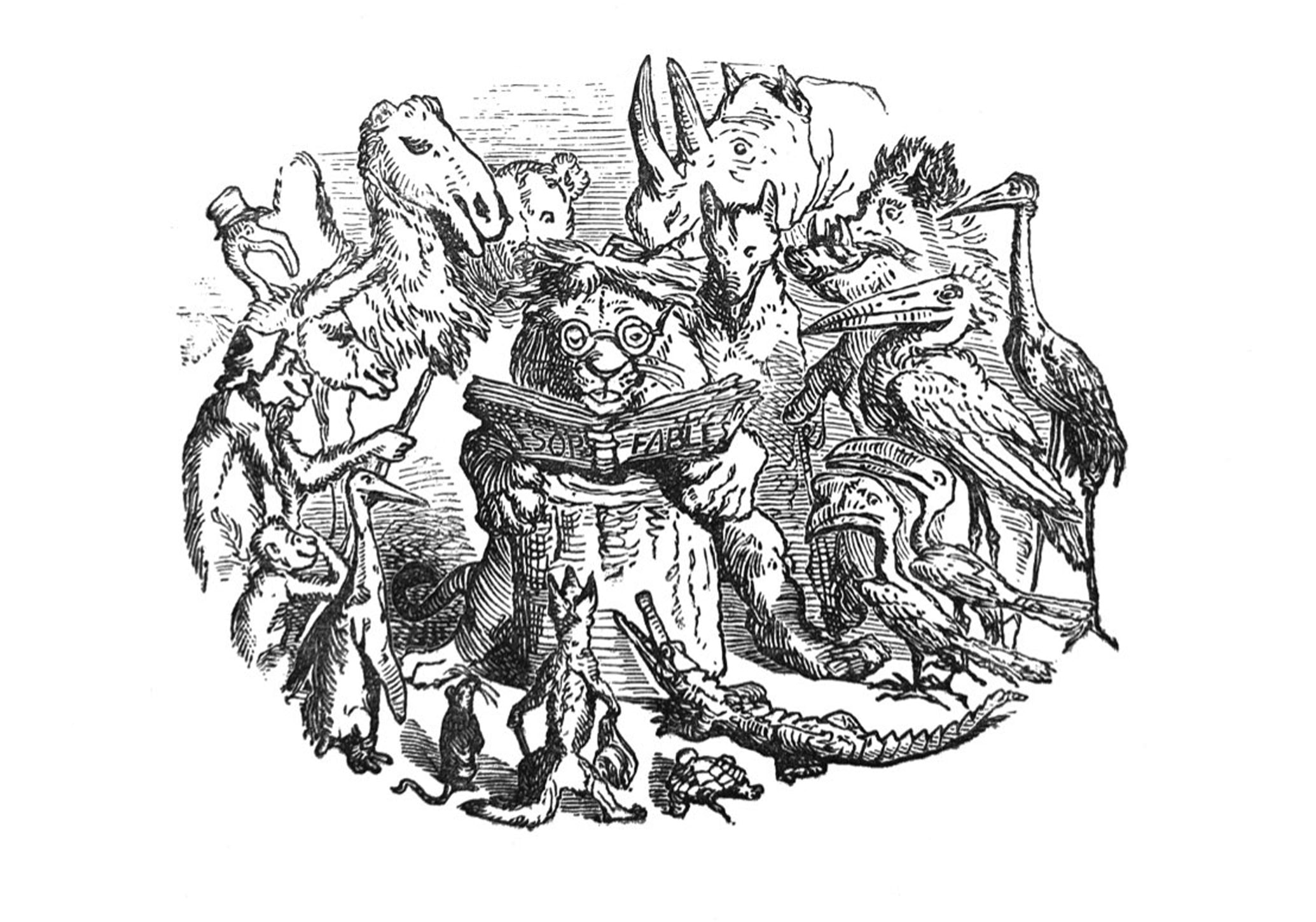
Matthew Mehan, associate dean and professor of government at Hillsdale College’s Washington, D.C. campus, has spent a lot of time thinking about culture as it relates to the imagination, writing multiple children’s books to this end. In his third and latest, The American Book of Fables, Mehan and illustrator John Folley take on the superhuman assignment of creating and collating an explicitly American cultural mythology. Drawing heavily from Aesop, Father Goose, and, more boldly, Cicero and early American historical documents including The Federalist, John Adams’s journals and letters, and various settler travelogues, the nearly 400-page color-illustrated volume consists of newly Americanized versions of classic fables and nursery rhymes, as well as original fables, fiction tales, and poetry, each labeled for a different age group: “Littles,” “Middles,” and “Bigs.” Accompanying the book are a number of resources for further study, most notably a downloadable American Almanac of Animals and a Grand Old Glossary.
The structure of the book could only have been conceived by a college professor. (Having been Mehan’s student, I can say this with great regard: here is a thoughtful man.) The American Book of Fables contains 13 chapters—a nod to the 13 original colonies—each assigned to a different geographic region, such as Appalachia, New England, or the West Coast. Throughout the book, each set of stories is selected to underscore a line from the Declaration of Independence, such that reading the book’s subheadings in order gives you the complete text of the nation’s founding document. Some, by necessity, cheat a bit to make this possible: Under the phrase “The history of the present King of Great Britain” lies the subsequent text on George III’s legal maneuverings, while “He has refused his assent to laws” does the same with the litany of “He has” clauses that comprise much of Jefferson’s argument.
With all this impressive structure, one might wonder whether the book is readable. With my three-year-old on one side and my one-year-old on the other, I opened it to the chapter on the Everglades. While my older child closely attended to Mehan’s recurring character Hugh Manatee, a philosophically minded mammal who travels the U.S. to find his way back home, my younger child preferred excerpts from Cicero. Boredom was nowhere in sight.
Perhaps most impressive is Mehan’s dedication to American natural history in selecting the creatures for his fables. Not only do the animals in each story correspond to the geographic region of the chapter to which they belong, but they were also selected to provide the reader with a complete taxonomy of the American frontier: “He found our American Book of Fables / where, taking pains to fill its gables / were every beast and bird portrayed / that America held when first surveyed.” One of these animals, a bull elephant seal, is cast as a robot on the coast of California, with his lines “written by Grok (mostly).” Hugh Manatee jousts with the AI seal at one point about the meaning and purpose of personality.
Those who are familiar with Mehan’s other works will not be surprised to find his political philosophy mingled with these tales.
One of his earlier children’s books, The Handsome Little Cygnet, published in 2021 around the peak of transgender ideological acceptance, carries a thinly veiled lesson about the destructive nature of attempting to change one’s very nature.
In The American Book of Fables, “The Cavefish and the Lead Miner’s Wife” dramatizes an argument often seen in debates over abortion. A lead miner digs a well in the groundwater below his property; when he finds a cavefish in the water, he plans to toss it into the brambles, but the cavefish begs to be spared, reminding the miner he keeps the water clean. “What do you think? Should we keep the little fella?” the lead miner asks his wife. “It’s our well, so it’s our choice.” Mehan’s lead miner’s wife disagrees: “It might be ours now, but it’ll be somebody else’s one day.” Like Aesop, Mehan ends almost all his fables with a moral—in this case, “Don’t look a gift horse in the mouth.”
It is the nature of fables to be didactic. This is both a strength and a weakness. Some critics of The Handsome Little Cygnet found Mehan’s message to be too blatant, though a great deal more readable than other “conservative” children’s books, and the same voices would likely take issue with The American Book of Fables. But subtlety, for all its virtues, is not the point here. A fable is primarily a morality play, with the answer written out in plain text at the conclusion, because virtue is not something about which children ever need ambiguity, least of all today. Mehan delivers not new morals, but old forgotten ones, the sort our grandparents used to feel no shame in repeating: “Before we go to battle, we ought to count the costs,” or “It is unwise to rule a country not your own.”
The question remains whether sincere consideration of the history of a place will awaken true affection for it. The diverse cast of creatures, long excerpts from explorers, and playful paintings of majestic landscapes all aim to revive respect for America and her history, a sort of consciousness-raising for the American way of life. Mehan seems to wrestle with this when he ends the book with one of several original poems, “American Morning,” which is about settlers: “If we could dredge the harbor and port the air / and send our ships abroad to make things fair…if we could do what our fathers did before, / then what on earth would we be grateful for?”
Americans no longer have a wild frontier to tame; instead, they should have gratitude for the ones who did. In Mehan’s work, these two things are not as opposite as they first appear, unless we take gratitude to mean mere mute appreciation. But if we take it to be something more—to require something of the grateful—we might recall the word “stewardship” and the phrase “to till and to keep.” As The American Book of Fables shows, America has no lack of original stories. What she requires, and what Mehan offers, is cultivation.
The American Mind presents a range of perspectives. Views are writers’ own and do not necessarily represent those of The Claremont Institute.
The American Mind is a publication of the Claremont Institute, a non-profit 501(c)(3) organization, dedicated to restoring the principles of the American Founding to their rightful, preeminent authority in our national life. Interested in supporting our work? Gifts to the Claremont Institute are tax-deductible.
Suggested reading

Say the word. Scare the establishment.
The Sunshine State’s education reforms are a model for the nation.

A golden age is within our grasp—but we must act now.

Scares and scars from the Oscars stars.

