

Libertarianism again fails natural right.
Justice Thomas: Courage in Defense of Natural Law Constitutionalism
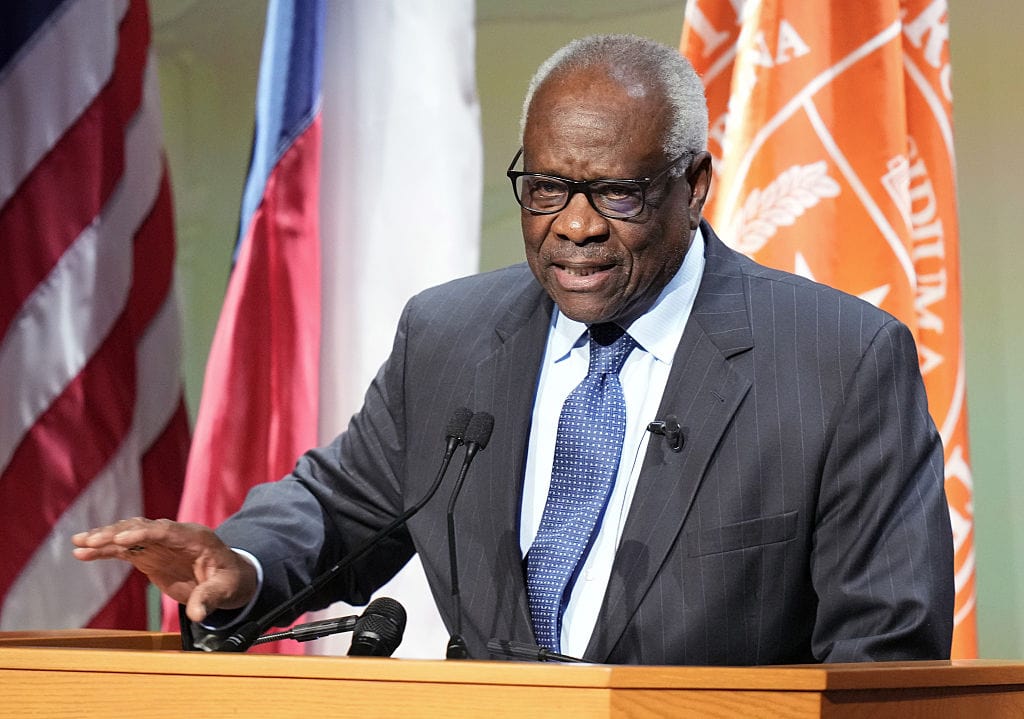
His speech deserves careful attention—and considerable praise.
Justice Clarence Thomas’s recent speech at the University of Texas was vintage Thomas: deeply reflective, historically grounded, and unapologetically devoted to first principles. At a moment when many public officials seek safety in ambiguity, Thomas instead offered moral clarity. He spoke not merely as a jurist, but as a statesman concerned with the long-term health of the American republic. In doing so, he echoed themes long championed by scholars associated with the Claremont Institute: the primacy of natural rights, the centrality of the Declaration of Independence, and the necessity of civic courage in preserving constitutional government.
Thomas’s remarks were particularly striking because they resisted the fashionable reduction of constitutional interpretation to technocratic expertise or evolving social consensus. Instead, he returned repeatedly to the enduring truths that undergird the American experiment. The Constitution, in Thomas’s telling, is not simply a procedural document or a malleable framework for administrative governance. It is the institutional embodiment of a moral and political philosophy rooted in the self-evident truths proclaimed in 1776.
This insistence on recovering the moral foundations of constitutionalism places Thomas squarely within the tradition of political thought cultivated by Claremont scholars over several decades. Figures such as Harry Jaffa, Thomas West, and William Allen have argued that the American Founding cannot be properly understood apart from the natural right principles articulated in the Declaration. The Constitution derives its legitimacy not from historical accident or mere democratic will, but from its grounding in the equal natural rights of all persons.
Thomas’s jurisprudence has long reflected this understanding. Unlike many modern judges who treat constitutional law as a balancing test among competing interests, he approaches the Constitution as a document with an ascertainable meaning anchored in enduring principles. His originalism is therefore not merely methodological—it is philosophical. It rests on the conviction that the founders believed certain truths about human nature and political authority to be universally valid.
That philosophical seriousness was evident throughout Thomas’s Texas speech. He warned against the erosion of institutional integrity and the growing tendency to subordinate constitutional limits to ideological expediency. Such warnings resonate powerfully today. Americans increasingly inhabit a political culture that prizes administrative efficiency over self-government and emotional grievance over civic responsibility. Thomas challenged this drift by reminding his audience that liberty requires restraint—not only from government officials but also from citizens themselves.
This, too, is a deeply Claremontian insight. Claremont scholars have consistently argued that republican self-government depends upon civic virtue. Free institutions cannot survive indefinitely among a people unwilling to exercise prudence, moderation, and moral responsibility. The administrative state, in this view, grows not simply because elites desire power, but because citizens gradually relinquish the burdens of self-rule.
Thomas’s own life story lends extraordinary credibility to these themes. He rose from poverty in segregated Georgia to the highest court in the land through discipline, perseverance, and intellectual independence. Yet unlike many public figures who emerge from hardship only to embrace fashionable orthodoxy, Thomas has retained a fierce commitment to personal responsibility and constitutional principle. He has repeatedly demonstrated a willingness to stand alone when necessary—a quality increasingly rare in contemporary public life.
Indeed, one of the most compelling aspects of Thomas’s speech was his emphasis on courage. He spoke candidly about the pressures facing judges, public servants, and citizens in an age of relentless political polarization and media intimidation. But he insisted that fidelity to principle must outweigh the desire for approval. Such courage, he suggested, is indispensable to constitutional government.
Here too the parallel with Claremont thought is unmistakable. Harry Jaffa famously argued that statesmanship requires moral courage rooted in an understanding of justice. Abraham Lincoln, perhaps the central figure in Claremont scholarship, exemplified this ideal through his steadfast defense of the Declaration’s principles against the moral relativism of his age. Thomas’s speech suggested that our own era demands similar fortitude. Constitutional government cannot endure if leaders lack the conviction to defend first principles against transient passions.
Critics often portray Thomas—and, for that matter, Claremont scholars—as nostalgic traditionalists seeking to resurrect an idealized past. But this caricature misses the deeper point. Neither Thomas nor Claremont advocates a simplistic return to the 18th century. Rather, they insist that the permanent truths underlying the American regime remain relevant precisely because human nature has not changed. Questions of justice, equality, liberty, and political legitimacy are not obsolete relics. They are perennial concerns of republican government.
Thomas’s remarks also offered an implicit rebuke to the increasingly dominant view that American institutions are irredeemably corrupt or fundamentally illegitimate. In recent years, much of elite discourse has portrayed the Founding as little more than a mask for oppression and exclusion. Thomas rejected this cynicism without ignoring America’s historical failures. Like Lincoln before him, he understands that the existence of injustice does not invalidate the principles by which injustice is condemned. On the contrary, the Declaration’s promise of equal natural rights supplied the moral standard by which slavery and segregation were ultimately defeated.
This point is essential. The American Founding contains within itself the resources for moral renewal. That has long been a cornerstone of Claremont scholarship, and Thomas’s speech reaffirmed that point powerfully. America’s principles do not require abandonment or reinvention. They require recovery and faithful application.
At a time when confidence in public institutions is collapsing, Thomas’s speech serves as a reminder that constitutionalism is not merely a legal arrangement but also a moral achievement. Self-government depends on citizens capable of understanding and defending the principles upon which their freedom rests. Courts alone cannot preserve the republic. Universities cannot preserve it. Political parties cannot preserve it. Ultimately, only a free and virtuous people can do so.
Justice Thomas’s address at the University of Texas was therefore more than a judicial reflection or academic lecture. It was a statesmanlike meditation on the condition of the American republic. By grounding constitutionalism in natural right principles and emphasizing the necessity of courage and civic virtue, Thomas articulated a vision strikingly consonant with the political thought of the Claremont Institute.
Whether one agrees with every aspect of that vision is beside the point. What cannot be denied is its seriousness. In an age dominated by ideological slogans, bureaucratic managerialism, and historical amnesia, Thomas offered something increasingly rare: a coherent defense of the American constitutional order rooted in first principles. For that alone, his speech deserves careful attention—and considerable praise.
The American Mind presents a range of perspectives. Views are writers’ own and do not necessarily represent those of The Claremont Institute.
The American Mind is a publication of the Claremont Institute, a non-profit 501(c)(3) organization, dedicated to restoring the principles of the American Founding to their rightful, preeminent authority in our national life. Interested in supporting our work? Gifts to the Claremont Institute are tax-deductible.
Suggested reading

Root, root, root for the electors. If they don't win it's a shame.

All hands on deck as we enter the counter-revolutionary moment.

Jack Smith’s case against Trump regarding his documents is unconstitutional.

Can it recover the separation of powers?

This Supreme Court term could be consequential.

