

Jack Smith’s indictments of Donald Trump are unconstitutional because he was already tried in the Senate.
In Support of Pete Hegseth
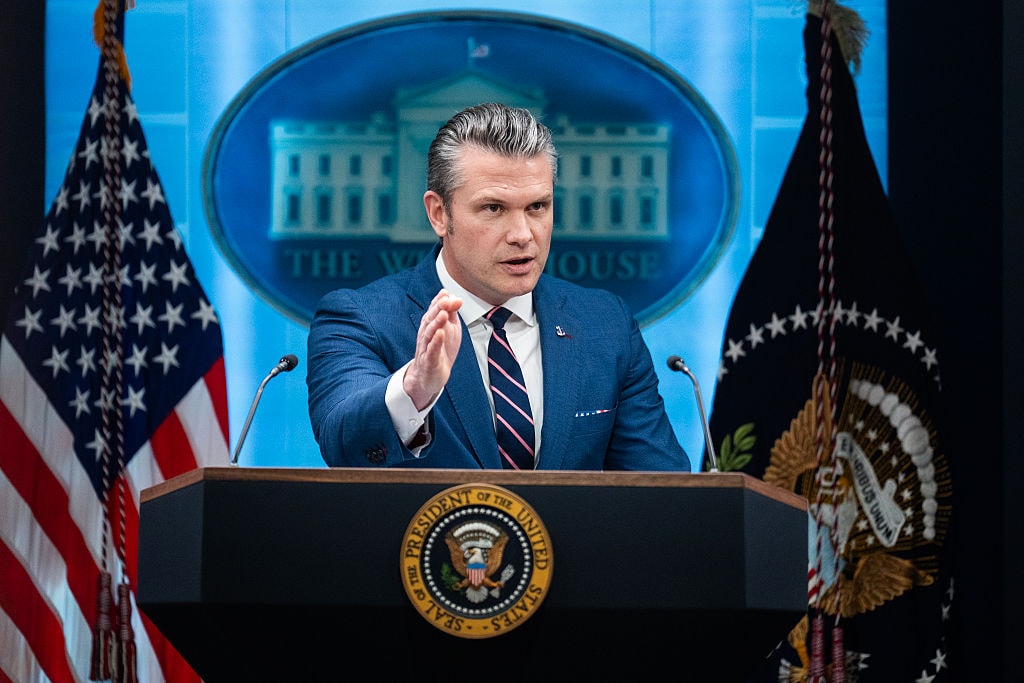
The secretary of war has done his job well.
Secretary of War Pete Hegseth is under attack from practically all sides. The Left has been after him since before his confirmation hearing. Some on the Right have likewise been lukewarm since Trump picked him, with interventionists hoping for one of their own such as Senator Tom Cotton, and restrainers wanting a candidate who aligns with their views. Throughout his tenure, the press has placed Hegseth under a magnifying glass, reporting on a long list of supposed controversies, which now includes his daring to fire generals and his willingness to carry out President Donald Trump’s orders in Iran. As the pressure has built, leaks against Hegseth, and even some calls for his firing, have begun to seep into the press.
President Trump should resist these efforts. Not only would firing Secretary Hegseth be a mistake, but doing so would undercut, and potentially even put an end to, his revolution against the uniparty.
Try, Try Again
President Trump faces a still-powerful military-industrial complex, as well as a hardened political establishment that backs it. He should learn from Andrew Jackson, both a former president and a political revolutionary, who came to understand how important it was to have loyal people around him.
The center of Jackson’s own political revolution was his war on the Second Bank of the United States, the symbolic and literal power center of the political establishment of his day. The bank’s president, Nicholas Biddle, lobbied congressmen into supporting it, with congressional victories being won on the back of financial contributions.
After years of seeking compromise in successive messages to Congress, Old Hickory finally had enough and vetoed the bank’s reauthorization. But its proponents had brought the reauthorization forward to make it an issue ahead of Jackson’s re-election campaign, a gambit that backfired spectacularly, as he won the election of 1832 in a landslide.
To eliminate the bank forever, Jackson developed a plan to remove its deposits and place them in state-run banks. Better still, Jackson was on firm legal ground: the law authorizing the bank allowed for such an action to be taken by the secretary of the treasury.
Jackson’s issue was that his treasury secretary, Louis McLane, told Jackson respectfully that he believed such an action went against the spirit of the law. Jackson promptly engaged in a cabinet shuffle, moving McLane to the State Department and bringing on a new treasury secretary, William Duane. But he was baffled to find that Duane also refused to remove the deposits, even going as far as to argue that the president had no authority to tell him how to run the Treasury Department. In a series of letters to Duane before he was fired, Jackson wrote that the bank had “forfeited [compromise] by the unjustifiable and high-handed manner in which its affairs have been administered.” Duane was promptly sacked, and Jackson’s fourth treasury secretary, Roger Taney, agreed to remove the deposits.
Trump should keep in mind Jackson’s persistence against the political establishment of his day—and the importance of having those around him who will carry out his agenda. Unfortunately, that was often not the case during his first term.
A Bad Turn
After his election in 2016, Trump found himself in a difficult position. His surprise victory represented a blow against the political establishment, but upon coming into office, he found that the old guard was still very much in command. New to having political power, like Jackson, Trump inadvertently picked cabinet officials who were more loyal to the establishment than to the American people who elected him.
James Mattis, Trump’s first secretary of defense, was one such individual. Mattis was lauded by the press and many on the Right as an upright, tough, and straightforward general. But he held secret meetings with other cabinet secretaries such as Secretary of State Rex Tillerson to blunt the president’s policies. Under his watch, Jim Jeffrey, Trump’s special envoy for the Global Coalition to Defeat ISIS, admitted to playing “shell games” with troop numbers in Syria. Mattis strongly opposed a range of Trump initiatives, and was so angered by the president’s decision to withdraw troops from Syria that he resigned over it.
All the while, the military was becoming more and more left-wing, a process accelerated by President Barack Obama’s firing of conservative military officials. We did not go from R. Lee Ermey to advertisements like the much-mocked “drone operator with two moms” by accident. They were the result of a sustained campaign to turn the military into a leftist propaganda machine. Mark Milley talking about “white rage” in 2021 was not a break in recent tradition—it was mainstream by that point.
If President Trump is going to be successful in overturning the political establishment of the United States, he cannot leave the military untouched. If the armed forces of the United States were functioning as they should—a military that defends America and destroys its enemies—there would be no need to recapture it. But it has been turned into a political weapon, and as such, it cannot be ignored.
Loyalty Above All
Which brings us to Pete Hegseth and his tenure as secretary of war. Since taking office, Hegseth has fired numerous high-ranking officers. Linda Fagan, the commandant of the United States Coast Guard, Lisa Franchetti, chief of naval operations, and others have seen their careers end early. He has also sought to undo Biden-era firings of soldiers who refused to take the COVID vaccine and has cut ties with woke universities, preferring to work with conservative schools like Liberty University. And Hegseth’s Pentagon has sought to follow through on President Trump’s call for Europe to do more by pulling back several hundred troops from Romania.
Those loyal to the old guard like former neoconservative Max Boot labeled these actions as evidence of “turmoil” and think that the Pentagon is being poorly run. But the opposite is the case. Remodeling a rotted-out house may seem loud—with lots of destruction, hammering, and noise—but it is a necessary restoration of order.
Hegseth’s willingness to attack progressive shibboleths is both exactly what he should be doing and why he is being attacked.
Another positive is that Hegseth is a civilian secretary of war without deep ties to the defense industry, a rarity as of late. While he saw combat, rather than joining the board of a weapons manufacturer, Hegseth became an advocate for veterans and took a gig at Fox News.
Contrast that with his three immediate predecessors, Lloyd Austin, Mark Esper, and James Mattis. All three served on boards or worked with defense contractors before or after running the Pentagon. If this seems like legalized corruption, it essentially is. These individuals were paid millions of dollars by the same companies they worked with as cabinet secretaries.
Hegseth is not a schemer who will backstab the president. Like Jackson with Taney, Trump picked Hegseth because he understood that Hegseth would faithfully carry out his orders.
If Hegseth eventually leaves of his own volition, so be it. There are of course other loyal potential successors. But he should not be forced out by an old guard furious that it has temporarily lost control of the Pentagon. Even those who do not agree with all of Hegseth’s policies should support him if they wish for Trump’s Jacksonian war against the uniparty to succeed.
The American Mind presents a range of perspectives. Views are writers’ own and do not necessarily represent those of The Claremont Institute.
The American Mind is a publication of the Claremont Institute, a non-profit 501(c)(3) organization, dedicated to restoring the principles of the American Founding to their rightful, preeminent authority in our national life. Interested in supporting our work? Gifts to the Claremont Institute are tax-deductible.
Suggested reading

Trump, Vance, and the coming conclusion of an entirely preventable war.

We celebrate the civilization he carried into the New World.
Jack Smith’s case against Trump regarding his documents is unconstitutional.

The positives and potential pitfalls of the Trump coalition’s approach.
Killing the Senate filibuster is key to passing the president’s agenda.

