

Kiev is desperate for the West to come to its rescue.
How the U.S. Depleted Its Arsenal
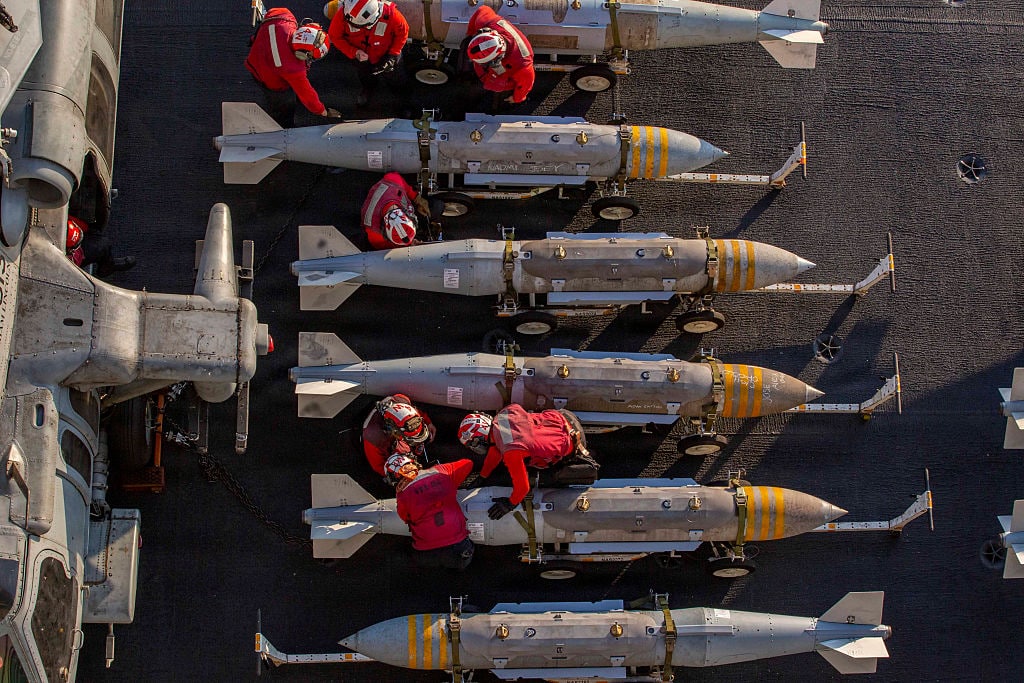
Operation Epic Fury has exposed the surprising state of our industrial defense base.
A little more than a week into the U.S.’s campaign against the Iranian regime—which the Pentagon classifies as a below peer level—Central Command is pulling interceptors from the Indo-Pacific to keep the defensive umbrella intact over the Persian Gulf.
How is this possible when every major strategy document of the 21st century promised that the United States military could handle what lay ahead?
The 2001 Quadrennial Defense Review, which replaced the Cold War two-war framework, pledged to “swiftly defeat” aggression in two theaters while winning decisively in one. The 2018 National Defense Strategy shifted the frame to Great Power competition, assuring Congress that the joint force could mount sufficient deterrence in three regions, fight and win one major conflict, and maintain the ability to deter a second. The 2022 National Defense Strategy introduced “integrated deterrence,” which described a force that could simultaneously address the “pacing threat” of China, the “acute threat” of Russia, and persistent challenges in the Middle East.
But in July 2024, the congressionally mandated Commission on the National Defense Strategy reviewed these assurances and delivered a unanimous verdict: the force-sizing construct was “inadequate,” the joint force was “at the breaking point,” and U.S. industrial production was “grossly inadequate” to sustain a major conflict.
The state of the U.S.’s arsenal was grossly oversold, and Operation Epic Fury now makes the scale of the shortfall impossible to ignore.
I am not arguing against the ongoing operation in Iran, for the tactical results speak for themselves. American and Israeli forces destroyed the Iranian Air Force and Navy. They killed the supreme leader, levelled his compound, and eliminated dozens of senior Iranian Revolutionary Guard Corps (IRGC) commanders and intelligence officials. Iran’s Foreign Ministry admitted that military units lost contact with central command and now operate on old general instructions. Secretary of War Pete Hegseth stated that Epic Fury delivered twice the air power of the “shock and awe” campaign in Iraq.
No serious observer questions American lethality. But questions should be asked about the arsenal behind that lethality, how it reached this state, and what the country must do to reconstitute it.
Two Decades of Malpractice
Responsibility for this failure spans multiple administrations and parties. For the better part of two decades, a bipartisan consensus treated the defense industrial base as a cost center rather than a strategic asset.
The neoconservative architects of the post-9/11 wars bear the first share of responsibility. They spent nearly 20 years and trillions of dollars on campaigns in Iraq and Afghanistan that consumed munitions, exhausted the force, and produced no durable strategic gains. The counterinsurgency fixation warped procurement priorities for a generation.
The Pentagon prepared for a war that demanded no deep magazines of precision-guided munitions or high-end interceptors, because the enemy had no air force. By the time the campaign against ISIS ended, the Pentagon had expended roughly 112,000 munitions and raided stores worldwide to sustain operations. Joint Direct Attack Munition inventories did not return to acceptable levels until 2021. When the joint force finally shifted its attention to Great Power competition after 2018, the industrial base had already atrophied. The factories did not exist. The production lines lacked funding. The skilled workforce had mostly retired, and the strategy documents continued to promise a force the budget never paid for.
The 2011 Budget Control Act then drained the Department of Defense of $1.17 trillion in purchasing power over the next decade. Pentagon leaders absorbed those cuts disproportionately in procurement to preserve research funding. That choice made sense in isolation—but it proved catastrophic. The Pentagon operated under continuing resolutions for 51 months between 2011 and 2024, and each month under a CR prohibited new production starts. Research budgets reached record levels while procurement accounts that would have sustained the industrial base went unfunded.
The Biden Administration inherited this depleted base and chose not to rebuild it. Every budget from FY2022 through FY2025 underfunded procurement relative to the strategy it claimed to support. Congress added between $37 and $45 billion above the president’s request each year because the request did not match the threat. The FY2025 budget requested zero new Tomahawks for the Navy. It cut Standard Missile-3 Block IB interceptor procurement from 153 over five years to zero, saving $1.9 billion on paper. The replacement, SM-3 Block IIA, stayed flat at 12 per year. SM-6 production held at 125 annually from 2017 through January 2025. Research and development spending grew by $21 billion from FY2022 to FY2023, while procurement grew by $13.5 billion. The Biden Pentagon watched Ukraine burn through stockpiles in real time and chose not to change course.
Biden’s Folly
Operation Epic Fury is now stress-testing the force that those two decades of malpractice produced. The results track with the procurement record.
The Navy maintains roughly 10,000 vertical launch cells across its surface fleet and submarine force, but it does not have enough missiles to fill all of them. Through 2023, the Navy procured approximately 12,000 SM-2s, 400 SM-3s, 1,500 SM-6s, and 9,000 Tomahawks across the full production histories of those systems. It expended at least 2,800 SMs and 2,900 Tomahawks over the same period. The Eisenhower Carrier Strike Group alone fired 155 SMs and 135 Tomahawks in a single Red Sea deployment against the Houthis. The Navy burned through more defensive missiles in 15 months against a non-state militia than it used in the three decades after Desert Storm.
Secretary of State Marco Rubio recently highlighted the interceptor disparity during testimony on Capitol Hill: Iran produces over 100 ballistic missiles per month; the United States builds six or seven THAAD interceptors in the same period. Standard military doctrine requires firing two interceptors per incoming target. Under that doctrine, monthly U.S. THAAD production can theoretically counter just three to four incoming ballistic missiles.
In June 2025, during the Twelve-Day War, the United States fired more than 150 THAAD interceptors while defending Israel, draining roughly 25% of the global stockpile in less than two weeks. The Biden Administration procured just 11 to 12 THAAD interceptors annually in its final budgets. At those rates, replacing what June consumed alone would take more than a decade.
The Drone Problem Nobody Solved
The ballistic missile shortfall dominates the public discussion, but the drone problem compounds it in ways the defense establishment has not addressed.
Iran fields thousands of one-way attack drones modeled on the Shahed series. Each one costs a fraction of the interceptor that can destroy it. A Patriot PAC-3 interceptor runs roughly $4 million, while an SM-6 costs $4.3 million. Meanwhile, an Iranian Shahed drone costs somewhere between $20,000 and $50,000. When a defender fires a $4 million missile at a $30,000 drone, the attacker wins the cost-exchange ratio by two orders of magnitude. Iran can produce and launch drones at a pace that exhausts defensive magazines regardless of whether those magazines start full.
The Navy discovered this problem during its Red Sea operations and adapted. Crews shifted to firing Sidewinder missiles and five-inch deck guns for drone defense rather than expending multimillion-dollar Standard Missiles on cheap Houthi unmanned aerial vehicles. That improvisation preserved interceptor stocks for the ballistic threats that demanded them. But it also exposed a gap that no strategy document has ever addressed: the United States does not field a scalable, cost-effective counter-drone capability sized for the threat volume that a state adversary can generate.
Directed energy and high-powered microwave systems represent the technological answer. Firms like Epirus have built portable platforms that can defeat drone swarms at a cost-per-shot measured in pennies rather than in millions. The Marines purchased early versions of these weapons, but these systems remain in limited fielding.
The Pentagon spent two decades buying weapons optimized for counterinsurgency and two more decades funding research on next-generation systems without producing them at scale. The drone threat that Iran demonstrates daily exposes the gap between the wars the neoconservatives chose to fight and the wars the defense establishment chose to study.
What the Next Weeks Hold
The campaign in Iran now enters a phase that will be defined by a single dynamic: the rate at which the combined U.S.-Israeli force destroys Iranian launch capability versus the rate at which coalition interceptor stocks deplete.
The Critical Threats Project at the American Enterprise Institute assessed on March 3 that the combined force has already destroyed approximately 300 Iranian launchers since the war began. Missile attacks against Israel and the UAE have declined sharply, and the air campaign against Iran’s launch infrastructure is producing results. Hegseth stated that the U.S. and Israel expect to obtain complete control of Iranian skies within days.
But several compounding factors could stretch the timeline beyond the four-to-five-week window the administration has outlined.
Succession Crisis. The IRGC named Mojtaba Khamenei as the Assembly of Experts’ successor. After Israel struck the Assembly session in Qom on March 3, Ali Larijani publicly rejected negotiations. Without centralized political authority, nobody in Iran can order a ceasefire. Decentralized IRGC units will continue firing from mobile launchers across Iran’s vast territory, extending the campaign and consuming interceptors with each salvo.
Regional Expansion. Iran struck U.S. bases across Kuwait, Bahrain, Qatar, and Iraq. A Kuwaiti F/A-18 shot down three American F-15Es in a friendly fire incident. Iranian drones knocked Amazon Web Services data centers in Bahrain and the UAE offline. An Iranian missile hit the U.S. Embassy in Kuwait. Israel launched a ground incursion into southern Lebanon while the Lebanese government banned Hezbollah’s military wing. Reports indicate that the CIA is working to arm Kurdish forces along the Iran-Iraq border. Each additional front consumes munitions and strategic bandwidth from a force already operating at the edge of its magazine depth.
The Strait of Hormuz. Twenty percent of global oil transits the strait, and tanker traffic has effectively been stopped. The White House has declined to commit to a reopening timeline but has ordered the Navy to escort tankers if necessary. Oil prices immediately spiked. The energy disruption raises costs across the defense industrial base at exactly the moment that base needs to surge. Rocket motors need energy, and machine shops need energy. The production ramp-up grows more expensive the longer the strait remains contested.
Ground Force. Iran spans a territory larger than Alaska and has a population of 88 million. Analysts at the Brookings Institution and elsewhere assess that U.S./Israeli airpower alone cannot achieve regime change. If the campaign’s political objectives outpace what airpower can deliver, pressure for ground deployment will grow. While it is hard to conceive of a meaningful commitment of ground forces, President Trump is keeping all options on the table. Historically, the gap between stated objectives and available means tends to expand in American wars, not contract. The neoconservative playbook of regime change by air followed by nation-building by improvisation should discipline the thinking of any policymaker tempted to widen the mission beyond what the current force can sustain.
China’s Gain
Every THAAD round fired over the Gulf subtracts from the force that deters in the Indo-Pacific. Every SM-3 expended defending the Fifth Fleet leaves one fewer available for the Taiwan Strait. The USS Abraham Lincoln Carrier Strike Group redeployed from East Asia to the Middle East. CENTCOM is already drawing on INDOPACOM stockpiles.
The Heritage Foundation warned in January 2026 that the People’s Liberation Army (PLA) could exhaust high-end interceptors within days of sustained combat, with some systems depleted after just two to three major salvos. Aggregate U.S. vertical launch system inventories, estimated at approximately 17,000 rounds, cannot support even one full fleet reload. Pier-side rearming introduces multi-week gaps.
China’s production capacity dwarfs Iran’s by orders of magnitude. While the U.S. can build six or seven interceptors a month, the corresponding capacities of the PLA are far superior. When a Reuters reporter asked China’s Foreign Ministry spokesperson directly whether Beijing might exploit American distraction to move on Taiwan, she declined to address the question. China held combined naval exercises with Iran, Russia, South Africa, and the UAE just weeks before the strikes. The country has also publicly stated its support for Iranian sovereignty while quietly pressuring Tehran to keep the Strait of Hormuz open for Chinese energy imports.
A single regional campaign against a sub-peer state now strains the force to its limits, which reveals the multi-war construct for what it always was: an aspiration disconnected from the industrial base and budget decisions that would have actualized it.
American Ingenuity
The units in the theater of operations are not waiting for the industrial base to catch up. They are improvising around the constraints that the defense establishment created.
CENTCOM has deployed $35,000 one-way attack drones in combat for the first time during Epic Fury. SpektreWorks LUCAS drones, modeled on Iran’s own Shahed design, have delivered strikes against Iranian targets at a fraction of the cost of a Tomahawk. Precision Strike Missiles saw their first operational use. The force is teaching itself in real time what doctrine should have codified years ago: cheap, autonomous, mass-producible systems change the cost calculus of modern warfare.
Translating that improvisation into formal doctrine and tying it to industrial capacity is now the central task.
The Trump Administration moved to sign framework agreements scaling THAAD production from 96 to 400 annually, quadrupling Tomahawk output, and pushing SM-6 past 500 per year. And Congress front-loaded $113 billion in modernization funding. Those moves addressed the right problems, but framework agreements do not equal contracts, contracts do not equal production lines, and production lines do not equal deliveries. The interceptors CENTCOM fires this week should have entered procurement in 2022 and 2023. They did not.
The deeper challenge sits below the contractor level. Roughly 3,000 precision machine shops across the U.S. fabricate 80 to 90% of the custom parts inside every interceptor, every cruise missile, and every autonomous system. The average lead machinist is in his mid-50s. Most of these shops run on manual processes with no digital connection to the primes (the top five defense contractors) above them or the Pentagon above that group. When a surge order hits, nobody sees the bottleneck until the production line stops. The single most critical constraint in the munitions supply chain remains solid rocket motors. Only a handful of qualified suppliers exist, a problem that procurement reviews identified in 2022. But the first serious capital investment did not arrive until April 2025.
Software-defined factories like Anduril’s Arsenal-1 in Ohio, designed to produce tens of thousands of autonomous systems annually, reached initial production last summer. AI-driven manufacturing platforms like Palantir’s Warp Speed now coordinate production scheduling across more than a dozen defense manufacturers. Automated precision machining firms have begun connecting sub-tier shops to the digital infrastructure that the primes already use. Directed energy companies now field counter-drone systems that defeat swarms at pennies per shot. These represent the beginning of an answer. Whether they scale fast enough depends entirely on whether the country treats the industrial base as the strategic asset it should always have been rather than the line item it chose to defer.
Reckoning Day
Operation Epic Fury validated American military lethality while simultaneously revealing that the magazine behind it cannot sustain a second front. The operation did not create the problem: two decades of deferred procurement, counterinsurgency distraction, institutional dishonesty about force capacity, and the bipartisan refusal to fund what the strategy documents promised created it.
The neoconservatives burned through stockpiles in wars that achieved nothing durable. Fiscal hawks gutted procurement accounts in the name of discipline while the national debt ballooned regardless. The Biden Pentagon inherited a depleted base and chose to prioritize research over production. Throughout, the strategy documents continued to promise capabilities, but the budget never delivered, insulating the defense establishment from accountability as the gap between rhetoric and reality widened.
The Trump Administration inherited the worst industrial hand any wartime president has held since the early months of Korea, when American troops fought with World War II leftovers because the postwar drawdown consumed the U.S. arsenal. The administration recognized the problem and moved to address it—the framework agreements, the supplemental funding, and the production commitments targeted the right shortfalls.
However, the underlying issue remains unchanged: a production base that received two decades of deferred investment cannot surge on command. The firms and policymakers who build the industrial architecture to close the gap between what the strategy promises and what the factory floor delivers will determine whether American military power remains a material fact. That effort should have started in 2021. It begins now because the operational consequences of further delay have become impossible to ignore.
The American Mind presents a range of perspectives. Views are writers’ own and do not necessarily represent those of The Claremont Institute.
The American Mind is a publication of the Claremont Institute, a non-profit 501(c)(3) organization, dedicated to restoring the principles of the American Founding to their rightful, preeminent authority in our national life. Interested in supporting our work? Gifts to the Claremont Institute are tax-deductible.
Suggested reading

The U.S. military has deteriorated to the point where it might not be able to win even one major battle, much less two simultaneously.

A recent publicity photo from the Navy tells us more than we wanted to know about military readiness.

Shattering the illusion of compliance.

Biden smugly refuses to preserve, protect, and defend the Constitution of the United States.

Preserving the rule of law, our Constitution, and our way of life.

