

Despite hostility from the Biden Administration, the report stands as a guiding light for future generations.
How an X Debate Reclaimed the First Amendment
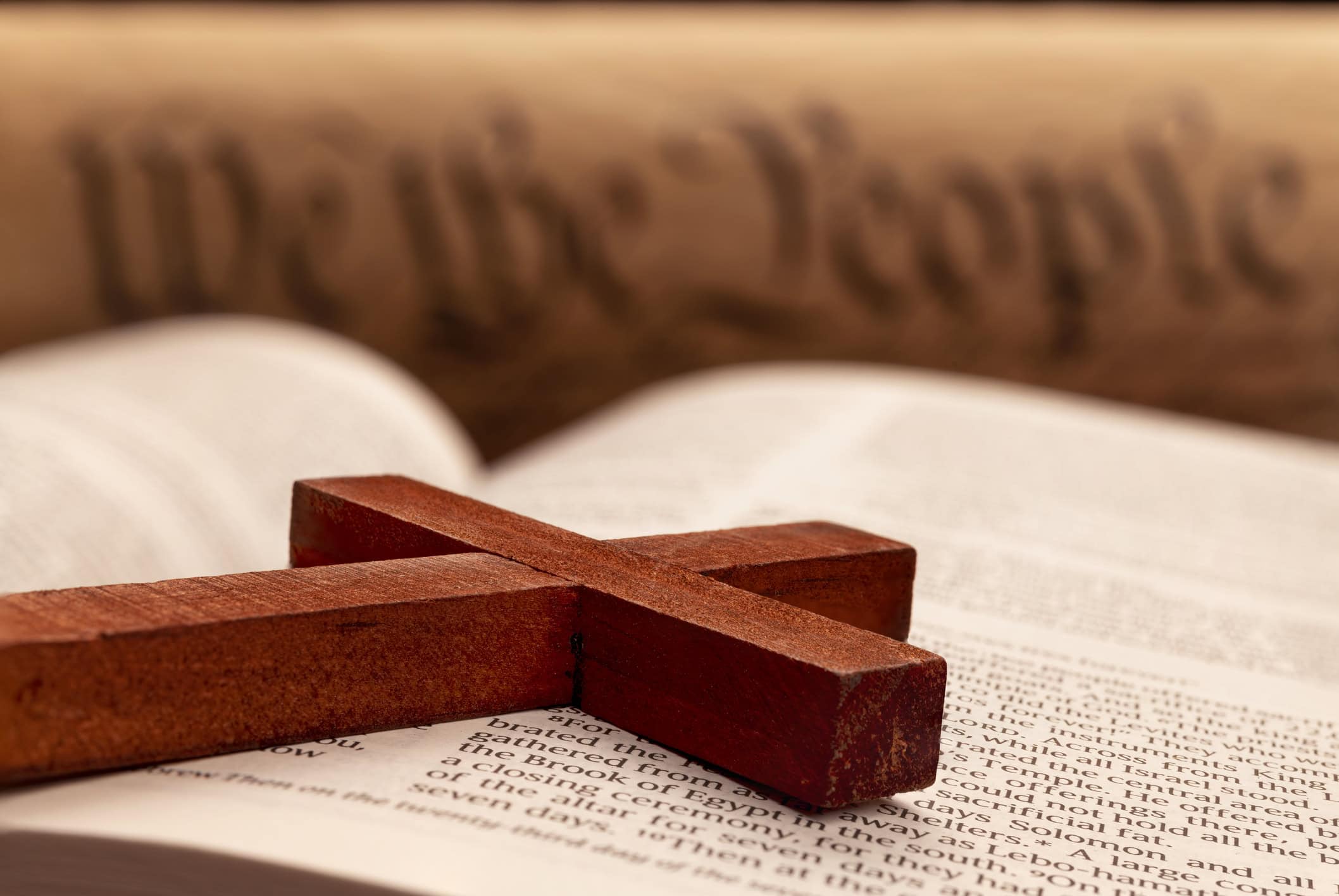
Americans have become rusty at arguing about religion in public.
When Defense Secretary Pete Hegseth and Pentagon officials briefly removed the Church of Jesus Christ of Latter-day Saints from a list of recognized faiths, Mormon commentators objected immediately, and evangelicals and Catholics jumped into the fray. The debate quickly outgrew the particulars of LDS doctrine and became a vigorous argument over the nature of God, the Trinity, revelation, authority, and the meaning of “Christian” itself. Though some of it was rude, much of it was insightful.
For many Americans, this felt unusual. We have grown accustomed to treating religious disagreement as something best kept away from the public square. But what happened on X revealed something important: Americans are increasingly willing to argue about religious truth in public again. That should be welcomed.
Most Americans assume that self-identification settles whether one is Christian—that anyone who claims to follow Jesus is a Christian. But what one means by “God” and “Jesus” matters more than just adopting a label. A group that worshipped the Flying Spaghetti Monster in Jesus’s name would not count as Christian.
Words have meanings, and categories have boundaries. The significance of the public debate on X was not about one side triumphing over the other—it was that Americans were arguing about first principles again.
Misunderstanding the First Amendment
For at least 70 years, Americans have been largely taught that the First Amendment protects only private religious observance, a Bizarro First Amendment that seeks to sideline the majority’s religion rather than to protect it.
Key Supreme Court cases such as Engel v. Vitale (1962) and Abington School District v. Schempp (1963) prohibited school-sponsored prayer and Bible reading, respectively. Whatever their legal merits, these decisions taught Americans that serious discussion of Christianity no longer belonged in public education. What disappeared was not dogma, but Christian dogma.
Earlier generations of Americans would have found this strange: the United States was filled with public theological disputes from its founding onward, in newspapers, pulpits, and town squares.
As Gerard Bradley argues in the Claremont Review of Books, American religion underwent a profound transformation after the founding. It increasingly came to be understood as a matter of private experience rather than objective truth. That trend reached a high point in Planned Parenthood v. Casey (1992), where the Supreme Court famously declared that “At the heart of liberty is the right to define one’s own concept of existence.” But if each individual determines his own meaning, all objective common ground between humans is lost.
By contrast, the founding fathers believed that religion is about truth and reality; it is not merely a subjective state of changeable feelings. They believed that God is real and that He created human nature and gave humans their rights. While they did not want the government to prefer one Christian denomination over all others, they did not want to exclude religion from government and society, because God the Creator is the cornerstone of republican government.
This is a truth of natural religion as well as revealed religion. Atheists possess the same natural rights as everyone else, but those rights do not depend on atheism being true.
As Bradley points out:
The right of religious liberty exists, then, precisely to enable everyone to perform an inalienable duty. This moral obligation to worship God is not solely a revealed truth. It is also the plain implication of natural religion: if (since) there is a creator God who continues to care for all there is according to a providential plan, it is fitting that creatures respond accordingly, by giving homage pleasing to that God, whom the founders often referred to as “the Great Governor of the Universe.”
A New Era
The Mormon-Christian controversy is a sign that America is finally emerging from what I call the Madalyn Murray O’Hair era. O’Hair, the founder of American Atheists, wanted not only to ensure that the government refrained from establishing a church but also that religion steadily retreated from public life altogether. Christians largely accepted the bargain: keep faith private, avoid hard questions, and no more prayer or the Ten Commandments in public schools.
But this arrangement never worked. Universities kept teaching comprehensive accounts of morality and human nature, but those accounts were now increasingly shaped by progressive and Marxist assumptions. Only one side stopped defending its worldview in public: conservative Christians. Neutrality never arrived; Christianity was simply sidelined while rival worldviews were taught and funded instead.
European colleagues have often pointed out an irony: students in many European countries receive far more formal instruction in the Bible than American students, yet those societies are among the most secular in the world. American public education avoids serious engagement with Christianity, yet most Americans still identify as Christian.
Throughout American history, faith survived not because institutions avoided religious questions but because Americans argued about them openly—in churches, schools, newspapers, and civic life. The First Great Awakening, the Calvinist-Arminian debates, the controversies over Catholicism, the disputes over modernism and fundamentalism, and movements like the LDS Church all reflect a society willing to wrestle publicly with competing truth claims.
What is historically unusual is not religious controversy but the expectation that it should disappear. These are arguments about the nature of reality. Without agreement about reality itself, there can be no lasting agreement about how to govern ourselves.
The revival of public religious argument is welcome, but debate alone isn’t sufficient. Contemporary Americans often treat conversation as the highest good. But the purpose of debate is to discover what is true, not to keep debating. A society that argues endlessly without reaching conclusions grows cynical; disagreement becomes entertainment, and argument becomes performance.
The founders did not believe truth was unknowable. They argued because they believed reality could be known and that public life should reflect those truths. The First Amendment was added to the Constitution because the founders believed open debate would help a free people pursue truth. They agreed that religion was indispensable to republican government: a free people needs moral formation, which requires an account of human nature, which naturally leads to questions about God.
Whether God exists, whether Christianity is true, or whether Mormonism and Catholicism worship the same God are not just matters of identity or entertainment. They have answers. Confucius taught that good government depends on the rectification of names—words must mean what they mean. The same applies to “Christian” and to every other contested word in our culture.
American citizens should debate these questions openly and vigorously. But the goal cannot be perpetual conversation; it must be truth. If the Madalyn Murray O’Hair era taught Americans to stay silent about ultimate questions, perhaps its passing will teach them to speak again.
The American Mind presents a range of perspectives. Views are writers’ own and do not necessarily represent those of The Claremont Institute.
The American Mind is a publication of the Claremont Institute, a non-profit 501(c)(3) organization, dedicated to restoring the principles of the American Founding to their rightful, preeminent authority in our national life. Interested in supporting our work? Gifts to the Claremont Institute are tax-deductible.
Suggested reading
A half-measure whose time may have come.
Hell is full of laws and due process is strictly observed.

A once-in-a-lifetime opportunity to downsize the bureaucracy.
How the world’s oldest functioning governing document was built to last.
Progressive posturing in NYC creates a standard of savage permission.

