

America’s unserious political class is totally unequipped to deal with the threat.
Our Revolutionary Constitution
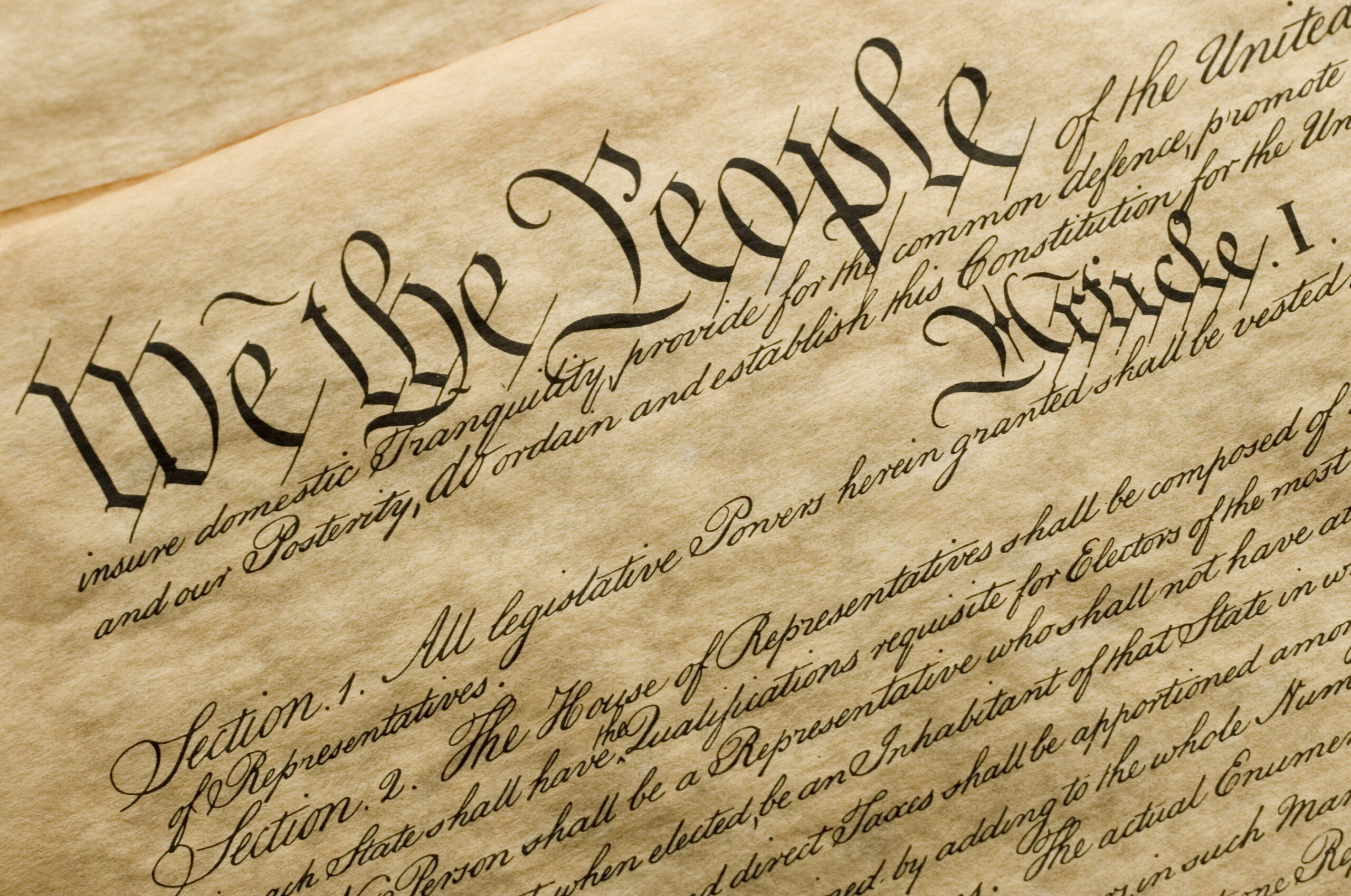
How the world’s oldest functioning governing document was built to last.
Editors’ Note
The following is an excerpt from Ilan Wurman’s book, The Constitution of 1789: A New Introduction, which will be published by Cambridge University Press on June 18.
The British constitutional system from which the American colonists separated in 1776 was not what Americans today understand as a written constitutional system. It was “unwritten”: There was no superintending written constitution that limited the power and controlled the acts of the legislature. In 18th-century Britain, Parliament was supreme. Whatever Parliament enacted with royal assent was the supreme law, which Parliament could always undo. “[T]he legislature, being in truth the sovereign power, is…of absolute authority,” William Blackstone wrote in his influential 18th-century Commentaries on the Laws of England. “[I]t acknowledges no superior upon earth.” “The power and jurisdiction of parliament…is so transcendent and absolute,” he reiterated, that Parliament “hath sovereign and uncontrollable authority in the making, confirming, enlarging, restraining, abrogating, repealing, reviving, and expounding of” all the laws of the realm.
Many of Britain’s constitutional principles were, however, written down. The Magna Carta of 1215, establishing principles of due process, is one example of how England’s (and later Britain’s) constitutional principles were reduced to writing. The Habeas Corpus Act of 1679; the Bill of Rights of 1689, enacted following the Glorious Revolution; and the Act of Settlement of 1701, granting lifetime tenure to judges, are other examples. Those writings contributed to a body of “constitutional law” because they were understood to derive from certain fixed principles and to advance fundamental ends. The system was unwritten principally in the sense that Parliament was the final arbiter of what those principles and ends were and could revise the constitutional rules at any time.
Because Parliament could always alter the British constitution, the term “constitution” was also understood as the arrangement of government institutions that happened to exist and the distribution of power among them. Blackstone described the British constitution as the distribution of power among the King, Lords, and Commons. But because Parliament could alter the institutional arrangements, there was no guarantee that those arrangements at any given time would advance liberty, the common good, or any of the other fundamental ends of civil government. “[I]f by any means a misgovernment should any way fall upon it [Parliament],” Blackstone wrote, “the subjects of this kingdom are left without all manner of remedy.”
Some Americans also thought of the constitution as did the English, as whatever arrangement and distribution of power happened to exist. Charles Inglis, an American Tory and royalist, argued in 1776 that the constitution was merely “that assemblage of laws, customs, and institutions, which form the general system; according to which the several powers of the state are distributed and their respective rights are secured to the different members of the community.” The historian Bernard Bailyn summarized this understanding: Parliament was “itself part of the constitution, not a creature of it.”
Americans saw the dangers of such an unwritten constitutional system in which the legislative power was supreme. The “heart” of the problem faced by the colonists in the 1760s, Bailyn has explained, was to determine in what sense the “‘constitution’ could be conceived of as a limitation on the power of lawmaking bodies.” The colonists were presented with “the continuing need, after 1764, to distinguish fundamentals from institutions and from the actions of government so that they might serve as limits and controls.”
This mode of thinking was not entirely new: Americans were steeped in 17th-century English constitutional thinking in which even Parliament was limited by prescriptive rules rooted in immemorial custom. The emerging 18th-century British constitution of legislative sovereignty and supremacy created an irreconcilable conflict between the older and this newer constitutional model, which led directly to the American Revolution. What was new, however, was the importance of establishing written constitutions as a solution to that conflict between those two constitutional models….
[T]he most important point settled by writing down America’s constitution was the conflict created between a constitution of customary practices and a competing constitution of legislative supremacy and sovereignty. A written constitution can commit customary constitutional principles to writing and make them binding on the legislature. The most important point that America’s written constitution “settled,” in other words, was that the people were sovereign.
***
[T]his old science of politics, this combination of small republics and a confederated league for matters of common defense, proved unworkable. Taxes and troops were the two most essential ingredients for fighting and winning the ongoing Revolutionary War; yet, because the Confederation Congress could only act through the individual states, it had to requisition such taxes and troops from the states. The confederated government thus had to rely on the states’ good graces to provide the money and the soldiers, and several states were not quite willing to pay their fair share. Between 1782 and 1789, Georgia did not make a single payment to the Confederation government. A single state, Rhode Island, thwarted the efforts of the twelve others to impose a minimal national impost tax to help finance the war, and other states also insisted on problematic conditions.
The central government was also unable to protect against domestic upheavals such as Shays’s Rebellion, a taxpayer revolt in Massachusetts. And Americans discovered that the states discriminated against one another’s commerce and engaged in other commercial rivalries, which not only hampered economic prosperity but also risked creating more violent encounters. The states also threatened the national honor, routinely passing legislation in violation of the 1783 peace treaty with Great Britain….
Because the Articles of Confederation was adopted by the legislatures of the several states, whenever there was a conflict between federal and state authority, naturally the states would tend to favor their own laws. Moreover…[a] league of states could be dissolved by any member of the compact.
***
One key feature of this new science of politics was therefore that the confederated portion of the government would itself be authorized and approved by the people themselves; it would not be a mere league of states from which any one could secede at any time. The second key innovation was that the laws enacted by the new national government would operate directly on the people themselves….
Although the national government would have the legitimacy that comes from the authority of the people themselves, and would operate on the people themselves, it would still retain a key feature of the old science of politics: Its powers would be limited to subjects requiring the common action of all the states. As Madison reminded his readers, “[I]f the government be national with regard to the operation of its powers, it changes its aspect again when we contemplate it in relation to the extent of its powers,” for “its jurisdiction extends to certain enumerated objects only, and leaves to the several States a residuary and inviolable sovereignty over all other objects.” “If the circumstances of our country are such as to demand a compound instead of a simple, a confederate instead of a sole, government,” Hamilton agreed, “the essential point which will remain to be adjusted will be to discriminate the objects, as far as it can be done, which shall appertain to the different provinces or departments of power.”
The key features of the new Constitution, then, were first that the national government would be limited to objects of common concern, as a confederated government would be. That national government, however, would be authorized by the people themselves, rather than the states as states, and that government would operate directly on the people. The Constitution, Madison thus summarized, is “neither wholly federal nor wholly national,” but rather “a composition of both.” By “national,” Madison meant those powers today associated with the federal government as opposed to the states, and by federal he meant the powers of the states. This combination of national and state power, each approved by and operating directly on the people themselves, but each limited to its respective sphere, is what the term federalism has come to mean.
Even though the national government would operate on the people themselves, the states as states would have an essential role in establishing the laws of the national government that would operate in this manner. The Great Compromise at the Constitutional Convention proposed a Senate in which each state would have equal suffrage and whose state legislatures would choose the senators to represent them—the first of which mechanisms the framers thought so important that they made it unamendable. The Senate, designed in this manner to represent the states, would have a say in passing national laws, in making treaties, and in approving executive appointments, allowing the states to exert their influence throughout the machinery of the national government. And the Supremacy Clause ensured that only national laws made “in Pursuance” of the Constitution—pursuant to the bicameral process, which required the Senate’s consent—would supersede contrary state laws.
These features marked the framers’ new science of politics. They would give the national government necessary energy and legitimacy, but only over certain objects. The national government would not operate through the states, but the states would exert their influence in the machinery of the national government. These features would ensure a robust common defense against foreign enemies, while simultaneously avoiding the defects of the Articles of Confederation but also preserving the importance of the states. They would solve the problems of the old science of politics.
***
It is not surprising that the Constitutional Convention settled on a separate and unitary executive department. The Convention did not settle on this course immediately. In the opening debate, James Wilson and Charles Pinckney moved that the executive consist in a single person. John Rutledge argued that a single executive “would feel the greatest responsibility and administer the public affairs best,” although, importantly, he was against giving the executive the historically royal prerogatives of war and peace. Wilson also “preferred a single magistrate, as giving most energy dispatch and responsibility to the office,” and generalized the point about royal powers; he “did not consider the Prerogatives of the British Monarch as a proper guide in defining the Executive powers.” Despite these assurances, Edmund Randolph argued that he opposed unity in the executive because “[h]e regarded it as the foetus of monarchy.”
James Madison then proposed to “fix the extent of Executive authority” – to settle on the executive’s powers—before “determining how far” such powers “might be safely entrusted to a single officer.” He moved and the Convention subsequently agreed that the executive have “power to carry into effect[] the national laws [and] to appoint to offices in cases not otherwise provided for.” This statement will become particularly relevant: It suggests that “the executive power” was understood to be only the power to execute law.
A few days later, the Convention resumed the question of a single executive and voted in favor, seven states to three. Wilson was reassuring: “All know that a single magistrate is not a King.” In addition to the “vigor” that a single magistrate would bring, it would avoid the “uncontrouled, continued, & violent animosities” that would occur among multiple executives sharing power. Roger Sherman pointed out that at least in the states, the constitutions affixed councils to the governors; but Wilson argued that a council would obscure responsibility and give cover for malpractices. Elbridge Gerry added that a three-member executive would be like “a general with three heads,” which would be “extremely inconvenient in many instances, particularly in military matters.” That appears to have clinched the argument, and the delegates then voted in favor of unity.
One might summarize the proceedings: The president was not to have the prerogative powers of the king. At least, those powers were not to serve as a guide. And if the president’s only power was to oversee the execution of the law and to appoint officers to assist in that task, the people could safely entrust the president with the necessary energy.
Nevertheless, delegates continued to worry about the potential for this energetic, unitary executive to develop into a monarchy.
***
The delegates had decided to fix the extent of the president’s authority before deciding on unity; and they determined that the only powers the executive should have were to carry into effect the national laws and to appoint officers to assist in that function. When the Committee of Detail produced its draft, however, the president had several additional powers; the reader will also recall that the committee enumerated Congress’s powers despite the sixth resolution of the Virginia Plan. It is now easy to see why. It is one thing to vest Congress with the legislative power, the president with the executive power to carry law into execution, and the courts with judicial power to adjudicate cases under existing law. But what was to be done with the historically royal prerogatives, such as those over war and peace, raising and regulating fleets and armies, regulating coin and commerce, and the like?
Particularly because many of these prerogatives were not obviously executive in nature—as Wilson said, the prerogatives were not a proper guide to executive power—these historic powers had to be enumerated and assigned somewhere. The Constitution assigns almost all of them to Congress. That may explain the enumeration, which, as noted previously, may have resulted more from a desire to check executive power than to curb the power of the states. The draft then also limited in various ways those prerogatives assigned to the president, for example, allowing the president to adjourn Congress only if the two houses could not agree on the matter. And it authorized the president to issue pardons, but not in cases of impeachment; and eventually the treaty and appointment powers would be shared with the Senate. This strongly suggests that the committee was faithful to the Convention’s desire carefully to circumscribe the president’s powers precisely because the president was to be a sole magistrate.
To summarize the problem at hand, and the Convention’s solution: Energy in the executive was of paramount importance. As Morris had argued, an extensive republic could not long persist without an executive power with sufficient energy to pervade throughout. The examples of weak state governors and a central government without an independent executive were stark demonstrations. That is why the Convention adopted an independent and unitary executive with minimal dissent. The problem with unity, however, was that it risked devolving into tyranny; a unitary executive was “the foetus of monarchy.” A unitary executive is not necessarily a monarch, but has the potential to develop into one.
The question thus became, how was the Convention to keep a unitary executive from becoming a monarch? The task, as Alexander Hamilton put it in both the Convention and The Federalist, was to give energy to the executive, but only “as far as republican principles will admit.” Or as Madison said after he observed the excesses of legislatures, “The preservation of Republican Govt. therefore required some expedient” to check the legislature, but “required evidently at the same time that in devising” such a check “the genuine principles of that form should be kept in view.” One recalls Madison’s similar statement in Federalist No. 10: The problem the Convention addressed overall was how to create “a republican remedy for the diseases most incident to republican government.” Here, unity in the executive was one important remedy; but the executive itself had to remain republican in form. This was to be accomplished through the mode of selection and through carefully circumscribing the president’s powers.
The American Mind presents a range of perspectives. Views are writers’ own and do not necessarily represent those of The Claremont Institute.
The American Mind is a publication of the Claremont Institute, a non-profit 501(c)(3) organization, dedicated to restoring the principles of the American Founding to their rightful, preeminent authority in our national life. Interested in supporting our work? Gifts to the Claremont Institute are tax-deductible.
Suggested reading


It’s keeping young families from owning homes.

Only American citizens should decide who governs them.

A response to Angelo Codevilla.

Too often, experts who are working to "save American democracy" are doing anything but.
Delegitimization of the justice system is a key step toward progressive domination.

