

Meet this moment, Mr. President, before it’s too late (and it’s almost too late)
France’s Long Slide
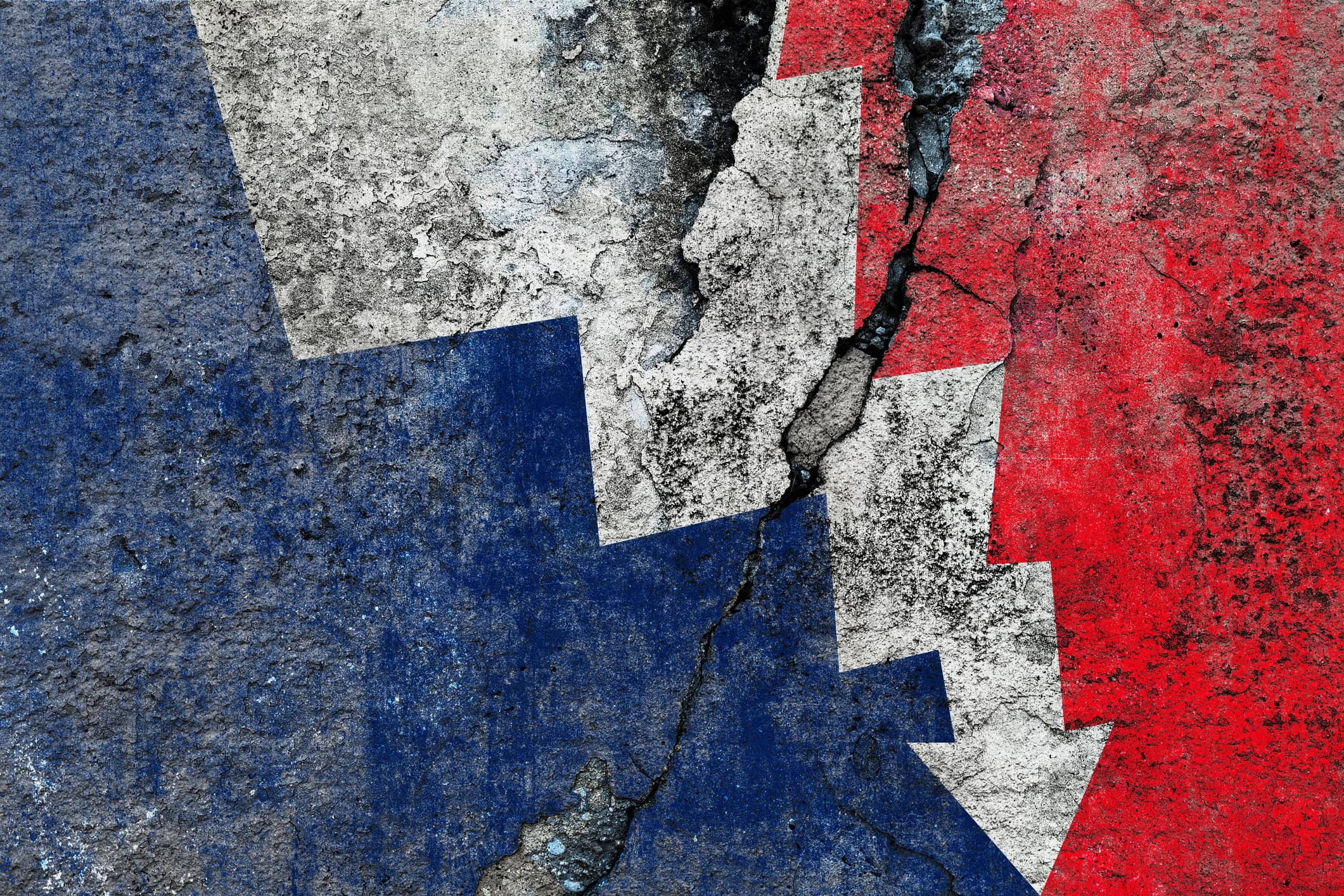
The slow-motion collapse of a great nation.
Editors’ Note
The following is an excerpt from Éric Zemmour’s book, The Suicide of France: The Quiet Revolution That Destroyed a Nation, which was translated by Nathan Pinkoski and will be published by Encounter Books on July 14.
France is in freefall. Industry, agriculture, public finances, trade, educational and cultural standards, health, scientific research—nothing is mastered any more, and everything is going downhill at high speed. The luxury-goods, defense, and aeronautics industries, along with wine and cereal crops, are the last islands of French excellence to survive in an ocean of mediocrity. The French people feel that they can no longer control their own destiny.
I often say that immigration is not the cause of anything, but it makes everything worse. It was collège unique and the methods of the pedagogists that destroyed the school. But the massive immigration of people from Arab-Muslim countries, most of whose parents have very little social capital and a dull hostility to French culture, has considerably accelerated the collapse of standards and violence. It was the 35-hour working week and bureaucracy that disrupted the hospital system. But the unlimited, free admission of patients from all over Africa overwhelmed and sank a French hospital system that 25 years ago was still recognized as the best in the world.
Violence is everywhere, haunting and distressing our fellow citizens. To understand what is happening to us, we need to go back to the concept of the “process of civilization” of Norbert Elias—the great German sociologist, one of the greatest of the 20th century, who analyzed the evolution of Western societies towards ever greater individual rationality, shepherded by ever more powerful and imperious states. This is what President Emmanuel Macron referred to in 2024 when he spoke of a “process of de-civilization” that would be at the root of the growing violence in France today. I think this is the wrong reference to make. What does the great German sociologist actually say? That France, her Church, and her kings have, over the centuries, transformed plundering, bawdy lords into refined, courteous courtiers, by teaching them self-control of their passions, impulses, and emotions. Over time, the bourgeois imitated the nobles and the people imitated the bourgeois. And all of Europe imitated the French. Europe, not the world. On the other side of the Mediterranean, in Arab-Muslim civilization, the process that Elias describes has never happened, and passions, impulses, emotions have continued to be suppressed by ferocious, brutal reprisals. When people who have learned to control themselves encounter, on the same soil, those who expect fierce and brutal reprisals that never come, it’s a safari for the latter, where the people who have undergone Elias’s “process of civilization” become game. Against them, anything goes. So there is no “process of de-civilization” of the entire French population, as the president of the Republic implies, but the explosive meeting on the same soil of two peoples who do not have the same history, the same mores, the same ways of regulating violence.
For a long time, the Left dismissed the debate by repeating peremptorily: “There is no insecurity, only a feeling of insecurity.” And for a long time, their opponents recoiled at this “denial of reality.” But we need to move beyond this conventional exchange. This “feeling of insecurity” haunts the daily lives of French people and ensures parents whose children are out on the town have sleepless nights. It forbids young girls to dress in short skirts when they go out in the evening in certain neighborhoods, terrorizes the old lady who no longer dares to put her jewelry on in the street, and spoils the outings of young people, never safe from encounters that turn into insults; “brawls,” as the media like to say, that turn into tragedies. And sometimes, more and more often, death comes at the end of it all: death by stabbing, death by machete, death after rape, the death of a French youth, most often by the blows of one of these “adolescents,” as the media discreetly call them, to conceal the fact that, more often than not, the culprits are from the Arab-Muslim immigrant community. These crimes, which are becoming more and more numerous, more and more frequent, more and more commonplace, are not random events, crimes of chance, but “francocides.” They are the murders of young people killed because they are “French,” “Gallic,” “whities”; in other words, young Christians or young Jews, young Whites.
For the French, it’s a recent and cruel discovery: the State, which shaped the country and now protects them from birth to death against all the risks of life, has turned against them.
Historically, France is undoubtedly one of the most “Hobbesian” nations in the world. The Monarchy, the Empire, then the Republic—all the regimes that have succeeded one another for over a thousand years—have made the State sacred, and accustomed the French to relying on its strength, even if it means giving up many of their freedoms. In France, the willingness to pay taxes is one of the highest in the world, which reassures our country’s foreign lenders. In France, unlike in America, there are no over-the-counter weapons.
Appalled and furious, the French are realizing that this glorious history is behind them. Their State no longer protects them. It has abandoned what it had built up over the centuries: its borders, the strength of its army and police force, the rigor of its justice system, the efficiency of its public services. Worse still, the State has turned against the French, with the taxman robbing them and the justice system looking on with the loving eyes of Chimène at the predators from across the Mediterranean who rob them, pillage them, rape their daughters, and kill their sons.
The State is too weakened to protect the French people, but it is still capable of punishing their alleged transgressions. The French are distraught and livid. If they still live in the “prince’s reflection” as Anatole France used to say, nobody embodies the prince anymore. Society (of individuals) has triumphed: it has enslaved the State by tying it down (with judges, the media) and disintegrated the people by depriving them of their national memory through deculturation, while shattering their unity through immigration.
The great historian Marc Bloch wrote a famous phrase to describe the “cold civil war” (sometimes hot) that had agitated our country since the French Revolution: “there are two categories of French people who will never understand the history of France: those who refuse to be moved by the memory of the coronation of Reims; and those who read without emotion the account of the Festival of the Federation.”
What would Bloch have to say today about the millions of French people, especially young people, who, through ignorance or rejection, are not moved by either event?
For decades, our elites, Right and Left, have served up Europe as the miracle draught for all our ills. Europe was “peace,” Europe was “strength through unity,” Europe was “protection,” Europe was “Greater France.” Over time, these slogans have melted like snow in the sun. War has returned to European soil; dissension and divergent interests have undermined European solidarity and weakened each of its countries; in the name of its free-trade ideology, the European Commission has offered the European continent to a triple imperialism of American technology, Chinese industry, and Islamic demography. France has left the role of continental hegemon to Germany, which, with its industrial power and rigorous management, leads the European Union through the false nose of the European Commission.
All the more reason for historian Pierre Gaxotte’s nostalgia: “Europe existed. It is now behind us. It was a civilizational community, and that civilization was French.”
For decades, across the two referendums of 1992 and 2005, Europe has divided France and the French people. This split between a federal Europe and national sovereignty was just one more confrontation in a country that has never stopped tearing itself apart throughout its history.
We are indeed the land of civil wars. Our entire history has been fraught with them, and it has been the specter haunting all of our governments over the centuries. When you read L’Identité de la France (The Identity of France) by the great historian Fernand Braudel, you can see why: France’s unity is endangered by excessive diversity. Diversity of languages, terroirs, family models, religions, and so on. The “France of 343 cheeses” that de Gaulle referred to is an amusing allegory of this existential anguish.
Braudel described France as the country where every time a foreigner attacks and invades, whoever that foreigner may be, there are Frenchmen who ally with him against other Frenchmen. It was Bishop Cauchon who gave Joan of Arc to the English to burn; it was Protestants and Catholics who called on German, English, and Spanish rulers to fight the French king’s army during the Wars of Religion. Every century has had its share of confrontations, right up to the Second World War, with the collaborators and the resistance, or the Algerian War, with the Front de libération nationale and the Organisation de l’armée secrète. Every century has its parti de l’étranger, the faction that serves the foreigner. Jean-Luc Mélenchon, by taking charge of the Islamo-leftist camp, is just the latest avatar. From Cauchon to Mélenchon, it’s the same French story all over again.
Our kings, our emperors, and our republics have all done their utmost to reduce this diversity in order to avoid the risk of civil war. Over the last 50 years, however, our reckless and ignorant elites have exalted diversity. In the United States, Vice President Dan Quayle gave the era’s definitive statement: “diversity is our strength.” In France, the Right, the Left, the entire political class has been chanting the same litany to the word. Not only have they failed to combat diversity, they have elevated it to a veritable religion, stigmatizing heretics, ostracizing them, and even having the courts condemn them. They are ignorant and criminally insane.
***
Over the years, I’ve matured this analysis and diagnosis, born of my observations, readings, and encounters. For a long time, I believed that a traditional politician would appropriate it to forge a project that would meet the existential challenges besetting our people. I waited in vain. In the end, I decided to throw myself into the furnace. The involvement of writers and intellectuals in the political battle is a very French tradition: Chateaubriand, Balzac, Hugo, Lamartine, Tocqueville, Thiers, Barrès, Maurras, Zola, Aragon, Malraux, Druon, and so many others have not hesitated to take part in intellectual and ideological life, to stand for election, to be a deputy, senator, or minister. It seemed to me that I could and should humbly follow in this prestigious lineage.
The 2022 presidential campaign was exciting and brutal. The immense hope that my candidacy aroused in many French people stunned the media and political bubble. The political class reacted violently to my unexpected intrusion. I won’t dwell here on the highs and lows of a rollercoaster ride of a campaign, the ups and downs of which I recounted in another book, Je n’ai pas dit mon dernier mot (I haven’t said my last word).
What I want to stress here is that my presidential candidacy shifted ideological lines. The existential anguish of the French people in the face of their disappearance is finally being taken seriously. The “great replacement” is no longer marginalized as a literary fad or a conspiracy theory. The French people’s desire to emancipate themselves from the State’s shackles, standards, and taxes, which enslave them without protecting them, is also recognized by all. Ideological victory has not led to political victory, but we know that it always takes time to move from one to the other.
We saw this in the United States. Trump’s unexpected success in the 2016 presidential election had caused nothing irreversible. Nobody was really ready: neither the candidate’s teams, nor the president. Nor, doubtless, the country itself. The triumph of 2024 has a completely different significance. The MAGA camp engaged in a veritable counterrevolution. A counterrevolution in the sense of the “Counter-Reformation” of the Council of Trent after the Protestant revolution. I don’t think the comparison is excessive. The revolution brought about by the Left in the 1960s tore America away from its age-old history, like a river diverted from its course. France, as we have seen in this book, followed exactly the same path in the 1970s. This revolution, which started in America, set fire to the whole of the West. It was therefore necessary for the counterrevolution to start from America too, if it is to have any chance of prevailing.
It was because I had for years been making the same diagnosis of the West’s ills, which has weakened all our countries, that I instinctively supported Trump’s campaign. In France, the party I have the honor of leading, Reconquête, was the only one in the French political class to clearly state its preferences and its joy at Trump’s victory.
It is indeed a historic event for an American government to combat both the migratory invasion and the ravages of wokism in universities and corporations. Trump is also trying to put an end to globalization. While it has served the interests of consumers and financiers, it has also led, particularly in the United States and France, to massive deindustrialization, causing unemployment and misery. It also led to the rise of a mighty China that no longer hides its ambition to take revenge on the “century of humiliations,” the 19th century, during which it was dominated, colonized, and butchered by the often arrogant, sometimes cruel Western powers.
On November 11, 2018, we celebrated the centenary of the armistice that put an end to the First World War. President Macron had invited Chancellor Merkel, alongside all our allies of the time, the British and Americans in the forefront, to speak of reconciliation, peace, and friendship between peoples, in particular between the two fierce enemies of yesterday, France and Germany. Prearranged speeches, heard a hundred times over. None of our leaders at the time nor any of the media commentators understood that with these ceremonies, the 20th century was being laid to rest. The 20th century was indeed Le Siècle de 1914 (The century of 1914), according to historian Dominique Venner’s great book. A long century determined by what Europeans had experienced during those four years. The appalling discovery of industrial warfare; the horror of the trenches amidst mud and rats; the mobilization of an entire youth, an entire people, an entire economy, and every mind; the “brutalization” of our societies, which like a drug would accustom peoples to muscular and even violent methods of government, making the bed of political regimes that were based on the “permanent mobilization” of men and peoples: fascism, Communism, Nazism.
In order to escape this curse of 1914, the 20th century was also the century in which liberal recipes, brought to the pinnacle and imposed by America, flourished: individualism, egalitarianism, feminism, antiracism, universalism, pacifism, borderlessness, consumerism; judicializing the relations between states and between the state and its citizens; collective security, international governance, and above all non-governmental organizations; the debasement of peoples, nations, and national sovereignties. For better or for worse, this is the world that emerged and strengthened throughout the 20th century. All the Western organizations created after the Second World War—the IMF, OECD, World Bank, U.N., and so on, under the aegis of the United States, were already on the drawing boards of President Wilson’s collaborators in Paris in 1919. These plans were not hard to rediscover: Roosevelt had been one of President Wilson’s advisors…
This world was prophesied in President Wilson’s famous speech after his reelection in 1916. It was midwifed by his old collaborator Roosevelt and his successors, both Democrats and Republicans, because it served the best interests of the American imperial republic. It has now fallen to another American president to bring this world to an end, and to forge a new one for the 21st century.
It was because I had understood, along with others, that the world that had emerged from 1914 was collapsing under its own contradictions, and that the remedies had become worse than the evils, that I wrote The Suicide of France. It was because I wanted to give my country a fighting chance that I ran for president in 2022.
The 21st century will be terrible: it will be a telluric mix between the 19th century and the Middle Ages. It will see the return of states, peoples, and nations, a confrontation between great powers, where “force takes precedence over law,” in Bismarck’s famous phrase, and where the game between European rivals, France, England, and Germany, will simply be extended to the whole world, with these new players: China, the United States, Russia, India, and Turkey. It will see the return of religious fanaticism carried out by Islam, as in the 7th century, with its cohort of violence, intolerance, sacrilege, and superstition; with tribalism, pillage, massacres, mass rape, obscurantism, and irrationality.
The time has come for every people, for every continent, to return to the very essence of their civilization. This is already happening all over the planet: Russians are rediscovering Orthodoxy and the tsars, even when they were Red; China is returning to the teachings of Confucius, India to Buddha, Islam to Mohammed and the Ummah, Turkey to the Koran and the Ottoman Empire. All of them are returning to their deepest identities in order to tear themselves away from Western universalism, which they experience—partly with good reason—as a dispossession, an illusion, a subjection. Only Europe and the West are slow to reclaim their roots, perverted as they are by a corrupted universalism and a poorly digested humanism. Paradoxically, this Western universalism, once the weapon of European imperialism, has now become its prison, even its deadly poison. In the United States, the Trump network, with Vice President JD Vance as its mouthpiece, no longer hesitates to proclaim the greatness of Western civilization, Jewish prophecy and Catholic majesty, Greek rationality and Roman law. Some European countries, often the smallest, in the east but also in the west of the continent, have understood the danger and are no longer deluded by the suicidal mirages of a nihilistic universalism. That leaves the great European nations, France, Germany, and England, who are the last to understand where the wind of renewal is blowing.
Through word and deed, I’m fighting with all my might to put France back at the heart of this struggle to return to our roots, to the roots of our Judeo-Christian and Greco-Roman identity, to our genius for freedom, rationality, and beauty.
The American Mind presents a range of perspectives. Views are writers’ own and do not necessarily represent those of The Claremont Institute.
The American Mind is a publication of the Claremont Institute, a non-profit 501(c)(3) organization, dedicated to restoring the principles of the American Founding to their rightful, preeminent authority in our national life. Interested in supporting our work? Gifts to the Claremont Institute are tax-deductible.
Suggested reading

Ireland’s leaders are inviting disaster.

The philosopher’s focus on citizenship is consistent with Donald Trump’s message.
We need to send them elsewhere.

The largest COVID fraud case yet reveals systemic blind spots.

The fight over Chick-fil-A makes it plain.

