

Mad crowds and pseudo-events wrack Barcelona.
Orbán’s Defeat in Hungary Exposes Rifts on the American Right
The Senate GOP establishment sides with the Left.
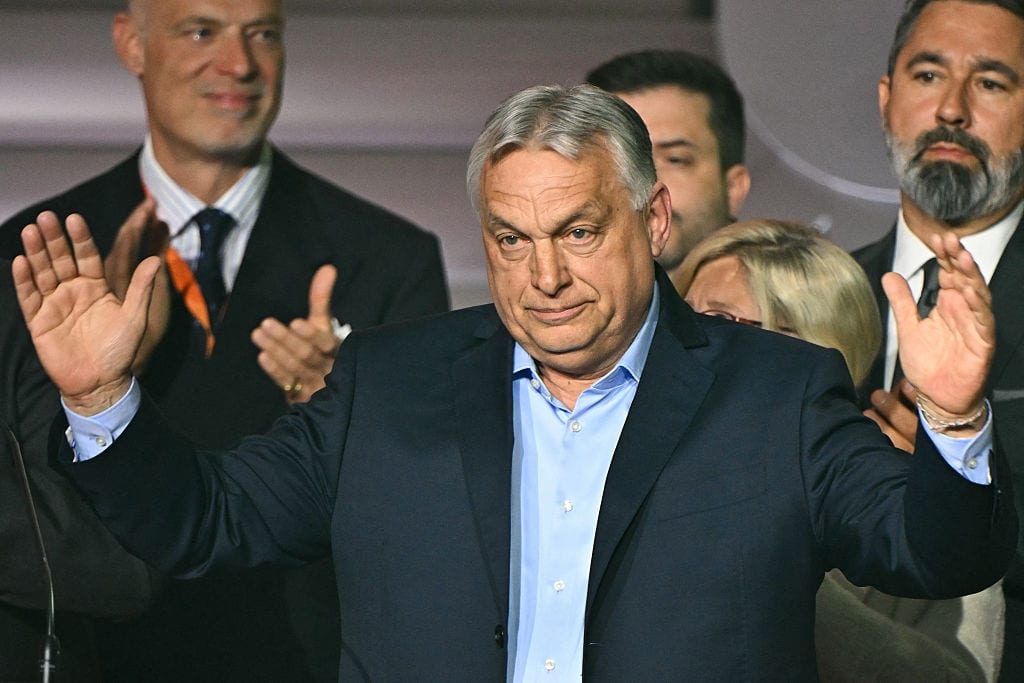
Hungary’s elections earlier this week marked a seismic shift after 16 years of Viktor Orbán’s dominance, as Peter Magyar’s opposition Tisza party won with over half the vote and a supermajority in the legislature.
The attention focused on this small Central European country may seem disproportionate—but Orbán attracted not only the active support of the Trump Administration, with Vice President Vance flying out to rally for him in person, but also equally strenuous opposition from the American Left and its allies in Brussels. In the wake of Orbán’s defeat, left-wing luminaries Hillary Clinton, Barack Obama, and Alex Soros (son of Hungarian native and Orbán arch-nemesis George and inheritor of his left-wing activist empire) were among those sending out celebratory tweets.
“We didn’t go because we expected Viktor Orban to cruise to an election victory,” Vance later told Fox News. “We went because it was the right thing to do to stand behind a person who had stood by us for a very long time.”
I have some personal familiarity with Hungary, having made two multi-week visits as a visiting fellow at the Danube Institute, a conservative think tank that was broadly aligned with (though occasionally critical of) Orbán’s government.
Despite my own support for Hungary’s national project under Orbán as a bold model for the global Right, I was hardly blind to its flaws, either then or now. I am not surprised that, at least for now, the Hungarian people sought new political leadership. For one, 16 years is a very long time for any one leader in a democratic system, and eventually voters will look for change. Helmut Kohl presided skillfully over German reunification before being bounced by voters in the late 1990s after 16 years in power.
Corruption and cronyism have also been ongoing problems in Hungary. While it is difficult to know whether it was really worse than in other post-Communist nations in Eastern Europe, given that the same folks pushing these critiques were the people falsely calling Hungary “autocratic” or a “dictatorship,” there is a public perception that Orbán tolerated significant corruption.
The Hungarian economy remained sluggish in recent years, as it lagged behind similar countries in growth. Its trajectory was not helped by the E.U. withholding tens of billions of dollars due to the Orbán government’s refusal to accept various bureaucratic diktats. High inflation was also a real problem. And yes, Hungary’s relationships with Russia and China were also legitimate concerns—one that the Trump Administration raised directly to the Hungarians, without making these issues the entire fulcrum of our relationship. And thus it was that Péter Magyar, a former senior member of Fidesz who ran on replicating much of Orbán’s nationalist program—particularly on immigration—while reducing Hungary’s isolation from the E.U. and cracking down on corruption, was able to triumph.
After his victory, Magyar noted his intention to continue Orbán’s firm immigration policies:
I will make it clear to the President of the European Commission and to all European leaders that Hungary will take a very strict stance on immigration and will not accept any pact or allocation mechanism of this kind, and furthermore we will keep the border fence reinforced and even plug the holes that are there now, because there are holes in that border fence, probably not by accident.
That Magyar campaigned as he did shows the depth of Orbán’s accomplishment in redefining the political debate in Hungary. If Magyar continues to take this approach, embracing the core of Orbán’s nationalist revolution while improving transparency and E.U. relations, he could govern quite successfully. But he will receive a lot of pressure to give in from the E.U. and domestic leftists in his coalition.
Attack of the GOP-e
What is more interesting for Americans than the domestic Hungarian political reasons for Orbán’s defeat are the deep fissures it has exposed on the Right. The old guard Senate GOP establishment, in particular, remains at war with an America First foreign policy. Despite Orbán’s strong support from President Trump, several leading Republican senators couldn’t resist publicly showing their disdain for Orbán. (For each one who spoke out, you can be sure that more Republican senators feel the same way but have chosen judicious silence.)
“Congratulations to Péter Magyar on his election as Hungary’s new leader,” wrote outgoing 65-year-old North Carolina Senator Thom Tillis on X. “This outcome underscores the power of democracy and NATO prevailing over the previous regime’s support for autocracy and Putin.”
Seventy-three-year-old Florida Senator Rick Scott, a member of the Foreign Relations Committee, tweeted that “The Hungarian people have chosen freedom by rejecting Putin and standing with their western allies here in the United States and in Europe.”
And 75-year-old Roger Wicker of Mississippi, chairman of the Senate Armed Services Committee, was equally blunt: “The freedom-loving people of Hungary have voted decisively in favor of democracy and the rule of law…. They’ve rejected the malign influence of Vladimir Putin, the world’s most malicious dictator and decided their own future.”
What is remarkable about all three tweets is that they are virtually identical to those released by Clinton, Obama, and Alex Soros. They didn’t just frame the election as a choice of policy on Russia versus Ukraine—contrary to all evidence of the election they had just witnessed—but as a question of “freedom” and “autocracy” versus “democracy.” It is an example of the uniparty in action.
Even worse was 84-year-old Mitch McConnell’s Fox News op-ed, appearing the day after the election, with a headline stating that Orbán’s loss is a “lesson” for the American Right. He argues that conservative admiration for Orbán is based on a “myth,” as Orbán offers only a cautionary tale, not a political model.
What really angers McConnell and his colleagues is Orbán’s lack of support for the Ukraine War, an obsession among the establishment that has not abated. The senior citizen senators seemed trapped in an intellectual time warp, simply unable to understand that Russia, while an adversary of America and the unquestioned aggressor in Ukraine, is not the Soviet Union in either its goals or its power. Contrary to their assumptions, our relationship with Russia should not be viewed through a Cold War-era lens, nor should another country’s position on the war in Ukraine be considered the sole determinant of our strategic relationship with that country.
The most revealing statement of the GOP establishment mindset occurs toward the end of McConnell’s op-ed, when he notes that “to the extent that what happens in Hungary matters to America, it is a question of whether its actions on the world stage—not its social policies—align with America’s strategic interests.”
At first glance, this sounds like common sense. Certainly, America’s strategic interests must come first in its relationship with any country. That is literally what it means to be America First. But the question is how one defines strategic importance for a small European country like Hungary that has relatively little military or economic weight to throw around.
Was it in our strategic interest to have a right-wing and nationalist European partner aggressively asserting its sovereign rights over left-wing bureaucrats in Brussels?
Was it in our strategic interest to have a European partner pushing unabashed pro-family social conservatism against pressure and fines from Brussels?
And most importantly, was it in our strategic interest to have a European country effectively standing up (as it did alone for years) against the Brussels open borders regime and the replacement of the European population with culturally incompatible foreigners?
To McConnell and other establishment senators, these are minor issues because they ultimately don’t care about them, even though they determine the fundamental character and destiny of all countries. McConnell and his colleagues are globalists, and therefore see the world only as a geopolitical chessboard. America could be totally demographically and culturally transformed—but as long as we keep sending enough dollars to Zelensky, our geriatric Senate Russia hawks will be happy.
McConnell’s references to “illiberal court-packing,” “[f]awning servitude to authoritarians,” and Hungary offering “little in the way of strategic alignment, let alone ‘moral cooperation,’” are identical to the talking points issued by the establishment Left. It underscores McConnell’s failure to appreciate one of Orbán’s greatest accomplishments: steering non-governmental institutions of society toward right-wing ends.
Orbán understood how to wield power legally—a virtue that has been absent from the GOP for decades (this is why Republicans are so ineffective even when they win). He used legal powers and ruthless, but constitutional, means to tame Hungary’s left-wing judiciary in ways McConnell would never dream of.
The Senate GOP establishment’s anti-Orbán broadsides are also notable because Orbán was the only European leader who endorsed Donald Trump in 2016, and he stuck with him through thick and thin in the ensuing decade. That sort of support should engender fondness for any leader—and would indicate, at the very least, that one might offer some gracious comments in his direction after his defeat. Unless, of course, you hate Trump and the voters he represents—as these senators seem to—and therefore see Orbán’s support of Trump as one more black mark against Orbán.
Alive and Kicking
In immediately conceding defeat, Viktor Orbán demonstrated the very democratic values his GOP critics claimed he threatened. They concede the Left’s premise that strong nationalist leaders like Orbán are inherently anti-democratic, because all of them ultimately agree with the Left’s worldview, including a belief that it is fundamentally “undemocratic” to aggressively challenge leftist control of powerful non-governmental organizations. Meanwhile, Budapest still looks European, and minorities such as Jews can walk freely on the streets without fear of violence—which is not the case in large parts of Paris and London. But for the GOP establishment, none of that matters.
Trump’s 2024 victory rested on voters demanding sovereignty, border security, and skepticism of endless foreign entanglements—precisely the instincts Orbán operationalized in Hungary. When McConnell urges the Right to learn the “lesson” of Hungary, he is really urging a return to pre-Trump Republicanism: muscular internationalism abroad and cultural weakness and demographic replacement at home.
Orbán is proof that even a small nation can defend its borders, its families, and its sovereignty against elite consensus. For American conservatives confronting their own demographic and cultural challenges, Orbán’s model—flawed yet instructive—offers lessons in statecraft that transcend any single election result, which is why so many conservatives flocked to Budapest during his time in office.
Without Orbán, we would likely have no Marine Le Pen, Jordan Bardella, AfD, Giorgia Meloni, or other rising nationalist leaders and parties in Europe that might set their nations on a more positive course. Whatever his flaws, Orbán showed right-wing nationalists the art of the possible. And that alone has a great deal of strategic value.
In the end, McConnell is correct that Hungary itself is a small player in the realm of geopolitics. But the GOP establishment’s reactions to Orbán’s defeat show that the failed pre-Trump consensus is still alive and well in the Senate GOP.
And that is very concerning indeed.
The American Mind presents a range of perspectives. Views are writers’ own and do not necessarily represent those of The Claremont Institute.
The American Mind is a publication of the Claremont Institute, a non-profit 501(c)(3) organization, dedicated to restoring the principles of the American Founding to their rightful, preeminent authority in our national life. Interested in supporting our work? Gifts to the Claremont Institute are tax-deductible.
Suggested reading


Teaching the world the value of liberty.

Trump’s call to end birthright citizenship is a necessary corrective.

The recent elections reflect broad dissatisfaction with the loss of national and cultural sovereignty.

Jean Raspail’s The Camp of the Saints should be required reading.

Empathetic immigration policies put our country at great risk.

