

The great self-evident truth of the Left.
Blood, Soil, Creed—and the Immunities of American Citizenship
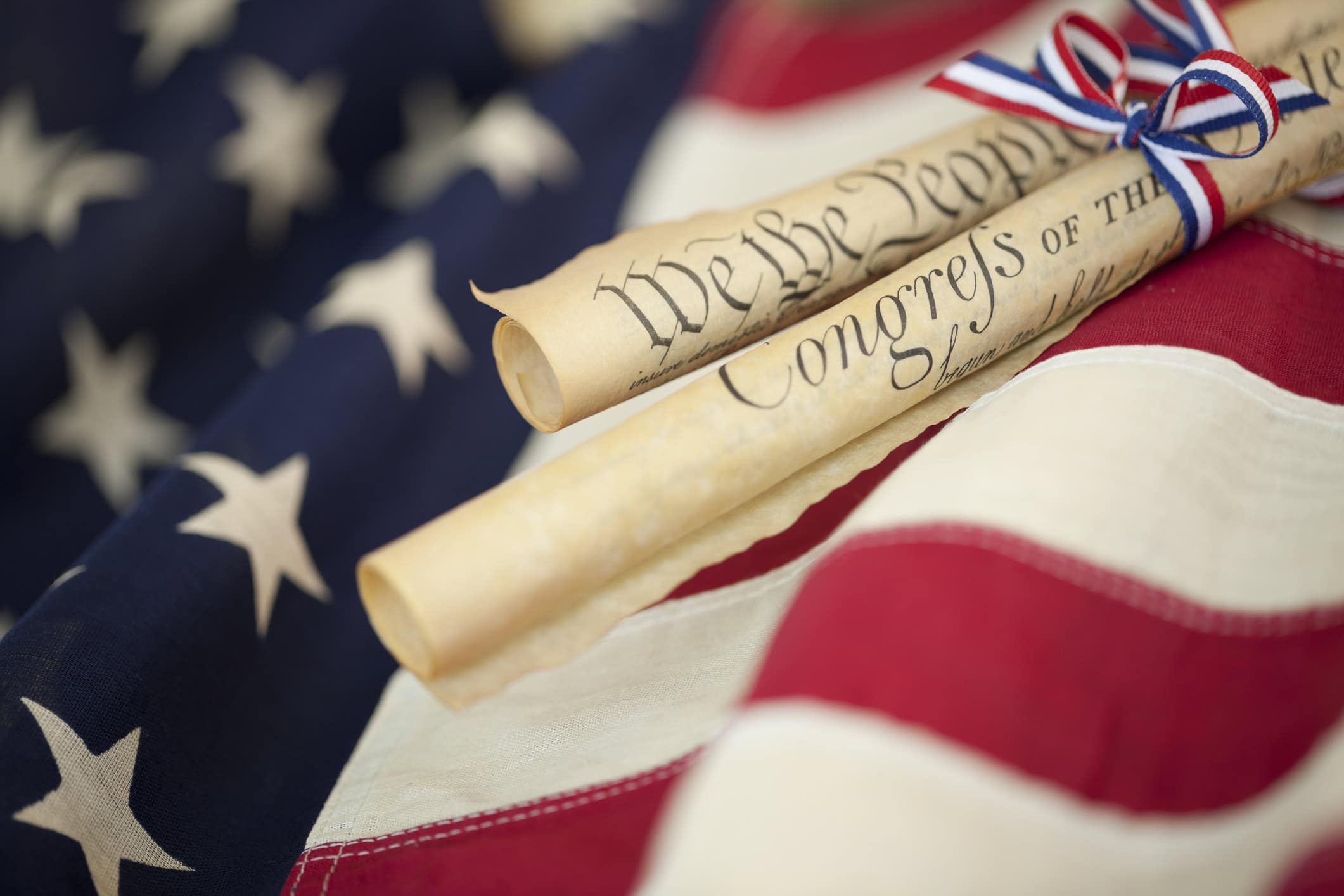
The original meaning of the Privileges or Immunities Clause.
Editors’ Note
The following essay is adapted from David R. Upham’s Taking American Citizenship Seriously: The Recovery of the Fourteenth Amendment (Bloomsbury Academic, an imprint of Bloomsbury Publishing Inc.), which is available now.
Though scholarship surrounding the Constitution’s 14th Amendment has generated much controversy, it has nonetheless established one stable point of consensus. Since its adoption, virtually all authorities have agreed that its first section bars state laws that impose a racially defined fiscal or regulatory burden on American citizens. The states cannot, for instance, establish any “black code” or “white tax.”
At the same time, there has been remarkable dissensus as to three closely related matters. First, precisely what provision of that amendment—whether the Privileges or Immunities, Due Process, or Equal Protection Clauses—establishes this prohibition? Second, what other discriminations besides race are forbidden? And third, does the ban on discriminatory burdens extend to benefits, such that the 14th Amendment bars discriminatory public expenditures (educational segregation, affirmative action, etc.) as well as discriminatory taxes?
The In-munia of American Citizenship
As to the first question, the conventional answer—the Equal Protection Clause—is simply not persuasive. As many have pointed out, by its text and original understanding, that provision does not bar unequal laws but unequal enforcement—the discriminatory refusal to provide one legal benefit: the protection of the laws: no state shall “deny to any person within its jurisdiction the equal protection of the laws.” The evil to be redressed was the lawless violence resulting from the systemic refusal of Southern white officials to protect freedmen, unionists, and Northerners against such crimes as murder, arson, theft, etc.
Rather, from an originalist standpoint, the answer is almost certainly the Privileges or Immunities Clause. That provision bars the states from making certain “laws” that abridge certain “immunities” (from the Latin in + munia) and consequently bars laws that impose certain munia (taxes, burdens).
The 14th Amendment’s chief author, Ohio Senator John Bingham, clarified that the “immunities of citizens” meant “exemption from unequal burdens.” Consequently, during its adoption, participants usually treated the Privileges or Immunities Clause as the primary constitutional corollary to the statutory, racial-equality mandates of the Civil Rights Act of 1866. Moreover, in the decade after ratification, it was this clause rather than the Equal Protection Clause that served as the basis for constitutional challenges to laws mandating racial segregation in marriage and education.
Forbidden Inequalities
The 14th Amendment does not nullify all unequal burdens. All laws imposing burdens discriminate on countless bases. Our tax and criminal codes are replete with classifications, many of which are (arguably) grossly unjust or imprudent.
We can refine our inquiry: we are seeking a certain type of immunity—the immunities of citizenship. We can therefore set aside the immunities of alienage (for example, against liability for treason) or the immunities of humanity (for example, against arbitrary coercion). Our goal is to identify those unequal burdens whereby a citizen is treated like an alien, what we might call the burdens (or badges) of alienage.
What unequal burdens besides racial discrimination, represent such badges of alienage? The contemporaneous discussion of the 14th Amendment points to an answer. Across thousands of pages of discussion, officials seemed to identify only three illegitimate bases for imposing a burden on the citizen.
First, officials mentioned hereditary classifications. Of these, racial discrimination was the amendment’s principal target. More precisely, the immediate evil to redress was hereditary discrimination against the African freedmen and their descendants. The freedmen, markedly distinct by color, had been subject to hereditary servitude and alienage. Therefore, to secure these citizens’ rights against the badges of alienage, the 14th Amendment would bar “discrimination…because of race, color, or previous condition of [hereditary] servitude,” to use the formula initially adopted by the joint committee.
According to some proponents, the ultimate version of Section 1 likewise barred any “regard” or “reference” to race. Louisiana Governor J. Madison Wells said it would secure “the rights of citizenship to all persons, without reference to race or color.” Ohio’s Senator John Sherman told voters that Section 1 mandated “that every body—man, woman and child—without regard to color, should have equal rights before the law; that is all there is in it.” And John Geary, in his successful campaign for the Pennsylvania governorship, explained that the citizen, “without respect to color…shall be entitled to receive civil rights in all the States and Territories,” in conformity with provision already made in Pennsylvania by “our fathers”: that everyone “without regard to color, so far as civil rights were concerned, should be equal before the law.” Several opponents in the Midwest likewise emphasized this race-neutral rule, alleging it would extend to equal political rights.
Various officials spoke more broadly, indicating that the measure would prohibit all other hereditary burdens. One popular petition, repeatedly referred to the joint committee, called for the adoption of this wording: “[N]o State shall make any distinction in civil rights or privileges on account of race, color, or parentage among any of the citizens of the United States.” Several officials such as Jacob Howard said the measure barred discrimination on the basis of “caste” (the primary meaning of which, according to Webster’s dictionary, was “hereditary class”). The Chicago Tribune elaborated on the broad effect against all hereditary burdens. The 14th Amendment would “knock down the barrier [of] aristocracy,” and secure to “the naturalized Irishman, the naturalized German, the Yankee, and last, but not less horrible, the colored man,” the right to go into all the states, and therein enjoy the rights of property and commerce equally with “any of the first families…the old first-class people.”
Second, and less frequently, the amendment’s supporters said it also barred geographic discrimination. Tennessee Governor William Brownlow explained that besides securing the freedmen’s civil rights, Section 1 would “also prevent unjust and oppressive discrimination by one State against the citizens of other States.” After racial discrimination, the secondary evil to be redressed was that Southern states would, vis-à-vis Northern citizens, not only withhold the equal protection of the laws, but also impose onerous legal burdens. Just after ratification was announced, Bingham explained the danger in a candid interview: without the amendment, if a Northerner went to the Southern states, the former rebels “could tax his property to the extent of confiscation,” and then use such confiscatory taxes “to pay for their lost n—–s.”
The freedom from discrimination on the basis of place, however, extended beyond state-origin discrimination to national-origin discrimination. For instance, in 1867, Representative William Kelley of Pennsylvania celebrated the equality of all American citizens in every state, regardless of state or country of origin:
No matter whether from the South or New England, or the Liffey or the Shannon, the Danube or the Rhine, the little words, “Our country,” were dear to every man, and to none as much as to an American…. In this country, no matter where a man was born, he is entitled to all the privileges and immunities of every State as soon as he is naturalized; and if the citizen of Tennessee chose to go to Pennsylvania he can do so, and still be at home…. Into whatever State he may go he is still an American citizen; and if they chose to go to the late Russian possessions, to enter upon the ice trade or hunt walruses, they could do so, and [I] would recommend them to take a large American flag with them and hang it on the North pole.
Third, even less frequently, supporters said that the 14th Amendment prohibited creedal discrimination. Early in the 39th Congress, some Republicans urged Congress to proceed from the principle of equal rights, regardless of race, color, or creed.
Accordingly, after Congress proposed the amendment, various commentators saw in it a ban on such discrimination. Wisconsin’s Senator Timothy Howe told voters that Section 1 prohibited creedal as well as racial discrimination:
By this amendment, whether they cherish that animosity any longer or not, it must not find expression in their legislation—that they must make equal laws for loyal and disloyal—for white and for black, let their feelings be what they may. [Cheers].
In a similar vein, during formal ratification debates, some state legislators in Wisconsin and Pennsylvania explained that Section 1 would guarantee equal rights “regardless of color, race, or creed,” or “without distinction of race, color or religion.”
Many other Republicans implied the same by appropriating the old Jeffersonian formula that had always treated creedal discrimination, along with interstate discrimination, as illicit. In his first inaugural address, Thomas Jefferson had celebrated, as first among “the essential principles of our government…. Equal and exact justice to all men, of whatever state or persuasion, religious or political.” On January 9, 1866, John Bingham found the Jeffersonian principle already embodied in Article IV’s Privileges and Immunities Clause, and explained that he hoped for an amendment to give Congress the power to enforce that principle. And during the Campaign of 1866, Bingham again appropriated this slogan to explain the proposed amendment.
Of course, Jefferson and other Democrats had always omitted race from the list of required equalities. But Republicans were happy to correct that mistake. A decade later, in their last great civil rights measure, Republicans began the Civil Rights Act of 1875 in these terms:
[W]e recognize the equality of all men before the law, and hold that it is the duty of government in its dealings with the people to mete out equal and exact justice to all, of whatever nativity, race, color, or persuasion, religious or political.
By Reconstruction, it was hoped that racial discrimination would now be treated like creedal discrimination—as fundamentally un-American.
These three bases—heredity, geography, and creed—are the only forms of discrimination that seemed to violate the 14th Amendment’s guarantee of equal citizenship. To my knowledge, no participant—whether supporter or opponent—during the adoption of the amendment mentioned any other form of inequality.
Various scholars have suggested that sex and marital-status discrimination should be included along with race. The principal basis for this analogy is a comment that New York’s Robert Hale made in challenging Bingham’s original “equal protection” proposal presented to Congress in February. Hale noted that sex and many forms of classifications were no more and no less “unequal” than racial classifications, and thus Congress would have power to rewrite the entire law of marriage.
But Hale was referring not to equal citizenship, encompassed by the “privileges and immunities of citizens,” but to the “extremely vague, loose, and indefinite” language as to “equal protection” found in the original February draft—to empower Congress to secure to all persons “equal protection in the rights of life, liberty, and property.” Under the April draft, that language was modified by “of the laws”; the new version satisfied Hale and other Republicans. The context suggests the reason: the qualifier left to the states the authority to make or modify the laws defining protection, with the forbidden denial limited to a refusal to enforce such laws.
For the most part, there was a deafening silence as to countless other forms of discrimination, including sex, age, wealth, etc. One congressman drew a sharp contrast between creedal and racial discrimination and those other classifications. William Lawrence declared that “mere race or color, as among citizens, never can” be a licit basis for discrimination. In contrast, “distinctions created by nature of sex, age, insanity, &c…are recognized as modifying conditions and privileges.”
Why did Lawrence expressly (and his colleagues tacitly) dismiss any concern with such forms of discrimination? Some scholars have attributed this opinion to blindness as to the injustice of sex and various other “class” distinctions. Like his contemporaries, it seems that Lawrence was woefully ignorant of women’s claims to equal rights.
To the contrary, the injustice of sex discrimination, including the reform of marital coverture, was a matter of prominent public discussion in the 1860s. Indeed, while making the 14th Amendment, legislators were pursuing sex equality in various other areas. Some of the same Midwestern legislatures that ratified the amendment also voted for sex equality in the state universities and proposed state constitutional amendments eliminating “male” as a prerequisite for voting. But at the same time, there is no evidence anyone claimed that the 14th Amendment compelled such reforms.
Many other proposals of this sort were advanced at this time. In the House of Representatives, for instance, one congressman proposed a measure to ban sex discrimination in federal employment. Seeming to think his colleagues would agree with his egalitarian opinions, he remarked,
This is a dictate of common honesty, of reason, and of justice; in fact, instinct, without reason, would feel and understand the justice of this… The question whether men or women should be employed should depend, not on sex, but on qualifications, merits, and claims to Government consideration.
This egalitarian congressman, incidentally, was Ohio’s William Lawrence.
In relation to the immunities of citizenship, what distinguished these three forms of discrimination from others? We find an answer to our question “rolling around our feet,” to adopt Socrates’s expression. These three categories—blood, soil, and creed—are precisely the ones our republic has always used to distinguish members from non-members—and for good cause: these discriminations arise from the nature of the citizenry: the citizens form a community of households (blood), sharing a common territory (soil), and governed by a common constitution (creed), as Aristotle observed.
But as to ordinary civil rights, the use of these distinctions to impose any fiscal or regulatory burden is an injustice. Whatever is necessary in defining members from non-members becomes, among members, an injustice. A duty at the border of the citizenry becomes a crime among the citizenry. By imposing burdens on undoubted citizens on the basis of their parentage, place of birth or residence, or creed, the lawmaker effectively calls into question the validity of their citizenship. Even the slightest burden, even a one-penny racial tax, is an intolerable badge of alienage, and thus an abridgement of the immunities of citizenship.
At the same time, as to political rights, these same distinctions may also be necessary and proper. What’s necessary at the border of the citizenry may also be appropriate in distributing political power. We require all legislators and officers, federal and state, to take an oath to “support this Constitution.” During Reconstruction, officials and even voters were subject to new creedal oaths, many of them approved by Congress. While most required mere loyalty to the Union, in at least two states (Arkansas and Alabama), prospective voters had to endorse not only the Union, but also the civil and political equality of all, regardless of race, color, or previous condition of servitude.
Indirect Abridgements of Immunities—and Segregation
Do these immunities against hereditary, geographic, and creedal burdens entail the citizen’s equal right, regardless of race, creed, etc., to certain non-protective benefits like public employment, healthcare, and education?
At first glance, the answer must be no. The immunities of citizenship represent exemptions from burdens and not entitlements to benefits. And the Equal Protection Clause prohibits the denial of one benefit only—the protection as defined by the laws.
Still, insofar as governmental benefits are derived from taxes and other takings, any discrimination in the distribution of these revenues would seem to represent an indirect burden on the taxpayers. So, for instance, any racial discrimination in the distribution of benefits would thus indirectly but emphatically abridge one of the “immunities of citizens of the United States.” As attorney Douglas Smith has elaborated, this same consideration may invalidate all racial preferences: “If the term ‘immunity’ could be so construed, then to the extent that a race-conscious admissions program imposed unequal burdens on various classes of citizens, it would be unconstitutional.”
This inference seems quite persuasive. Any hereditary, geographic, or creedal discrimination in the distribution of benefits would seem to abridge the immunities of citizens of the United States indirectly. Any laws imposing such indirect munia violate the Privileges or Immunities Clause.
Still, various prevalent discriminatory practices would seem to preclude such an interpretation of the 14th Amendment. Then, as now, geographic discrimination was ubiquitous in the distribution of such benefits as education. Then, but less so now, racial discrimination was common (but not ubiquitous) in the distribution of educational benefits, chiefly in the form of racially segregated schools. And this discrimination was legal in Northern states like New York, Pennsylvania, and Ohio—the very places that the amendment’s authors said would be unaffected by it.
These questions are difficult to answer. Our inquiry is hampered by both the silence of the amendment’s framers and the obscurity generated by our own heated controversies. Still, the framers probably would have said something like the following.
As to geographic discrimination, the distinction arises by necessity, by the nature of the good provided. If, as was then believed, the household had the primary responsibility for providing food, health, and education to its members, then the political community could only supplement, not supplant, the household. As an auxiliary to the household, these benefits should be financed and distributed locally, close to the household. A state could not, for instance, justly distribute schooling (an extension of the home) on a geography-blind basis. Some attention to the household’s location was necessary.
As to racial discrimination, the nature of the benefit did not require any such separation. Common citizenship required common schools. Indeed, any racially defined burden, requiring an American child to travel further from her home to receive schooling, was adverse to the very nature of the benefit by burdening that household.
Accordingly, while the amendment was pending, a minority of Americans, chiefly Northern African Americans, contended that equal citizenship precluded racially segregated schools. In the fall of 1866, conventions of “colored citizens” in Indiana and Illinois insisted on their equal right to attend the common school closest to their homes.
The Illinois Convention of Colored Men made a persuasive constitutional case of obvious relevance to the pending 14th Amendment. By Article IV’s Privileges and Immunities Clause, they were “entitled to equal rights before the law,” and thus an immunity against “all discriminations on account of color or race.” On this race-blind basis, “all the people” must have “the benefit in common of the free schools.”
The Convention rejected the state’s current policy, by which colored citizens had separate schools funded by separate taxation. The Convention found the policy unequal in two respects: (1) colored citizens would not enjoy, in common with others, the land grants once made from the common national property—in which colored citizens had an interest as much as whites; and (2) their children would have additional travel burdens, as they could not enjoy “the well organized and ably conducted schools in the districts where they reside.”
Nonetheless, most white citizens in most states were unwilling to accept interracial households and, by extension, interracial schools. Despite supporting an amendment to establish our common citizenship, many were reluctant to accept common schools. At the same time, the education of the citizenry was an immediate moral and constitutional necessity. And this necessity made lawful the immediate establishment of schools, even if still segregated.
Indiana’s Governor Oliver P. Morton seemed to understand that this contingent necessity made racial segregation permissible. In his January 1867 address to the Indiana legislature, he recommended both the ratification of the 14th Amendment and the speedy establishment of separate schools “for colored children”—a reform he said was required by the spirit of the Civil Rights Act, the spirit and letter of the state’s constitution, and more generally “justice, humanity, and sound policy.”
Still, he took pains to justify this racial separation, gesturing toward a particular contingent necessity: “I would not recommend that white and colored children be placed together in the same schools, believing, as I do, in the present state of public opinion, that to do so would create dissatisfaction and conflict, and impair the usefulness of the schools.” The people of Indiana were then simply too racist for common schools.
I think it probable that the prevailing opinion among the Northern leaders whose support was essential to both winning the Civil War and the passing of the Reconstruction Amendments was as follows:
(1) that human personhood, and therefore freedom, as secured by the 13th Amendment, is prior to citizenship secured by the 14th Amendment;
(2) that as to citizenship, the enjoyment of the privileges thereof is more important than an immunity against any indirect racial tax or other such burden;
(3) that education is necessary to maintain and enjoy both this human freedom and these privileges of citizenship, especially participation in the commonwealth’s markets and public discussions;
(4) that the brute facts of widespread poverty and ignorance preclude reliance exclusively on privately funded education; and
(5) that at least two other brute facts effectively make racially integrated schools impossible:
(a) the stubborn prejudices of the whites throughout the Union, and
(b) the fresh memories of the unspeakable evils of both slavery and the war to end slavery, especially in the South.
Therefore, the states then had the compelling moral and constitutional duty, under the 13th and 14th Amendments, to secure to all Americans, especially the freedmen, the rights of freedom and citizenship by the immediate establishment of general taxpayer-funded education. The duty was so compelling that the states must acquiesce to present necessity—only while the necessity prevailed—of a real but relatively minor violation of the 14th Amendment: an indirect abridgement of the immunity against racial burdens.
Consider, in this regard, these remarks by Chief Justice Salmon Chase in 1867, as reported by the Wheeling Daily Register:
Chief Justice Chase was present to-night in Richmond at the dedication of the Normal High School building for colored persons. He delivered an address, and said, by the Grace of God that the fetters had been struck from the limbs of millions of slaves, and they had become free. Having become freedmen, they had now become citizens with all of the responsibilities and privileges of citizens; being citizens, it was necessary that they should be educated to accomplish this end. The teachers at first came from the north, then sects were formed to further the object, and he was glad to know that the great society of which he had the honor to be President had been instrumental in erecting the building which was being dedicated and which he hoped would accomplish much good. The work of educating the freedmen was just begun, but by organized efforts much would be enforced. The day was not far distant when the States of the South would have a system of free schools in which all might be educated—schools in which there would be no discrimination [emphasis added].
Chase, perhaps, thus suggested something like the following:
Education and segregation today.
Education and segregation tomorrow.
Education and desegregation, some day soon—with all deliberate speed.
The American Mind presents a range of perspectives. Views are writers’ own and do not necessarily represent those of The Claremont Institute.
The American Mind is a publication of the Claremont Institute, a non-profit 501(c)(3) organization, dedicated to restoring the principles of the American Founding to their rightful, preeminent authority in our national life. Interested in supporting our work? Gifts to the Claremont Institute are tax-deductible.
Suggested reading
Too often, experts who are working to "save American democracy" are doing anything but.
Delegitimization of the justice system is a key step toward progressive domination.

Officers are using the “Constitution” to subvert the chain of command.
It’s a product of judicial policymaking untethered to the real meaning of the First Amendment.
A response to recent misrepresentations of our work.

