

Against the backstabbing, collaborationist “Right.”
Making AI Data Centers Work for America
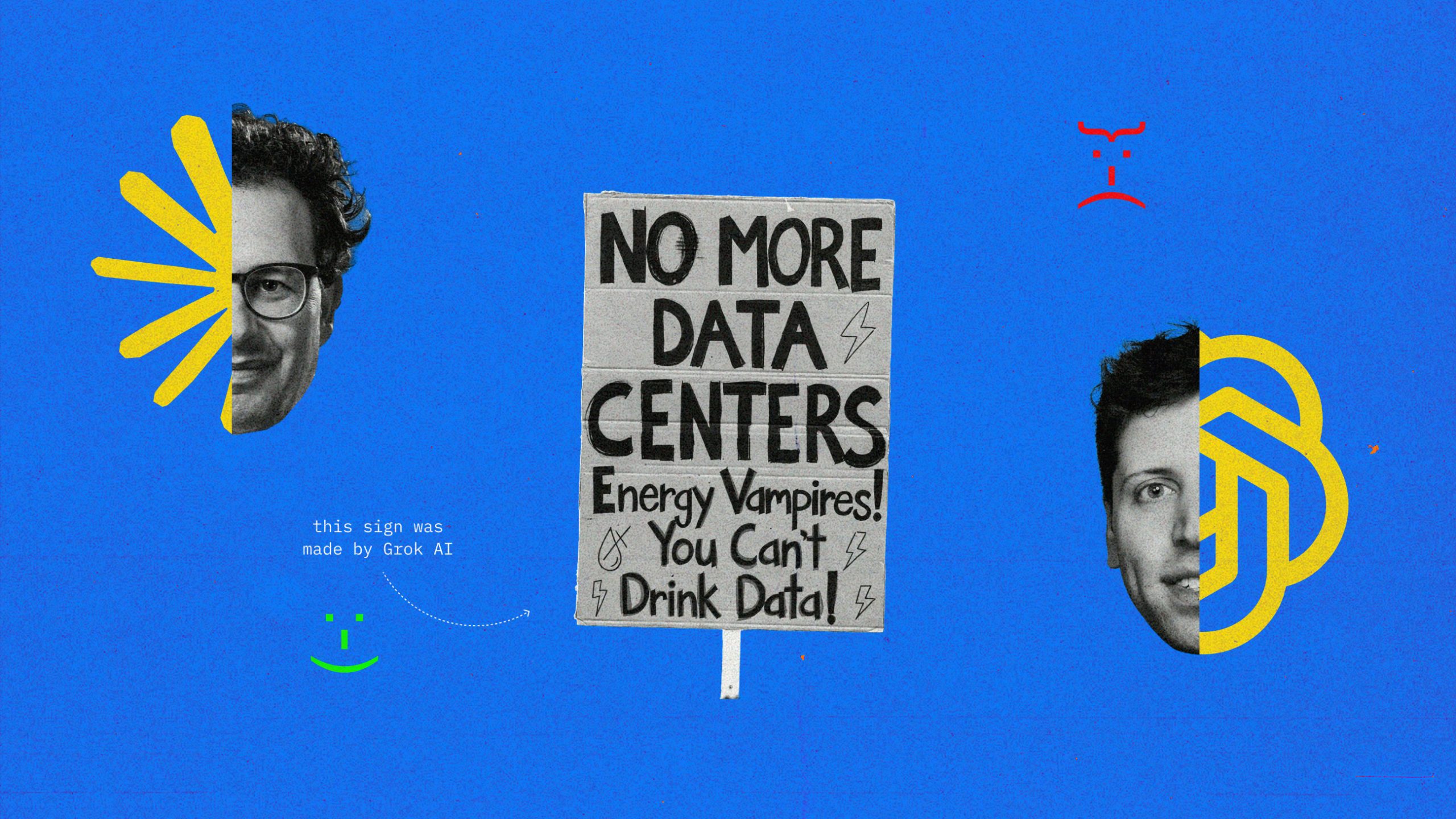
A “dynamic dozen” could both advance our industry and preserve our form of government.
Though hype and doomerism tend to suck up a lot of oxygen in the AI discussion, it will probably be more productive for Americans to focus on the concrete goals desired by leaders in the industry. Then we may ask whether and how a majority of citizens might be convinced those goals are worthy of the effort required to attain them. I propose we focus first on the question of “compute”—how much computing power is required to operate cutting-edge AI at scale, and what kind of data centers are required to provide it.
There are some in the AI industry—developers, advocates, and the “hyperscalers” who want to build super-massive data centers—who do what they do out of an obsessively spiritual devotion to what they’re building. But a great deal of the business is run by successful Americans in the industry who mostly just really enjoy doing what they do best, which is building new things using state-of-the-art tools. This may not be obvious to the cross-partisan group of citizens who range from skeptical to hostile toward AI, who tend to think of all tech enthusiasts as wide-eyed, quasi-religious fanatics dreaming of a robot apocalypse or singularity. So for skeptics, an important reality check is realizing that many—probably the majority—of AI’s day-to-day builders have more practical and cosmically modest aims.
Another key reality check, this one for the accelerationists who do dream of an AI-saturated future, is that insisting on more compute, accessible anywhere and everywhere and as fast as possible, is not a form of politics that is going to win any elections anytime soon. To be honest, it’s hard to win elections with that approach to anything. Pounding the table like this, even on something as nice and popular as liberty itself, doesn’t sweep you (or your supported candidates) into office; even a blanket demand for equality-maxing does not guarantee the kind of electoral victory needed to protect, much less advance, your sweeping but vague agenda. People want—and, in our system of government, people justifiably expect—concrete details.
I sound these two notes of caution together because of several recent conversations with AI-savvy people at the intersection of politics and tech about the debate over data centers—how, at what scale, and on what timeline to build them. I was struck by a sense that concretely detailed policy proposals around data center scaling seemed absent from the industry and policy conversation.
Seeking a clear place to begin hammering out something specific, I chatted my way to an understanding that the big goal was a certain quantity of compute, sufficient to meet domestic (including government) targets and to avoid a sudden eclipse by international competitors (read: China). Okay, I replied, why not change the debate in a way that could benefit everyone involved by pitching, say, a “dynamic dozen” data center plan? With a simple number like that, I reasoned, the debate could shift to the tactical terrain of determining the best places to site the builds, taking advantage of preexisting natural, strategic, and infrastructural conditions while avoiding watchouts and pitfalls—including, yes, local resistance.
The response I got—from people on the policy side as well as the hard tech side—was that this sounded like an interesting and probably fruitful approach. Then why hadn’t someone else inserted it into the debate yet? Why hadn’t I seen such a proposal, and why did it seem that no one else had either?
The answer refers back to the reality checks above. It wasn’t that accelerationists had muscled such nuts-and-bolts thinking out of the debate, or that the main players didn’t think details would improve the quality or the outcome of the debate. It was simply that the builders were busy building. The executives were busy inking what deals they could in a highly competitive space. The thinktankers were heads-down in their own narrow lanes. The staffers were aswim in ungainly draft legislation. The hyperscalers were training their models. Everyone was busy doing what they thought they did best.
The industry leaders who believed in the value of the more-faster-now mantra were beginning to realize that the political appeal of that approach among the broader electorate might be limited. But they had demanding day jobs and highly agentic rivals to contend with, and the bandwidth was lacking to spool out a comprehensive data center plan with specific goals and targeted pathways to them. This despite the fact that to do so would likely do much to take the fear, confusion, and sense of helplessness that presently characterize the national debate over data centers. Which helps explain why fear, confusion, and helplessness currently reign supreme.
Existential Questions
To very briefly sum up how we got here: for a very long time, hard-working builders coexisted fruitfully with America’s form of government. Super-concentrated industrial wealth did cause serious political unrest for certain periods of time, but not until the AI takeoff has the sheer act of building fast and big seemed to many citizens like a direct threat to the fundamental political structure and social identity of America itself. What does it profit an American citizen to gain a utopia of material abundance but lose the heart and soul of the United States?
It’s a primal question of identity. Many millions of people are not very excited by the prospect of trading the best regime yet invented—where individuals, families, and communities are free to live and worship largely as they please—for a supposedly even better regime in which all that old-fashioned individualism, family values, and community self-determination is dissolved in a technological acid bath of posthuman collectivism. Many people feel that this exchange, in fact, amounts to a metaphorical, perhaps even literal, devil’s bargain.
So here we are, with majorities across the country firmly opposed to building data centers in their localities, bills proposing moratoria on AI development spreading throughout state legislatures, and deepening purple-hued fury from voters who feel swindled out of their already diminished political agency by an accelerationist fait accompli. It’s rough because many of those voters aren’t simply haters of AI. Polling shows that most people who don’t love AI use it anyway—instead of boycotting the tech, protesting the industry, or hurling improvised explosive devices at the homes of industry leaders.
The overwhelming majority of Americans would really rather not have to choose between scrapping AI on the one hand and scrapping their country on the other. They want balance: a sustainable middle path that preserves (maybe even strengthens?) our longstanding social contract—the one that reconciles open innovation, political freedom, and cultural decentralization, on terms beneficial to just about everyone involved.
How can voters possibly be faulted for wanting to keep America America without its becoming a stale and brittle museum of itself?
Imagine my surprise and relief, then, when, after not that much digging, I discovered that some leaders in the AI space are indeed doing the hard work of hammering out a carefully reasoned, detail-rich, and practically delimited approach to data center construction. You wouldn’t know it from your social media feed, or from the established news media, but a small group at the Department of Energy (DOE), working with research from the RAND Corporation and Anthropic, has been developing a robust and rigorous program quite a lot like the commonsensical one I had in mind. It’s very real, fairly nonpartisan, and well underway. But if you’re not a professional insider, or the kind of private citizen who hangs out on energy.gov or browses the Federal Register, you probably had no idea until now.
The DOE plan
Here’s the shape of the Energy Department’s schema. Due to explosive demand, driven in significant part by the strategic imperatives of statecraft, RAND began last year with a projection that by next year world compute targets would amount to nearly 70 gigawatts (GW). Nearly 12 months ago, Anthropic estimated the requisite minimum for U.S. needs at about 50 GW by 2028. Getting there is tricky: our existing infrastructure is subject to congestion, energy spikes, wild swings in power loads that can destabilize or fry electrical grids, and unsurpassable hardware limits on capacity even under ideal conditions—a little over 4 GW per site according to RAND research conducted this spring. As the AI critics have observed, although their catastrophizing has often been overhyped or just overestimated, those challenges can be expected to put unacceptable pressure on our natural and man-made resource systems.
Yet, of course, pulling the national e-brake on data center development won’t freeze time and deliver us into a magical parallel universe where we no longer have to address hard problems. Citizens have every right to flex their political muscle to squeeze out or shut down local builds they duly judge misbegotten, but the AI backlash against hand-wavey accelerationism is poised to deliver the worst of both worlds.
That’s why DOE has spun up a strategic siting initiative that well-intentioned people with a range of views on AI can reason their way through, like well-functioning citizens are supposed to.
The agency’s initial RFI—a so-called Request for Information, which prepares the way for a full-blown proposal and procurement process—identified last spring not a dozen but 16 sites already managed by DOE, boasting man-made and natural infrastructure adequate to clearing permitting hurdles fast enough to spin up active data centers in time to contribute to hitting next year’s compute targets.
By summer, DOE had zeroed in on a Big Four: Idaho National Laboratory, Oak Ridge Reservation in East Tennessee, Paducah Gaseous Diffusion Plant in western Kentucky, and South Carolina’s Savannah River Site. Requests for Proposal went out to the private sector in the fall. Anthropic, meanwhile, focused their approach to site assessment around executive-branch prospects for adding 50 GW of compute by leasing out federal lands, taking advantage of preexisting power plants and sources, and, as in DOE’s case, speed-running permits where conditions allowed. And in March of this year, when RAND evaluated 22 site candidates, a majority scored moderately across onsite infrastructure and readiness for further construction, deployment, and use.
While some AI boosters and AI doomers might squint at consensus support for a carefully scoped approach to hitting ambitious compute targets—such as the Bipartisan Policy Center’s approving review of the DOE’s pragmatic effort—populist voters in both parties, feeling skeptical or unsure about data center growth, won’t be so negative.
Tailored to the Stakes
A dynamic-dozen database project, carefully scoped to hit key compute targets with builds at the best sites for swift, efficient, and not-unwelcome construction and operation, will keep a variety of options open for the future while respecting citizens’ present judgments, strengthening buy-in on the foundational layer of any strategic plan going forward. Political disagreement will recalibrate away from escalating confrontations over abstract visions of catastrophe toward grounded engagement that’s both more technical and more human. Geopolitical imperatives will receive their due, as will kitchen-table economics. A little sprinkling of patience, humility, and forbearance will go a very long way.
Of course, some savvy observers and policymakers already have their critiques of such an approach despite its many advantages. The sharpest criticism, however—that the federal government we actually have is too degraded an institution to be counted on to lead on AI deployment—is also the most sweeping. Its conclusion—that, on balance, hyperscalers and citizens alike are just going to have to wing it and the chips will fall where they may—may reflect a certain degree of realism about the difficulties of America’s situation. But its implications invite judgments that are simply too post-political, post-American, and ultimately too post-human to hold the civic body together amid threats foreign and domestic, or even, alternatively, to wind down and retreat to decentralized fragmentation in orderly and salutary fashion.
As presently configured, America can’t afford a strategic defeat of our tech industry, our federal government, or our body politic. No person or institution can assert complete control over any of those three sociopolitical pillars—the price of freedom! But while the three independently do what they do, it serves all well for us to at least move forward confidently with something like a dynamic-dozen data center plan, carried forward from the concrete siting selection process already begun.
The American Mind presents a range of perspectives. Views are writers’ own and do not necessarily represent those of The Claremont Institute.
The American Mind is a publication of the Claremont Institute, a non-profit 501(c)(3) organization, dedicated to restoring the principles of the American Founding to their rightful, preeminent authority in our national life. Interested in supporting our work? Gifts to the Claremont Institute are tax-deductible.
Suggested reading


Our proud nation and history deserve better.

A new playbook to curb its abuses.

Connecting the dots of complex systems breaks the conservative impasse.

To fight prejudice, get the bureaucrats out of power.

A playbook for all the states.

