

U.S. foreign policy leaders have become addicted to outsourcing atrocities.
Alignment Over Allegiance: Lessons from Brazil’s Elections
Helping our allies without wanting them to salute.
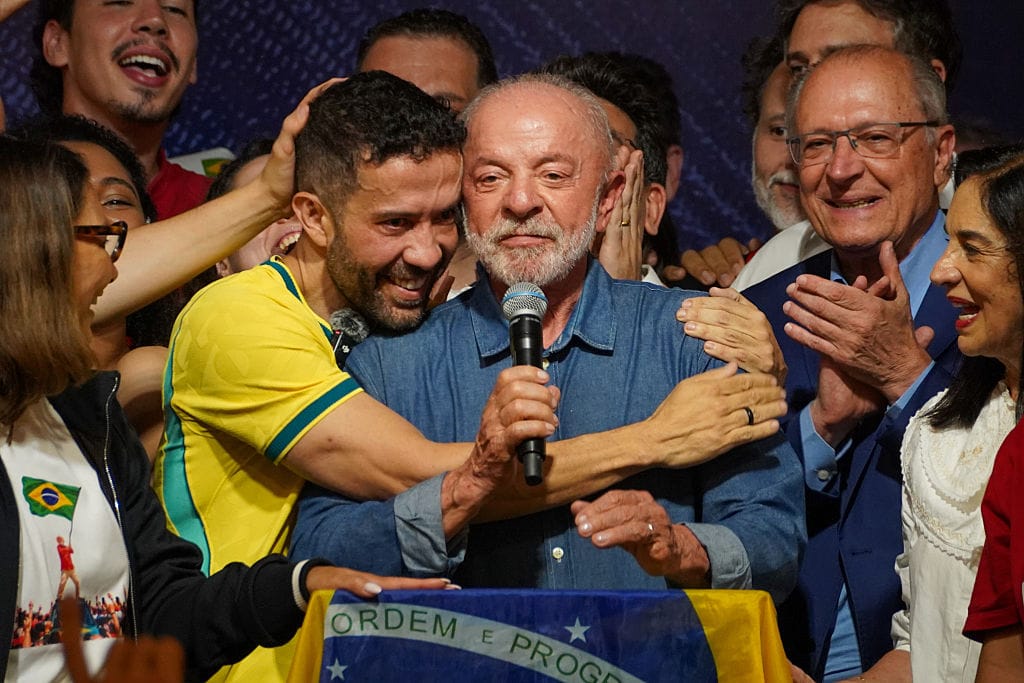
Kalshi election bettors are in mourning after Luiz Inácio “Lula” da Silva won an unprecedented fourth term on Sunday, beating Flávio Bolsonaro 52% to 48%, a margin of roughly 4.4 million votes—a 10 million-vote increase for Lula from the first round. The Bolsonaro family and its allies have called for the result to be annulled. Flávio and his family fled the country for the United States after Brazilian Supreme Court Justice Alexandre de Moraes demanded he turn over his passport after the loss.
Let’s start with the obvious: Lula’s victory is bad for the United States. Brazil remains a pillar of BRICS, and Lula has championed alternatives to the dollar. China bought $69 billion in Brazilian goods between January and July (the U.S. bought $21 billion). In July, Lula made Brazil a founding signatory of the China-led World Artificial Intelligence Cooperation Organization. And in August, Brasília announced a supercomputing project with Chinese companies Huawei and iFlytek worth about $250 million.
Lula refused to join Western sanctions on Russia, declared that the United States “crossed an unacceptable line” in capturing Maduro, and rejected American terrorist designations for two Brazilian gangs, Primeiro Comando da Capital and Comando Vermelho, in May. Four more years of this will undoubtedly cause continued headaches for the U.S.
Some will read Brazil’s election as a verdict on Trump, on tariffs, and on sovereignty. Yet the lesson that matters most for American policy sits one layer down. Washington has a habit of looking at Latin America as if it were a mirror, grading friends by how much of ourselves we see in them. Do they wave our flag? Do they stand loudest with Israel? Do their pews look like ours? Those may be fine traits in an ally. In a candidate, they can be dead weight.
There is a difference between alignment and allegiance. Alignment is what a friendly government does once in office: how it votes at the U.N., whose telecom vendors it trusts, whose ships it welcomes. Allegiance is what a candidate performs in public: the flag at the rally, the hands shaken, the loud gratitude. The current administration tends to demand both at once, and it sometimes ends up with plenty of the latter and less of the former. Worse, on the campaign trail the second can destroy the first. While a salute is cheap for us, it can be very expensive for our friends abroad.
Lula understood this better than the Brazilian Right did. He ran against Washington as much as against Flávio Bolsonaro. In Teresina, he called Bolsonaro supporters who carry American flags to rallies vira-latas (mutts) and “traitors to the homeland.” In Recife, he warned that a vote for his rival meant electing “a guy who will sleep wrapped in the American flag.” He branded Flávio “Trump’s candidate,” and the state’s intelligence agency sounded alarms about “critical” levels of U.S. electoral meddling.
We supplied the material. Eduardo Bolsonaro, Flávio’s brother, spent much of 2025 in the United States lobbying for punitive measures against his own country and was convicted of coercion by Brazil’s Supreme Court in June 2026. Flávio sat with Trump, JD Vance, and Marco Rubio at the White House in May. Washington imposed 50% tariffs on Brazil in July 2025, citing the prosecution of Jair Bolsonaro, and added 25% more under Section 301 this summer. Lula’s ad makers barely had to do any work.
The bind extends beyond Brazil. Conservative José Antonio Kast won Chile’s presidency on a platform friendly to Washington, then watched the United States impose a 12.5% “forced-labor” surcharge on Chilean salmon, grapes, blueberries, and wine in July, despite a free trade agreement in force since 2004. Many friends have been forced to defend the U.S. against domestic criticism from its own farmers. In campaign season, that’s an uncomfortable reality we cannot ignore.
Tariffs answer real grievances at home, and Washington should not drop them to protect its image. But American diplomats should assume that visible alignment with Washington can carry a cost for our friends and help them manage that cost rather than make them pay for it in public. Loud, public allegiance pleases outside validators. But the interest of the United States is a government in Brasília that votes well, buys well, and trades well. Sometimes the wiser gift from a friend is distance during the campaign and loyalty after it.
History offers another model, with caveats. At the 1933 Montevideo Conference, Franklin Roosevelt’s administration publicly accepted that no state had the right to intervene in the internal affairs of another. The Good Neighbor Policy was no act of charity. Roosevelt wanted markets, stable neighbors, and a quiet southern flank. Nine years later, nearly every country in the hemisphere broke with the Axis, and Brazil sent roughly 25,000 troops to fight in Italy. Perceived restraint in 1933 bought some solidarity in 1942. Roosevelt gave up the appearance of control and got the substance of alliance. Washington did not go quiet on its interests. It got more of them by asking less loudly.
The Evangelical Ceiling
Then there is faith, the symbol where the American Right has grown most complacent. Plenty of conservatives in Washington treat evangelical growth across Latin America as a fait accompli: wait a generation, and the region’s pews will vote like West Texas. Arithmetic says otherwise. Brazil’s 2022 census counted 27% of the population as evangelical and 57% as Catholic, the latter being the lowest share on record—and yet still a clear majority.
Lula, the Catholic in the race, can count. In late September, his campaign amplified a claim that Flávio wanted to strip Our Lady of Aparecida of her status as Brazil’s patron saint. Flávio denied it, and nobody produced evidence. The political scientist Paulo Moura put it bluntly to Gazeta do Povo: “Lula was losing the vote among Catholics and he created this move in an attempt to stem the bleeding.”
The play worked because it pointed to something real. On October 12, 1995, the Feast of Our Lady of Aparecida, a bishop of the Universal Church of the Kingdom of God kicked an image of the Virgin Mary on live television. The church’s founder, Edir Macedo, disavowed him. Brazilian Catholics remember it anyway. A rumor only needs to sound plausible.
By September 27, Quaest showed Lula leading Flávio among Catholics 48% to 29%, up from 43% support a week earlier. Evangelicals gave Flávio a real base, 46% to 27%. But the base was never Flávio’s problem. The margin was.
Americans (and our intelligence agencies) helped build this trap. In 1980, the Committee of Santa Fe urged the incoming Reagan Administration to “counterattack” liberation theology on the theory that a politicized Catholic clergy was the problem and the Protestant revival was the antidote. Washington’s move achieved relatively little. In March 1983, John Paul II stood on the tarmac in Managua and publicly rebuked Ernesto Cardenal, a priest serving in the Sandinista government. A year later, Cardinal Joseph Ratzinger’s teachings against liberation theology showed how it borrowed from Marxism and stood against the Church’s own tradition.
Every gain with the pastor risks a loss with the priest’s flock, and the priest’s flock is still bigger.
Prudence Over Performance
Finally, we turn to a key political lesson Republicans had to relearn in the months before the 2024 election: losers don’t legislate. In July that year, at Donald Trump’s urging, the party dropped support for a national abortion ban from its platform, which had been there for over four decades. Plenty of social conservatives fumed. But Trump won the election. The choice put the win ahead of the display, on the theory that power would do more for the cause than purity would.
Brazil’s Right needed the same discipline, and Washington should have encouraged it. Picture Flávio as a realist Brazil-first candidate running on the economy: friendly to Washington, but blunt in rejecting Lula’s charge that he was anyone’s vassal. He could still have courted pastors and kept the Israeli flags at church events while leaving the American ones at home and keeping the national message at the kitchen table. Moderation in posture is the price of admission to the room where principles become policy.
A candidate who flatters Washington is usually buying something for himself, and we end up paying for it. The lesson cuts both ways. Brazil’s Right must stop treating closeness to Washington as a credential voters reward, just as Washington must stop treating foreign campaigns as auditions for its approval. Before asking how a candidate’s loyalty looks from Washington, our diplomats should ask what it costs in São Paulo, Santiago, or Bogotá.
America does not always need its friends to love it out loud. Sometimes it even needs their silence. What it always needs is for them to win and govern alongside us. Prudence remains the mother of all political virtue—and pride, the queen of all vices.
The American Mind presents a range of perspectives. Views are writers’ own and do not necessarily represent those of The Claremont Institute.
The American Mind is a publication of the Claremont Institute, a non-profit 501(c)(3) organization, dedicated to restoring the principles of the American Founding to their rightful, preeminent authority in our national life. Interested in supporting our work? Gifts to the Claremont Institute are tax-deductible.
Suggested reading
Zelensky’s position is getting more untenable by the day.

It’ll be hard for the administration to resist supporting strikes.
NVIDIA CEO Jensen Huang shouldn’t try to run U.S. foreign policy.

Technology is raising fundamental questions that we’re not ready to answer.
Certain verities transcend time

