

Society won’t survive unless we put the guard rails back up.
Athens, Jerusalem, and the Western Soul
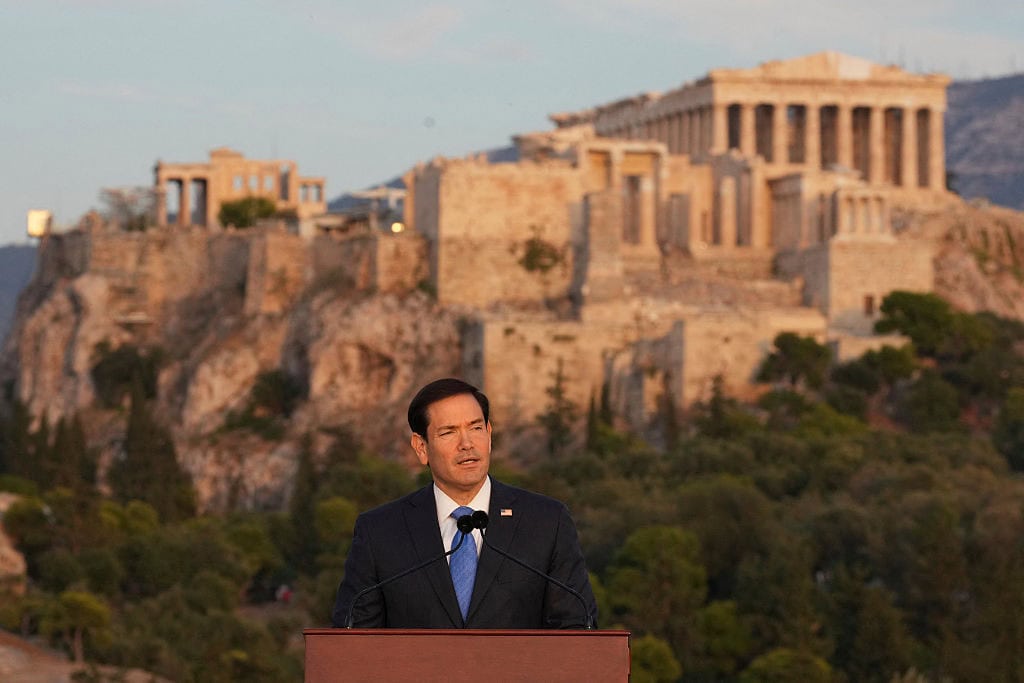
Spiritedness in the service of right reason.
Secretary of State Marco Rubio’s thoughtful and inspiring speech delivered at the Acropolis in Athens, Greece, deserves to be remembered for a long time to come, especially in an age increasingly dominated by ideological slogans and short attention spans. The speech combines impressive erudition and soaring rhetoric with an astute, if inevitably controversial, analysis of the contemporary international scene. More fundamentally, it seeks to come to terms with the foundational virtues and principles that have defined Western civilization since its origins in Greek antiquity.
The Athens speech only indirectly addresses the biblical pole that has also profoundly informed and shaped the Western heart, mind, and soul. Given the immediate purposes of Rubio’s speech, it is somewhat understandable that his remarks seemingly set aside the invigorating tensions—but not irreconcilable differences—between Athens and Jerusalem, and between magnanimity and humility, that have given life and purpose to the Western adventure. But a careful reading of his October 7 address suggests that Rubio is fully aware that one foundational pole cannot thrive today without the other.
In any case, as William Galston wrote in the Wall Street Journal, Rubio’s was a serious speech that deserves a serious response, though Galston overshot in reducing it to unabashed “pagan nationalism.” He spends most of his time giving the secretary of state Thucydidean lessons in the folly of hubris. Galston cites the disastrous Syracusan Expedition, in which 7,000 Athenian prisoners met their horrible fate in the underground pits of Sicily, and the arrogance displayed by the Athenian ambassadors during the Melian Dialogue as examples of the dangers inherent in the pagan nationalism Rubio supposedly extols.
There is indeed much of value to be discerned in contemplating those timeless Thucydidean lessons. But Galston, like a commentator in Spectator World, mistakes Rubio for the unscrupulous Alcibiades, whose flexibility of soul seemingly knew no limits. One needs to avoid polemics and take Rubio on his own terms.
As Paul Seaton points out in a particularly fine commentary on the speech in The Catholic World Report, Rubio’s remarks, however thoughtful, inspiring, and controversial, serve practical political purposes while also offering a serious analysis of the role of classical Greece in shaping Western civilization. Speaking in Athens, Rubio understandably accentuated the Greek character of Western civilization. This one-sidedness is appropriate for the exercise of political rhetoric, though perhaps not in a more disinterested historical, political, and philosophical work of scholarly analysis. Still, political rhetoric must also be judged by its plausibility and verisimilitude.
We must then be attentive to what Seaton calls the “concentric circle of audiences” that Rubio presumably had in mind. These include contemporary Greeks, whose country is now governed by a conservative government with close ties to the United States. Rubio emphasizes, perhaps inordinately, the Greek origins of democracy without noting the serious reservations the authors of The Federalist had about Greek democracies, which too often oscillated between anarchy and despotism. On the other hand, Rubio is surely right that Plutarch’s Lives of Noble Greeks and Romans helped inspire the founders’ admiration for lives lived at the service of liberty and human excellence.
Rubio’s audience also includes Europeans more broadly, particularly Western Europeans who seem to have lost what the French political philosopher Pierre Manent has called “the instinct for political existence.” Perhaps this accounts for Rubio’s rather unilateral defense of power politics, since contemporary Europeans tend to think there can be right without might, liberty without national self-respect and even self-assertion.
Rubio is right in these circumstances to remind Europeans of the indispensable role of thumos in the life of the soul and the life of a polity worth its salt. He also ably defends the moral legitimacy of the self-governing nation-state and forcefully warns against undue and utterly debilitating Western guilt and self-hatred. He takes pointed and well-deserved aim at “outsourcing more of our sovereignty” to “global bureaucracies far beyond the reach of our control.”
So far, so good. But in articulating the excellences of Greek civilization and its contribution to civilization simply, Rubio goes somewhat astray. His account of Greek life rightly emphasizes its agonistic character, its “fierce individuality and relentless ambition,” its “daring exploration and invention,” its “yearning for discovery, for adventure, risk and glory.” These are genuine goods, but only up to a point. When confronted by what Tocqueville called “democratic despotism,” in which weak and ineffectual human beings lose any sense of moral agency and active civic life, these Greek virtues seem like inestimable goods.
But an “impatience with the notion of impossibility, chafing at all boundaries and limits” cannot be the final word either. Political wisdom weaves together restraint and possibility, ambition and limits, moral and civic agency with a warning against self-defeating hubris. The “common anthropology” of the West, rightly lauded on this occasion by Rubio, indeed invokes “the idea of a natural order,” “a distinctive understanding of virtue,” the non-subjective character of “truth, goodness, and beauty,” and “the whole tradition of natural law” to which human beings must wisely defer. The best of the Greek and Roman philosophers—Plato, Aristotle, Cicero—and a Christian thinker of the rank of St. Augustine taught us how to get this balance right. Moderation and magnanimity, greatness and an appreciation of limits, must ultimately go hand in hand.
In our listless and dispirited age, the secretary of state was not wrong to evoke the indispensability of “thumos”—“the fire of passion, strength, courage, pride,” which Rubio calls “the heart of civilization.” But his critics were not wrong to note what he largely presupposed—that spiritedness must be guided by practical reason of the kind lauded by Aristotle in Book 6 of his Ethics. Our imaginations need to be stirred by Homeric heroes, but in our civilization shaped by Socrates and Jesus, we cannot simply imitate them.
In On Duties, Cicero insists that there can be no worthy human life or political community without a spirited defense of the precious goods at the heart of civilization itself. But in the end, the great Roman orator, statesman, and political philosopher insists that “arms” must “yield to the toga.” What Cicero called a “spirit lofty and magnificent” values physical courage, but “domestic courage” above all. “Strength of body” must be guided by “strength of mind,” spiritedness by what Aristotle and Cicero called “right reason,” which has a place for the spirited defense of liberty and the full range of the human virtues.
Aristotle, too, amply recognizes a place for spiritedness guided and informed by practical reason. In Book 7 of his Politics, he presents the political liberty of the Greek cities as a judicious mean between northern peoples like the Celts, “filled with spiritedness” but “relatively lacking in thought and art,” and Asian peoples of his time who had souls “endowed with thought and art,” but were “lacking in spiritedness.” Aristotle could not be clearer: one needs to be both “spirited and endowed with thought” to be free and to govern oneself “in the best manner.” On a future occasion, this fuller account of the role of spiritedness—and its limits—might be explored by the secretary of state.
In the eloquent and penetrating defense of heroism and duty with which Rubio’s speech culminates, he firmly differentiates the nobility of those who are “willing to die for their cause” from those who “worship death.” The heroism lauded by an older West is, he rightly insists, “wholly different from what we see, even now, for example from fanatics like the radical Mullahs of Iran, whose cult of death hails child suicide bombers as national heroes, and portrays martyrdom as an end in itself.” There is no heroism without decency, without respect for what Rubio elsewhere calls the “natural law.” He thus points, however indirectly, to the ultimate need to bring Greek and Judeo-Christian wisdom together to do justice to the noble inheritance passed on to us by Athens and Jerusalem (and Rome). Rubio’s reference in his talk to the “unapologetic pursuit of national power” by the United States, however, risks confusing power as an indispensable means with power as an end in itself, the fatal flaw of Machtpolitik or overwrought realism.
In Athens, Secretary of State Marco Rubio returned in a most serious and suggestive way to foundational questions about the meaning of Western civilization that thoughtful citizens and statesmen avoid at their peril. There was no more fitting place to do so than in Athens, with everything it represents. Let us take up his challenge and continue the civic dialogue that can only enrich a free—and spirited—people.
The American Mind presents a range of perspectives. Views are writers’ own and do not necessarily represent those of The Claremont Institute.
The American Mind is a publication of the Claremont Institute, a non-profit 501(c)(3) organization, dedicated to restoring the principles of the American Founding to their rightful, preeminent authority in our national life. Interested in supporting our work? Gifts to the Claremont Institute are tax-deductible.
Suggested reading


The divide between church and state doesn’t separate religion from public education.

The replacement of Easter by this new feast day in the progressive liturgical calendar is a provocation.

Teaching the world the value of liberty.

Americans have become rusty at arguing about religion in public.
They need to cease their public quarrel.

