

If they can’t have their way, they want to burn it down.
Congress Schools the Schoolmasters on Tariffs
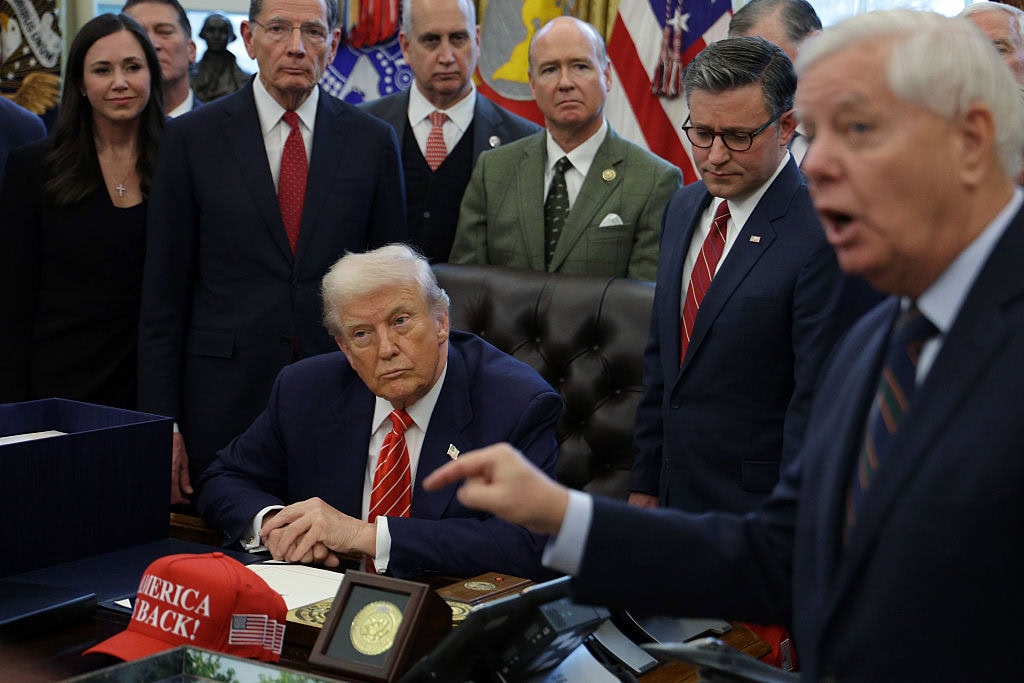
Its response to the Supreme Court in Learning Resources, Inc. v. Trump.
The Lindsey O. Graham Sanctioning Russia and Iran Act of 2026 became law on September 18, ratcheting up the Trump Administration’s pressure to bring Vladimir Putin to the negotiating table and end the Russo-Ukrainian War. It also gives the president new tariff authority for the first time since the Trade Act of 1974 became law 52 years ago. This comes less than seven months after the Supreme Court struck down President Trump’s use of the International Emergency Economic Powers Act of 1977 (IEEPA) to impose his tariff regime.
The Graham Act allows the president to impose sanctions on major entities and figures in Russia tied to its defense industrial base, as well as on any other nations that aid its defense sector or import Russian energy. It also enables the president to increase tariffs on imports of Russian energy by up to 500% ad valorem and levy tariffs of up to 100% ad valorem “on countries that purchase Russian-origin crude oil or natural gas or facilitate sanctions evasion.”
The countries in question must be the five “largest importers, by total volume” of Russian energy products or the top five “countries facilitating Russian oil sanctions evasion.” The Graham Act is a little unclear about how the top five will be measured (it specifies sections 2709 and 2711 of the Harmonized Tariff Schedule), but potential targets could include China, India, the E.U., Brazil, South Korea, Turkey, Vietnam, Japan, Singapore, or Saudi Arabia, among others, according to figures on Russian energy export destinations for August 2026.
The straightforward political reading of the law is that it advances both the president’s goal of securing peace between a NATO proxy and the world’s largest nuclear power while restoring his unilateral power to impose tariffs; Congress, buoyed by hawkish pro-Ukraine sentiment, gave the latter power to achieve its goal.
The Graham Act should be seen as Congress’s response to Chief Justice Roberts’s majority opinion in Learning Resources v. Trump, in which he sought to teach a lesson in constitutionalism 101. His holding was narrow but straightforward: Congress gave the president immense power to block trade with other countries under declared national emergencies. But it did not say anything about imposing a tariff, which Chief Justice Roberts claimed is part of the taxing power; ergo, the president illegally usurped Congress’s enumerated authority to tax under Article I, Section 8 of the Constitution. Roberts sought to remind us that “no taxation without representation” is still true. Justice Neil Gorsuch likewise applied the “major questions doctrine” to prevent “the continual and permanent accretion of power in the hands of one man” and to defend the separation of powers and the deliberative process of lawmaking as a “bulwark of liberty.”
Justice Brett Kavanaugh’s striking dissent, by contrast, highlighted an important error in Roberts’s judgment. IEEPA succeeded the Trading with the Enemy Act (TWEA), which delegated authority to the president to “regulate…importation.” In 1971, President Nixon used TWEA to impose a 10% baseline tariff on all imports to deal with a balance of payments crisis. The U.S. Court of Customs and Patent Appeals upheld that usage in U.S. v. Yoshida International, Inc. Seeking to rein in presidential power following Watergate, Congress passed the National Emergencies Act in 1976 and IEEPA in 1977. These laws require the president to declare and extend annually any national emergency, which Congress could cancel by concurrent resolutions passed by both houses.
IEEPA’s delegation of authority copies almost word for word the language TWEA used to authorize various trade restrictions. Therefore, IEEPA’s purpose—granting the president broad emergency power to deal with crises—should be understood in continuity with the TWEA.
Chief Justice Roberts stated that Congress could not have intended to give the president such a sweeping delegation to impose tariffs under IEEPA based on “vague language.” In the Graham Act, Congress has clearly rebuked the Court’s decision and reinstated that power.
Hours after the Supreme Court issued its ruling, President Trump announced a 10% tariff under Section 122 of the Trade Act of 1974, a longstanding, unambiguous tariff authority that has been upheld by the courts. Subsequently, two Section 301 investigations were announced. Stymied at one turn, the president began rebuilding the tariff regime by other means. Congress’s restoration of President Trump’s power to unilaterally apply tariffs (albeit under some limitations related to Russia) signals that the American people disagreed with the Court’s majority.
We are right to disagree. We need the tariffs, and Congress is no longer suited to set the tariff schedule, especially as economic policy and foreign policy have merged and require flexibility in response to sudden events around the world. Delegating this authority reflects this shift in power and recognizes the president’s superior competency to make these decisions for the public good. We can bemoan the decline of congressional power and statesmanship, but we should not do so to the detriment of the nation’s needs.
The president has since announced that he is waiving sanctions and tariffs against Russia as he tries to bring down gas prices before the midterms. This is not a retreat from the law but its application. The Graham Act gives him unilateral authority to change course based on changing circumstances, something only the president is properly equipped to do. We must not forget that the “means” of targeting Russia and its enablers ultimately serve the end of restoring a deterrent against our largest trading partners. We can expect a full-throated use of these powers after the midterms.
The Supreme Court is a “republican schoolmaster” that educates the public on the contours of the government and the foundations of republicanism. But it sometimes gets things wrong. While it has the final say in a case before it, the Constitution is not simply what the Supreme Court says it is. Rather, discerning constitutional meaning is the responsibility of every leader who swears the oath—and, more broadly, of all patriotic, loyal citizens.
In restoring President Trump’s power to impose and alter tariffs quickly, Congress followed Alexander Hamilton’s recommendation that the legislature “may prescribe a new rule for future cases.” This time, the schoolmasters were schooled.
The American Mind presents a range of perspectives. Views are writers’ own and do not necessarily represent those of The Claremont Institute.
The American Mind is a publication of the Claremont Institute, a non-profit 501(c)(3) organization, dedicated to restoring the principles of the American Founding to their rightful, preeminent authority in our national life. Interested in supporting our work? Gifts to the Claremont Institute are tax-deductible.
Suggested reading


Officer selection and training cannot be placed at the service of the diversity regime.

This Supreme Court term could be consequential.

Laws against its distribution are still on the books.
The official Republican vision of political power is so constrained that you have to wonder why they want it.
The Democratic Party’s center cannot hold.

