


Martin Luther King, Jr.’s “I Have a Dream” speech casts a golden thread across three centuries, connecting us to the source of the American dream.
The Truth About DOGE
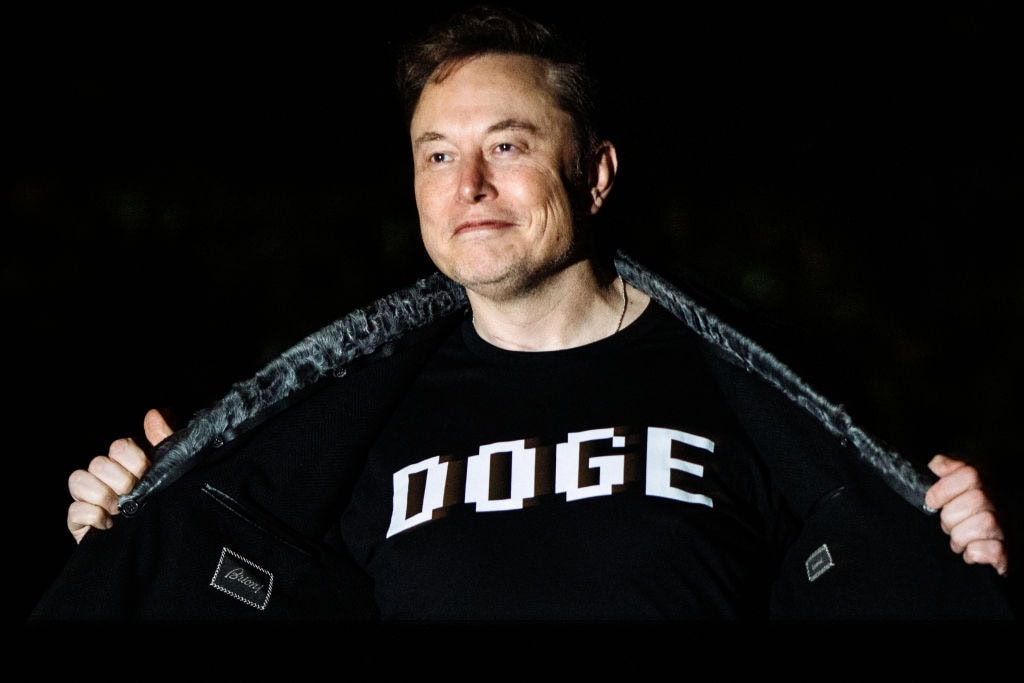
It was never going to save America.
Editors’ Note
The following is an excerpt from Unelected: How You Paid a Sinister Elite to Take Over America by Jennica Pounds and Joshua Lisec, published today by Passage Press.
DOGE was never going to balance the budget.
DOGE was never going to unwind $38 trillion in U.S. federal debt nor reverse the sovereign-debt spiral engulfing every unelected advanced economy. No amount of administrative efficiency can meaningfully alter a fiscal architecture that is already mathematically insolvent.
Even if DOGE had been fully empowered—no obstruction, no lawsuits, no bureaucratic sabotage—it still could not have put the country back on a sustainable path. Because the problem is the structure of the global system and the incentives that hold it in place.
Soros sees the sublimation of political authority into transnational authority. That is how the NGO-Administrative Complex grows, by steady erosion of incentives, forcing governments into dependence on technocratic, supranational coordination to survive the same crises their own policies (and their own voters) can no longer manage. Which means we must confront a terrifying inevitability: A global financial order is coming.
Maybe next year. Maybe in 20 years. But it is coming. Not because the NGO-Administrative Complex dreams of it, but because the mathematics of debt leaves no other exit. When it arrives, borders will still exist, flags will still wave, elections will still be held, but the actual locus of fiscal power will not reside inside borders. And with the loss of fiscal power, so goes the political power. The nation-state will remain a symbol, not sovereignty. We have entered the Post-Westphalian age, and there will be no going back.
This is the trajectory Soros mapped. This is the trajectory the debt supercycle demands. This is the trajectory that explains why DOGE could never be enough.
That said…
If Soros is right—and the evidence says he is—then the rise of a global fiscal system is not the consolidation of the NGO-Administrative Complex. It is the moment the Complex ceases to exist in its current form.
I’ll explain. We’ve seen throughout the book that the NGO-Administrative Complex survives by metaphorically balancing on three pillars:
1. Borders, which allow international NGOs to extract legitimacy by moving resources, influence, and ideology across nation-states.
2. Nation-state bureaucracies, which outsource functions to NGOs and multilateral bodies, creating a distributed administrative class subsidized by the taxpayer.
3. Elections, which they do not control directly but influence indirectly via grants, “civic engagement,” regulatory capture, and information arbitration.
That tripart system only works as long as sovereignty remains fragmented across dozens of national governments. That fragmentation allows them to remodel it all, erecting themselves as the system’s metaphorical girders.
But the rise of a global fiscal order does something they cannot survive: It collapses everything into itself.
Once global debt management consolidates at a supranational level, the NGO-Administrative Complex will no longer arbitrate between nations because the meaningful decisions will no longer happen between nations. Sovereignty ceases to be a nation-state phenomenon; it becomes something else.
This is the epistemic pivot, the same kind that ended the Cold War and forced NATO to reinvent itself. Institutions built for the old world end up weightless in the new one. They don’t adapt; they mutate. In that mutation, they stop being what they were.
As I said at the Hillsdale Free Market Forum 2025 event, “We end the Fed, or the Fed ends itself. Either way, the Fed is dead.”
The NGO-Administrative Complex becomes obsolete the moment global fiscal authority becomes inevitable. Not more powerful. Not more entrenched. Obsolete.
Once borders are symbolic and sovereignty is no longer national, the legitimacy of the NGO-Administrative complex collapses. There is no “nation” to democratize. No “election” to steer. No “domestic policy” to influence.
As a consequence, sovereignty will move downward.
Techno-Populism Is Coming
Global fiscal consolidation dissolves the middle layer—the NGO-Administrative Complex—that depends on nation-states as intermediaries. The power vacuum jumps past the nation-state…to the individual.
Once the fiscal architecture is global, individuals are no longer tethered to national bureaucracies to build or influence institutions. The “sovereignty myth” collapses. And with it falls the administrative state that kept everyone believing that politics was the only available arena.
As global fiscal authority becomes the operative source of power and national authority fades into symbolism, individuals and small groups face fewer constraints on what they can create:
- parallel financial rails (see: Bitcoin)
- parallel civic institutions (see: Turning Point USA, Turning Point Action)
- parallel media (see: 𝕏)
- parallel communications (see: Starlink)
And this will eventually mean:
- parallel governance models (see: The Network State)
The old enforcement architecture of national bureaucracies steered by international NGOs no longer matters. To quote Elon, “You are the media now.”
This is how the NGO-Administrative Complex dies—by supersession. This is not just prophecy; it’s already present reality.
Recall how a handful of people on 𝕏 outperformed an entire polling industry backed by universities, media networks, and billion-dollar institutions. Why? We could accept feedback; they could not. We could take in disconfirming evidence; they could not. We could adjust our models; they could not adjust their worldview.
This is Conway’s Law in action. The polling industry wasn’t wrong because of incompetence; it was wrong because its architecture made it impossible to be right. A closed epistemology produces closed directives, which produce closed organizations, which eventually produce closed institutions. Closed institutions do only one thing when confronted by reality: they break.
We are already building parallel institutions, because the old ones cannot metabolize truth anymore. Because the people, unlike the Complex, can still course-correct.
- 𝕏 became a parallel media.
- Passage Press became a parallel publishing house.
- DataRepublican became a parallel analytics engine.
- DOGE became a parallel government institution.
- The early-vote community became a parallel intelligence service.
- Starlink became a parallel communications grid.
In a world where our rulers cannot accept feedback, the people who can will inevitably win through building, iterating, testing, and improving until the parallel becomes the primary. The collapse of our trust in institutions is the collapse of their power through institutions. We do not need permission or prestige to build our own institutions.
The autopoietic system cannot change its form. But we can. We already are. And as sovereignty is shifting downward to the individual, so, too, is the battlefield.
The Next Battle
The NGO-Administrative Complex was never merely a network of grants, audits, conferences, and coalitions. Its real power rests in shaping what counts as virtue, identity, belonging, meaning—what a person believes he is. (Recall Elon Musk’s favorite phrase, “Woke mind virus.”)
When national sovereignty collapses and institutional sovereignty collapses with it, the last terrain left to conquer is the one tyrants have always wanted most:
The human soul.
The individual as the final unit of sovereignty means the individual becomes the final perimeter of control. And in a world where traditional institutions no longer command reflexive obedience, the Complex has already laid the groundwork for a different kind of architecture, one that operates inside people rather than above them.
This may sound abstract; it is not. It is the most concrete, organized, well-funded frontier of the entire ecosystem. You may have seen this language already: “transpartisanship,” “bridging the gap,” “thriving together,” “community building.” At its center sits an NGO called PolicyLink.
Long before DOGE ever touched a federal grant, the NGO-Administrative Complex had already built an infrastructure to engineer identities, moral frameworks, “values,” and civic consciousness at scale. A system designed to manufacture the inner life of a citizen in the same way USAID manufactured the civic life of foreign “transition states.”
In “A Revolution of the Soul,” an article for the fall 2024 issue of Stanford Social Innovation Review, PolicyLink states this outright: “The next American revolution must be a revolution of our collective and individual souls that allows us to grow into the fullness of our personhood and recognize the interconnectedness of all humanity.”
That is a direct quote. The soul becomes territory of the NGO-Administration Complex. They demand “soul work,” defined as the “transformative work of deep socialization.”
What is this “deep socialization”? PolicyLink continues: “We must prime our souls for the transformative work…. Soul work requires an ongoing practice of inward and outward reflection, as well as the courage to hold our wounds and faults, and those of other people and communities, with honesty and compassion.”
In other words: accept your guilt, adopt theirs, submit emotionally. This is the dissolution of the boundary between inner conscience and collective political obedience.
This is non-optional.
“If we are to recalibrate our systems, structures, and norms for the flourishing of all people, we must develop an individual and collective soul that can love all,” to create “a nation renewed through a flourishing democracy.”
Love is the keyword, but it is redefined to mean left-wing activism.
“To love all means to acknowledge the inherent dignity and worth of every person—not abstractly, but concretely—and to act in service of their flourishing.”
But what does “act in service of their flourishing” actually require? In practice, it means surrendering the self to the NGO-Administrative Complex, which defines what flourishing is: racial equity and social justice. This is Cultural Marxism—at its core, Communism—elevated to the spiritual domain.
To dissent from this is to suffer from an unformed soul.
“Soul work invites us to disengage from symbolic battles, perfectionism, and ideological purity…. It summons us to embody a principled consciousness without becoming ideologues…”
This is ideological conditioning by negation…stop resisting and stop arguing. Critique is pathologized as “maximalism.” You must surrender your mind to reconfiguration. The objective is explicitly named: “The task before us is to make an evolutionary leap to build social, cultural, and governing systems that work in service of human flourishing while manifesting within our souls an abiding love for all.”
That is psychological restructuring. This movement does not train citizens to reason through disagreement or assert their interests; it conditions them to be woke agents to carry out social justice.
This is the total and final inversion of Westphalia: The empire enters the conscience and calls it “love.”
But why should you care about a techno-hippie PolicyLink manifesto?
Because PolicyLink is embedded—operationally, financially, ideologically—inside the federal government.
- The U.S. Department of Housing and Urban Development credits its equity strategy to the “PolicyLink/Race Forward partnership,” which “result[ed] in the final action plan.”
- The Office of Management and Budget accepted PolicyLink’s formal recommendations, then incorporated them into White House policy.
- The U.S. Department of Health and Human Services lists PolicyLink’s National Equity Atlas as an official resource for its Data Observatory, using it to shape health equity benchmarks.
PolicyLink is also a named partner of More Perfect, the civic renewal campaign backed by bipartisan elites and timed to the nation’s 250th anniversary. Its founder, Angela Glover Blackwell—former VP of the Rockefeller Foundation—has delivered keynote addresses at the Federal Reserve Bank of Minneapolis and published with the Aspen Institute.
They are funded by the entire civic-capitalist spine: Open Society Foundations, Ford Foundation, Rockefeller Brothers, and others, collectively millions in philanthropic capital underwriting what now functions as de facto federal doctrine.
Why the fixation on capturing our souls?
Because they were never fighting us over grants. They were fighting us over jurisdiction, over who can define the citizen. Their project depends on treating the American people as subjects rather than free people, on redefining “democracy” as their management rather than our consent.
The old order—propped up by borrowed money, borrowed legitimacy, borrowed trust—cannot reform. It has forgotten how to be accountable. Its survival depends on persuading us that we cannot govern without it, that we are too fractured to hold the reins of our own republic.
DOGE shattered that illusion. Ordinary citizens built a federal institution faster than the elite class could defend USAID. We assembled a counter-regime out of the conviction that the people still matter.
The sovereign-debt supercycle is simply carrying the process to its conclusion. As fiscal power slips away from the nation-state, the administrative empire loses the vessel it depends on. When the vessel goes, so does the legitimacy. And when legitimacy goes, authority follows.
What rises next does not have to be their world. It can be ours. History isn’t a teleological line to universal liberalism; it’s recursive.
And so the story turns back to its first principle, to the oldest truth in the Americanist tradition:
Some trust in chariots, and some in horses.
Some trust in grants, and some in bureaucracies.
Some trust in institutions that promise safety while demanding surrender.
But this republic was never built on any of those things. It was built on the dangerous, undeniable conviction that free people can rule themselves. As the Declaration of Independence says:
We hold these truths to be self-evident, that all men are created equal, that they are endowed by their Creator with certain unalienable Rights, that among these are Life, Liberty and the pursuit of Happiness. That to secure these rights, Governments are instituted among Men, deriving their just powers from the consent of the governed, that whenever any Form of Government becomes destructive of these ends, it is the Right of the People to alter or to abolish it, and to institute new Government, laying its foundation on such principles and organizing its powers in such form, as to them shall seem most likely to effect their Safety and Happiness.
We are sovereign.
We always were.
And now they know it, too.
It is time to govern ourselves.
The American Mind presents a range of perspectives. Views are writers’ own and do not necessarily represent those of The Claremont Institute.
The American Mind is a publication of the Claremont Institute, a non-profit 501(c)(3) organization, dedicated to restoring the principles of the American Founding to their rightful, preeminent authority in our national life. Interested in supporting our work? Gifts to the Claremont Institute are tax-deductible.
Suggested reading


Why we remember Thomas Jefferson but have forgotten John Dickinson.
His speech deserves careful attention—and considerable praise.
From “created equal” to “born equal.”

Public administration is the engine of despotism in America.

Peer review funds derivative research at colossal expense.

