

One dose will erase your whole political mind.
President Trump’s $5,000 Fiscal Test
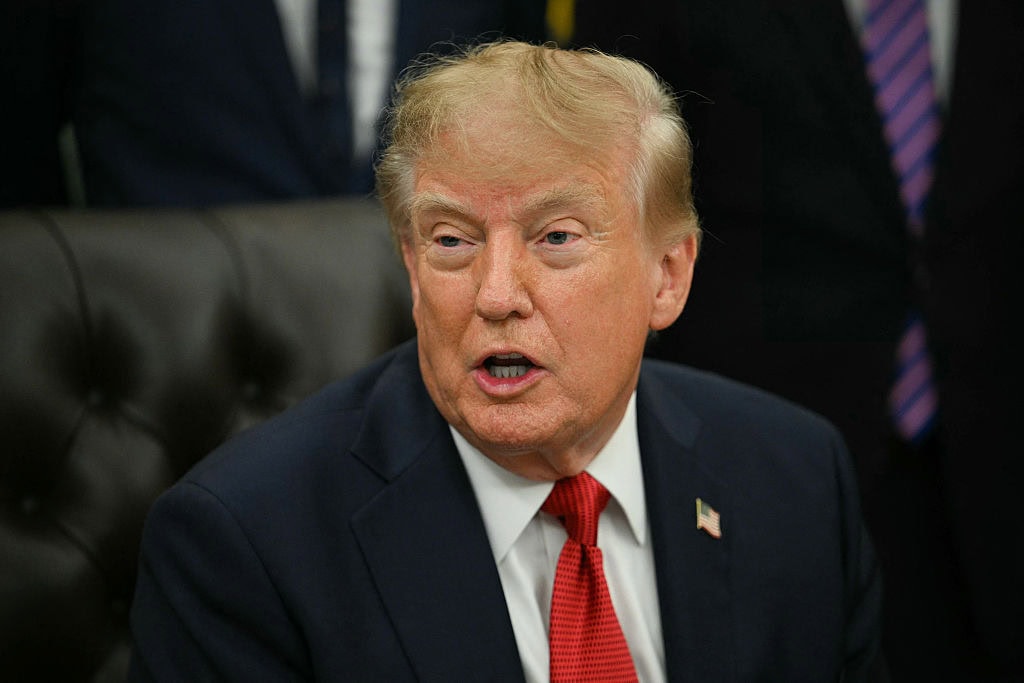
Washington is finally talking about the national debt.
President Trump may have accomplished something fiscal conservatives have been trying unsuccessfully to do for decades: he got Washington talking seriously about the national debt. All it took was promising a $5,000 payment—what he calls a “Trump Dividend”—to every adult American citizen if Republicans retain control of Congress. With roughly 240 million eligible recipients, the back-of-the-envelope cost is about $1.2 trillion.
Suddenly, the political class discovered fiscal responsibility. Critics immediately pointed out that the federal government doesn’t have over a trillion dollars lying around. They warned that the checks would increase the deficit. They reminded us that the national debt has surpassed $40 trillion. They worried about inflation, borrowing costs, and the burden we are leaving to future generations.
Those are legitimate concerns. In fact, they should have been dominating our national political debate for decades.
The federal government has been spending money it does not have at an astonishing rate. Annual deficits that once would have produced political panic are now treated almost as background noise.
A trillion dollars has become an almost meaningless abstraction. Consider how large a trillion is. A million seconds is about 12 days. A billion seconds is nearly 32 years. A trillion seconds is more than 31,000 years. Yet our political representatives routinely toss around trillions as though they are discussing the office-supply budget.
That is why the reaction to Trump’s proposed $5,000 checks is so revealing. Whatever one thinks of the proposal itself—and there are perfectly good reasons to question sending another trillion-plus dollars out the Treasury’s door—the renewed concern about borrowing raises an obvious question: Where has everybody been?
The United States did not wake up one morning with a $40 trillion national debt because somebody proposed sending Americans a check. The debt accumulated because, year after year, Congress spent more than the government collected and borrowed the difference.
Entitlement programs were created or expanded. Emergency spending became routine. Temporary measures acquired permanent constituencies. Politicians discovered that voters enjoy receiving government benefits considerably more than they enjoy paying the taxes necessary to finance them.
Washington’s addiction to debt is bipartisan, and Republican Congresses and presidents have substantially increased it just as Democrats have.
But that makes the current moment all the more useful. If a $1.2 trillion proposal is irresponsible because the country is already deeply indebted, then fiscal responsibility cannot begin and end with this particular $1.2 trillion. The same arithmetic should apply to every spending proposal.
Every dollar Washington spends ultimately comes from one of three places: current taxpayers (including importers via tariffs and, potentially, taxpayers if those costs get passed through to consumers), borrowing from future taxpayers, or money creation, which can erode purchasing power through inflation. There is no fourth category called “government money.”
That elementary fact tends to disappear from political debate whenever Congress is considering a favored program. Costs are described over ten years. Spending is called an “investment.” Borrowing is treated as somebody else’s problem.
Then somebody proposes mailing the money directly to the people, and suddenly everyone remembers that the Treasury has a balance sheet. Perhaps taking spending seriously again in speech is the most valuable thing about the $5,000 proposal.
This should immediately raise basic, nonpartisan questions: Can we afford this? Where will the money come from? How much interest will taxpayers pay on that borrowing? Is this expenditure important enough to justify passing its cost to our children and grandchildren? These questions should be asked whenever anyone—Republican or Democrat—proposes spending another dollar.
And the interest clock is already running. As the debt grows, interest consumes an ever-larger share of federal resources. Unlike most federal programs, interest cannot simply be canceled without defaulting on the nation’s obligations. Money spent servicing yesterday’s borrowing is money unavailable for defense, national infrastructure, Social Security, tax relief, or anything else tomorrow’s voters might consider important.
So by all means, debate the $5,000 dividend. Ask whether it is affordable. Calculate its effect on deficits and inflation. Demand to know where the money will come from. Senator Bernie Moreno, a Republican from Ohio, is drafting legislation to pay for it by instituting a market access fee on imports. That is a salutary development in a town that for too long has spent first without even bothering to consider who would pick up the tab.
But having rediscovered those questions, the political class should not forget them the moment this proposal disappears from the headlines.
If the prospect of $5,000 checks finally makes Americans look at a $40 trillion national debt and ask, “How on earth are we going to pay for this?” then the proposal will already have performed a useful public service.
The only question is whether Washington will keep asking it.
The American Mind presents a range of perspectives. Views are writers’ own and do not necessarily represent those of The Claremont Institute.
The American Mind is a publication of the Claremont Institute, a non-profit 501(c)(3) organization, dedicated to restoring the principles of the American Founding to their rightful, preeminent authority in our national life. Interested in supporting our work? Gifts to the Claremont Institute are tax-deductible.
Suggested reading


We need serious statesmen to emerge to prevent a fiscal calamity.

A tale of the heroic deeds of old from men of renown.

Why Morgan Stanley hires from Harvard.

They’re showing how to effectively combat the regime media.

But not in the way you think.

