

Don't bend the knee to wokeism.
Lincoln’s Corollary to the Declaration of Independence
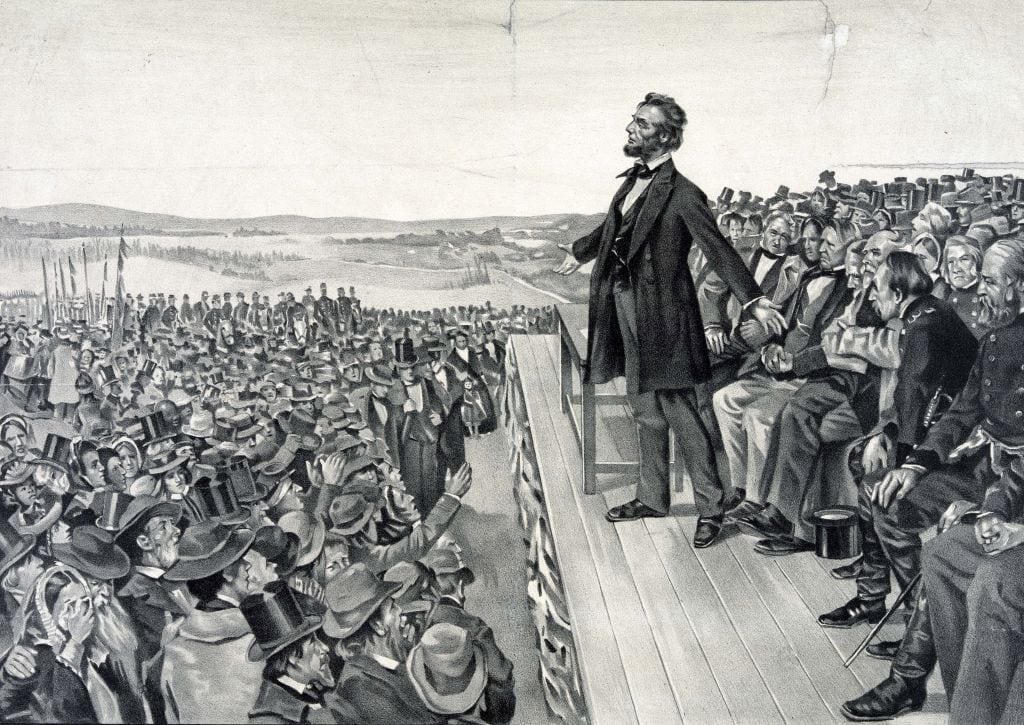
The moral logic of equality.
Editors’ Note
As we continue to celebrate the 250th anniversary of the American Founding, we will keep publishing reflections on the meaning of the Declaration of Independence, some by Claremont scholars and others by learned friends. In this piece, Professor Michael Burlingame explores Abraham Lincoln’s full-orbed understanding of the principle that “all men are created equal.” Read all the entries in our “Declaration at 250” series here.
Abraham Lincoln vastly admired the founders and the Declaration of Independence. But he felt compelled to add a silent corollary to the clause “all men are created equal and endowed by their Creator with certain unalienable Rights among them the right to Life, Liberty and the pursuit of Happiness.” That addition stated, in effect: “and the right to advance economically and socially as far as their talent, industry, ability, ambition, and determination will take them.”
Half a century ago, the late Gabor S. Boritt noted that Lincoln undertook “the task of updating the Declaration of Independence to meet the needs of a society exploding economically.” The Declaration, Lincoln believed, should be considered a ringing endorsement of social and economic mobility as the foundation of a free society. Equality of opportunity meant that everyone should have an equal chance in the race of life, but it did not mean equality of outcomes. Instead, it meant what Boritt felicitously called “the right to rise,” though he rather narrowly confined it to the realm of economics, whereas Lincoln included social as well as economic mobility.
Commenting on the Declaration’s phrase “all men are created equal,” Lincoln said,
I think the authors of that notable instrument intended to include all men, but they did not intend to declare all men equal in all respects. They did not mean to say all were equal in color, size, intellect, moral developments, or social capacity. They defined with tolerable distinctness in what respects they did consider all men created equal—equal with “certain inalienable rights, among which are life, liberty, and the pursuit of happiness.”
To understand what Lincoln was thinking, his March 6, 1860, speech in New Haven, Connecticut, is one of the most revealing expressions of his understanding of equality. In that underappreciated address, he singled out social mobility as the distinctive feature of American democracy. Alluding to a strike by workers at a Massachusetts shoe factory, he expressed sympathy for their cause: he wished that a “system which lets a man quit when he wants to…might prevail everywhere.” Lincoln explained that this was one “of the reasons why I am opposed to Slavery.” For “it is best for all to leave each man free to acquire property as fast as he can.” Lincoln continued:
I don’t believe in a law to prevent a man from getting rich; it would do more harm than good. So while we [Republicans] do not propose any war upon capital, we do wish to allow the humblest man an equal chance to get rich with everybody else. When one starts poor, as most do in the race of life, free society is such that he knows he can better his condition; he knows that there is no fixed condition of labor, for his whole life.
Lincoln cited his own biography as an example of what he meant, noting that just 25 years previously he “was a hired laborer, mauling rails, at work on a flat-boat—just what might happen to any poor man’s son!” That applied to everyone regardless of race.
I want every man to have the chance—and I believe a black man is entitled to it—in which he can better his condition—when he may look forward and hope to be a hired laborer this year and the next, work for himself afterward, and finally to hire men to work for him! That is the true system.
The Right to Rise
The most succinct expression of Lincoln’s understanding of equality and American democracy appeared in his special message to Congress on July 4, 1861, in which he summarized the case for warring against Southern secession:
On the side of the Union, it is a struggle for maintaining in the world, that form, and substance of government, whose leading object is, to elevate the condition of men—to lift artificial weights from all shoulders—to clear the paths of laudable pursuit for all—to afford all, an unfettered start, and a fair chance, in the race of life. Yielding to partial, and temporary departures, from necessity, this is the leading object of the government for whose existence we contend.
Lincoln had earlier cited his own experience in the race of life to strengthen the case against slavery. A friend recalled a speech where Lincoln noted that “we were all slaves one time or another, but that white men could make themselves free and the negroes could not.” He then pointed to his “‘old friend John E. Roll,’” who “‘used to be a slave, but he has made himself free, and I used to be a slave, and now I am so free that they let me practice law.’”
Slavery was wrong because the enslaved could not improve their social or economic condition, no matter how talented, ambitious, and industrious they were.
In 1859, Lincoln had made a similar argument before a Wisconsin audience. “The prudent, penniless beginner in the world,” he noted, “labors for wages awhile, saves a surplus with which to buy tools or land, for himself; then labors on his own account another while, and at length hires another new beginner to help him.” This was the Republican Party’s foundational doctrine, which was support for the “free labor” system:
the just and generous, and prosperous system, which opens the way for all—gives hope to all, and energy, and progress, and improvement of condition to all. If any continue through life in the condition of the hired laborer, it is not the fault of the system, but because of either a dependent nature which prefers it, or improvidence, folly, or singular misfortune.
That might explain a failure to rise, but what distinguished the more successful strivers from the less successful? In Lincoln’s view, it was ambition, industry, and a commitment to self-improvement.
Work, Work, Work
During the Civil War, Lincoln offered sage advice to a young Union officer who was squabbling with his superiors. Quoting from one of his favorite plays, Hamlet, Lincoln said that although Polonius’s counsel to his son—“Beware of entrance to a quarrel, but being in, bear it that the opposed may beware of thee”—was good, “and yet not the best.” Instead, Lincoln enjoined the captain: “Quarrel not at all.” The reasons he gave were practical:
No man resolved to make the most of himself, can spare time for personal contention. Still less can he afford to take all the consequences, including the vitiating of his temper, and the loss of self-control. Yield larger things to which you can show no more than equal right; and yield lesser ones, though clearly your own. Better give your path to a dog, than be bitten by him in contesting for the right. Even killing the dog would not cure the bite.
So do not waste time and energy that could be devoted to self-improvement in quarreling; the opportunity cost is too great.
Before his presidency, Lincoln offered guidance to another young man, a would-be attorney who asked what “the best mode of obtaining a thorough knowledge of the law” might be. Lincoln replied that the “mode is very simple, though laborious, and tedious. It is only to get the books, and read, and study them carefully.” Lincoln urged the young lawyer to read first “Blackstone’s Commentaries…say twice” and then “take up Chitty’s Pleading, Greenleaf’s Evidence, & Story’s Equity &c. in succession. Work, work, work, is the main thing.”
To a young man who wished to study law with him, Lincoln offered similarly good advice:
If you are resolutely determined to make a lawyer of yourself, the thing is more than half done already. It is but a small matter whether you read with any body or not. I did not read with any one. Get the books, and read and study them till, you understand them in their principal features; and that is the main thing. It is of no consequence to be in a large town while you are reading. I read at New-Salem, which never had three hundred people living in it. The books, and your capacity or understanding them, are just the same in all places…. Always bear in mind that your own resolution to succeed, is more important than any other one thing.
It might be objected that Lincoln’s corollary did not include blacks, for during the antebellum years when he championed the antislavery cause, he did not simultaneously champion equal opportunity for free blacks; he rather acquiesced in the dhimmitude to which they were confined by law and custom.
As he said in New Haven, he believed that the black man was entitled to enjoy a fair start in the race of life. But during the war he did little to follow through. Why?
The answer is that Lincoln believed, with reason, that to fight simultaneously for emancipation and for black civil rights would doom both causes. As he had maintained in 1854, he would support a great evil to defeat a greater evil.
Lincoln’s thinking seemed to have gone something like this: “Abolishing slavery is a life-and-death matter for 4,000,000 Southern blacks, while ending racial discrimination in the North affects 226,000 blacks whose status as second-class citizens, though truly deplorable, is much less deplorable than the plight of 16 times as many slaves. First things first; let’s not undermine both causes by fighting for them at the same time.” And Lincoln did just that.
As soon as Congress passed the 13th Amendment that outlawed slavery, Lincoln turned to black voting rights, which he publicly endorsed for the first time on April 11, 1865, and was murdered three days later for doing so.
Prudential Equality
Among Lincoln’s most vehement critics were the prominent abolitionists Wendell Phillips and Frederick Douglass, who insisted that the president fight for equal civil and voting rights during the war. But a month after Lincoln was assassinated for endorsing black voting rights, those two firebrands were in a similar situation, in which they championed voting rights for blacks but rejected feminists’ appeals to support female suffrage.
Phillips quoted Lincoln directly: “[O]ne war at a time.” The month after Lincoln was assassinated, Phillips said, “This is the negro’s hour…. The nation must settle first whether the black man shall be a citizen…. When that is secured, it will be time enough to consider the claims of woman.” In response, Elizabeth Cady Stanton indignantly declared, while sneering at Irish, black, German, and Chinese males: “Think of Patrick and Sambo and Hans and Yung Tung…making laws for…Susan B. Anthony.” She editorialized starkly:
The representative women of the nation, the daughters of Jefferson, Adams, and Hancock, who have ever been loyal to the principles of republican government, are degraded, humiliated, and outraged by being placed politically below the lowest orders of manhood…. Shall the daughters of this Republic be politically subject to the lowest orders of men—men just freed from slavery, and wholly unprepared for the responsibilities of citizenship?
To such rhetorical questions Frederick Douglass replied:
When women, because they are women, are hunted down through the cities of New York and New Orleans; when they are dragged from their houses and hung upon lamp-posts; when their children are torn from their arms, and their brains dashed out upon the pavement; when they are objects of insult and outrage at every turn…then they will have an urgency to obtain the ballot equal to our own.
This blunt retort from the same man who in 1862 denounced Lincoln for expressing support for colonization in a speech to five educated black Washingtonians, leading men of their community who had been invited to the White House, the first blacks ever so honored:
In this address Mr. Lincoln assumes the language and arguments of an itinerant Colonization lecturer, showing all his inconsistencies, his pride of race and blood, his contempt for Negroes and his canting hypocrisy…though elected as an anti-slavery man by Republican and Abolition voters, Mr. Lincoln is quite a genuine representative of American prejudice and Negro hatred and far more concerned for the preservation of slavery, and the favor of the Border Slave States, than for any sentiment of magnanimity or principle of justice and humanity.
Just as Douglass and Phillips openly emphasized the need for women to understand the necessity of prioritizing reform goals, Lincoln tacitly and tactfully made that point by postponing open support for black civil and political rights until slavery was virtually dead. Meanwhile, he had been working behind the scenes to promote the enfranchisement of blacks in Louisiana and other Southern states.
When the 13th, 14th, and 15th Amendments were adopted between 1865 and 1870, they were widely thought of as Lincolnian measures, carrying out Lincoln’s vision of a just, colorblind, egalitarian society in which people entered the race of life on a footing as equal as possible.
The American Mind presents a range of perspectives. Views are writers’ own and do not necessarily represent those of The Claremont Institute.
The American Mind is a publication of the Claremont Institute, a non-profit 501(c)(3) organization, dedicated to restoring the principles of the American Founding to their rightful, preeminent authority in our national life. Interested in supporting our work? Gifts to the Claremont Institute are tax-deductible.
Suggested reading
Morning Edition’s Steve Inskeep tried to reconcile America’s love of equality with its history, but it’s getting harder for many Americans to square that circle.
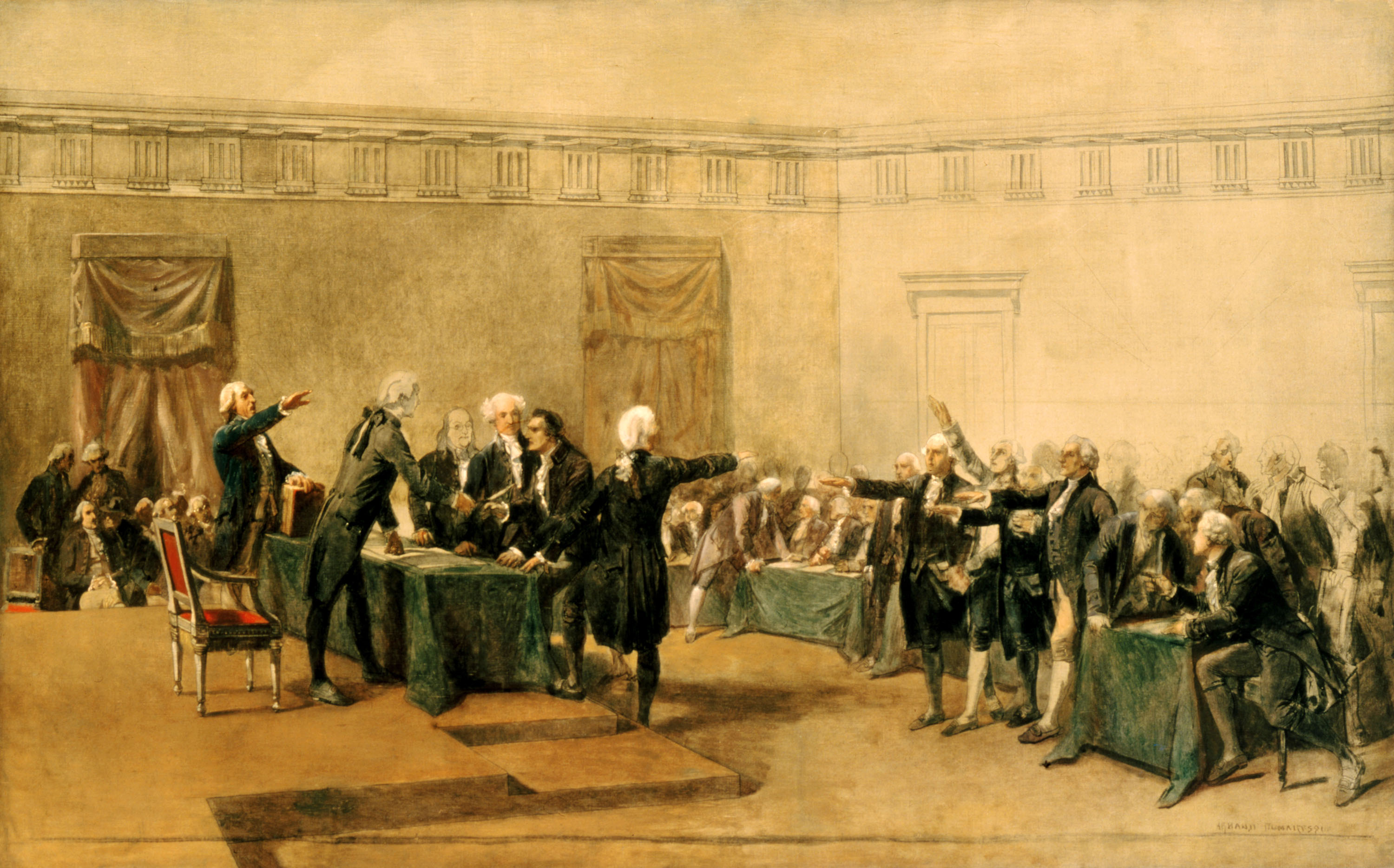
The Founders risked their blood and treasure in the fight for American self-government.
How the founders resolved the theological-political problem.

Yale is caught between what it should practice and what it must preach.

Undoing a corrupt eminent domain case doesn’t justify society-wide wealth redistribution.

