

A terrible idea whose time has come.
Why the Populist Right Is Gaining Ground
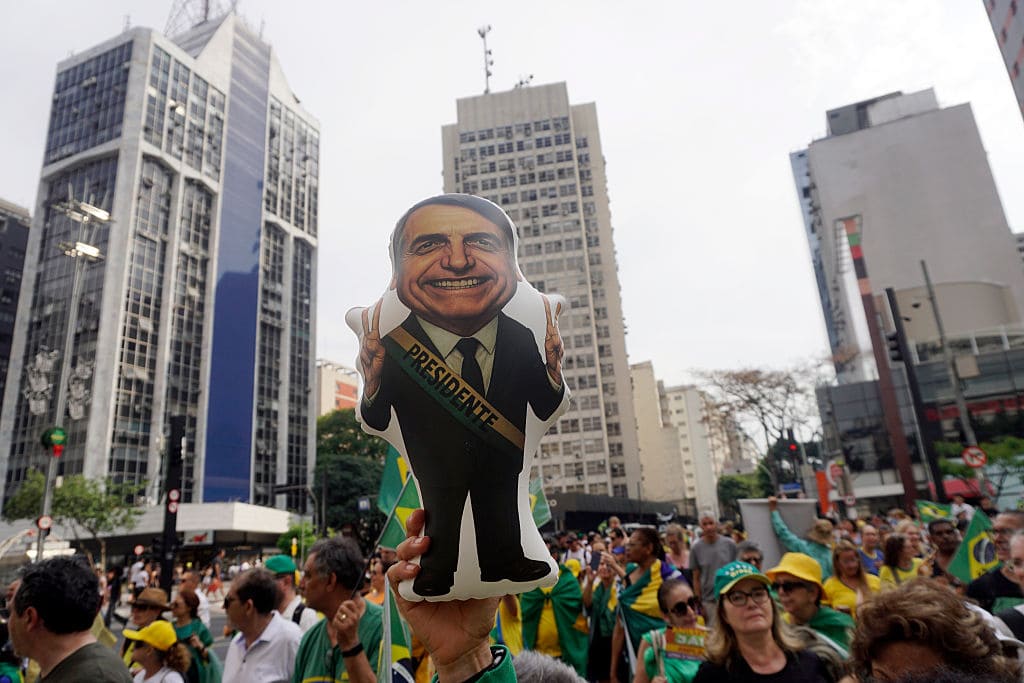
Brazil’s election and the politics of moral order.
The first round of Brazil’s presidential election is on Sunday. Two candidates are locked in a dead heat: Lula da Silva, incumbent president and founder of the center-left Workers’ Party, and Flávio Bolsonaro, the 45-year-old son of ex-president Jair Bolsonaro (2018-2022). Last year, Jair Bolsonaro was convicted of plotting a coup to remain in power after losing the 2022 election and sentenced to more than 27 years in prison.
The parallels between Donald Trump and Jair Bolsonaro are notable. They were elected in 2016 and 2018, respectively. Both are populist nationalists. Both are coarse, politically incorrect, and hostile to critics. Most remarkably, both lost re-election, after which supporters stormed the halls of Congress seeking to overturn the result. Though Trump, in contrast to Bolsonaro, avoided prison and returned to office, both command die-hard support and lead political movements that dominate the Right in their countries.
It is reasonable to ask why two countries as different as the U.S. and Brazil have followed such similar political tracks since the late 2010s. Why did the Trump model work in Brazil? Trump’s signature issues—illegal immigration and tariffs—were irrelevant there. To answer this question, we need to step back and consider populism in broad terms.
It is clear why Left populism occurs. Economic inequality arises; the rich capture the political establishment; then the poor and precariously situated vote in an outsider who soaks the rich. But why does Right populism occur? In part, because disorder also exists. Crime and illegal activities occur; drug gangs or insurgencies pop up; the political establishment fails to impose order; then the public votes in an outsider who promises to restore it.
But a separate source of Right populism is modernization itself—that cluster of shifts many countries have experienced over the past quarter millennium: from farm to industry, rural to city life, illiteracy to education, provincial, religious values to cosmopolitan, secular ones, and monarchy and dictatorship to democracy. In Left populism, the elite is the economic elite, but in Right populism, it’s the cultural elite: the shapers of opinion and culture, the cream of the urban, educated, secular, cosmopolitan class.
Certain issues activate both Right populist concerns—disorder and class conflict. Take immigration in the U.S. context. Trump tapped into a sense that mass illegal immigration was disorderly but that the cultural elite didn’t consider it a major problem or even tacitly supported it. Crime is another example. From the perspective of the Right populist voter, crime is menacing and chaotic, and a misguided liberal elite refuses to employ the harsh methods needed to address it.
Obstacles to Left Populism
Judging from both countries’ economic situations, one might think Left populism would have prevailed in the U.S. and Brazil. But left populists have been at a relative disadvantage for a few reasons, two of which are particularly important.
First, Right populists have more freedom to tack leftward on economics than Left populists have to tack rightward on culture. Consider the U.S. presidential primaries in 2016. On the Republican side, Trump was the insurgent. His signature issue, on which he outflanked his competitors, was cultural: build the wall. But on economics, he enjoyed a wide berth: he could defend Social Security and Medicare and propose sweeping tariffs.
On the Democratic side, Bernie Sanders was the insurgent. His main issue, on which he outflanked his competitors, was economic: tax the 1 percent and beef up the welfare state. But on culture, Sanders had little room to maneuver. Black Lives Matter protesters stormed the stage at one of his rallies. In a CNN debate, he was asked whether black lives or all lives mattered, and there was a right answer. Sanders gave the standard response but still lost minorities, women, and ultimately the nomination to more economically moderate candidates—Hillary Clinton in 2016, then Joe Biden in 2020.
Second, the welfare state provides a modicum of compensation to economic “losers.” Neither the U.S. nor Brazil is Scandinavia, but redistributive programs in both countries annually reduce the Gini coefficient, a classic measure of economic inequality, by five to ten percentage points. This at least marginally decreases demand for Left populism. There is no analogous mechanism for compensating those who lose out in the cultural domain. Many voters experience demographic change, affirmative action, the decline of religion, and the legalization of abortion and same-sex marriage as losses for which there is no redress. There is only the possibility of reversal—through deportation, the elimination of racial preferences, religious revival, and the reinstatement of abortion and same-sex marriage bans.
So perhaps it shouldn’t surprise us that Left populism hasn’t prevailed in Brazil or the U.S. But the question of why Right populism has prevailed remains.
The Role of Religion
Trump and Bolsonarism draw support from broadly similar perceptions: first, that society is afflicted by disorder; and second, that the cultural elite—and, more broadly, the modern elite class—is morally misguided and decadent.
The specific concerns aren’t always the same. As noted, Trump supporters are concerned about illegal immigration, and some are concerned about demographic change and lack of assimilation. These are non-issues in Brazil.
But take urban crime: it’s a massive problem in Brazil, and Bolsonaro is perhaps best known for his hardline stance on it. Although less severe in the U.S., crime is still a big problem, especially compared to Canada and Western Europe. Trump’s base has always cared about crime, which became an especially important issue during and after the summer of 2020.
Or take racial politics. The backlash to the “anti-racism” movement is a huge part of Trump’s appeal, and it is relevant to Bolsonarism, too. Whereas racist speech is protected by the First Amendment in the U.S., it is constitutionally unprotected and treated as a major crime in Brazil. In 2017, a federal judge fined Bolsonaro tens of thousands of dollars for disparaging comments he made about Afro-Brazilian descendants of escaped slaves. The U.S. Supreme Court struck down rigid racial quotas in university admissions in 1978 and the broader policy of race-based affirmative action in 2023; by contrast, the Brazilian judiciary upheld racial quotas in 2012, after which Brazil’s Congress made them mandatory in federal universities. In his 2018 campaign, Bolsonaro staunchly opposed racial quotas while supporting class-based ones.
Finally, take sexual politics—abortion, same-sex marriage, trans activism, and the like. These are major issues for Right populist voters in both the U.S. and Brazil. Trump’s 2024 campaign aired the “Kamala is for they/them; President Trump is for you” ad over 30,000 times in every swing state. Sexual politics are even more integral to Bolsonarism’s appeal. Brazil is significantly more religious and socially conservative—in that sense, more traditional—than the U.S.
Nevertheless, Brazil, like the U.S., has secularized considerably in recent decades. Movements challenging traditional views on abortion, sexuality, and gender have gained significant traction, especially among urban, college-educated Brazilians. The Workers’ Party has shifted left on sexuality and gender. So has the Brazilian judiciary, which legalized same-sex marriage in 2013, two years earlier than the U.S. Supreme Court. More recently, it has taken steps toward decriminalizing abortion and held that homophobic and transphobic speech, including individualized slurs and insults, are major crimes on par with racism and racial injury. Last year, Brazilian feminist Isabella Cêpa was granted asylum in Europe after being criminally charged for referring to transgender deputy Erika Hilton as a man.
Bolsonarism defines itself in opposition to these trends and in defense of the unborn, traditional marriage, and Christianity. Jair Bolsonaro has described himself as a “proud homophobe” and accused LGBTQ activist groups and political opponents of seeking to normalize homosexuality and transgenderism, especially in public schools. His 2018 campaign slogan was “Brazil above everything, God above all.” Jair is Catholic and raised his son, Flávio, as a Catholic, but both have cultivated strong evangelical ties. In 2016, Jair was baptized in the River Jordan by an evangelical pastor; earlier this year, Flávio followed suit.
In the end, religion may be the clearest lens through which to understand the recent political convergence of Brazil and the U.S. In both countries, politics have increasingly become a referendum on the kind of moral or religious order people wish to inhabit. Regardless of who wins the upcoming Brazilian election, that larger story will remain.
The American Mind presents a range of perspectives. Views are writers’ own and do not necessarily represent those of The Claremont Institute.
The American Mind is a publication of the Claremont Institute, a non-profit 501(c)(3) organization, dedicated to restoring the principles of the American Founding to their rightful, preeminent authority in our national life. Interested in supporting our work? Gifts to the Claremont Institute are tax-deductible.
Suggested reading
The global establishment's assault on national sovereignty.

At the National Conservative Conference, a vision of Christian humanism.
Olaf Scholz appears ready to import more Muslims.
The city’s residents never asked for this.
No, but he may have been elected by them.

