

The divide between church and state doesn’t separate religion from public education.
What’s Behind the Rise of Euthanasia in the West?
Living on borrowed time.
On July 14—Bastille Day—the French national team lost its semi-final match against Spain at the FIFA World Cup. The very next day, France’s National Assembly voted to legalize assisted suicide and euthanasia, providing a humane way out for those who could not stomach the bitter taste of defeat.
Putting aside the dark humor of the timing, France finds itself in good company now that it has legalized medical practices commonly described as “euthanasia” that actively and intentionally terminate human life. These practices are distinct from those in which a medical professional contributes to the end of a patient’s life either passively (for example, by withholding life-sustaining treatments at the patient’s request) or unintentionally (for example, by administering sedatives with the intention of easing pain, even when there is a risk of hastening death as a side effect).
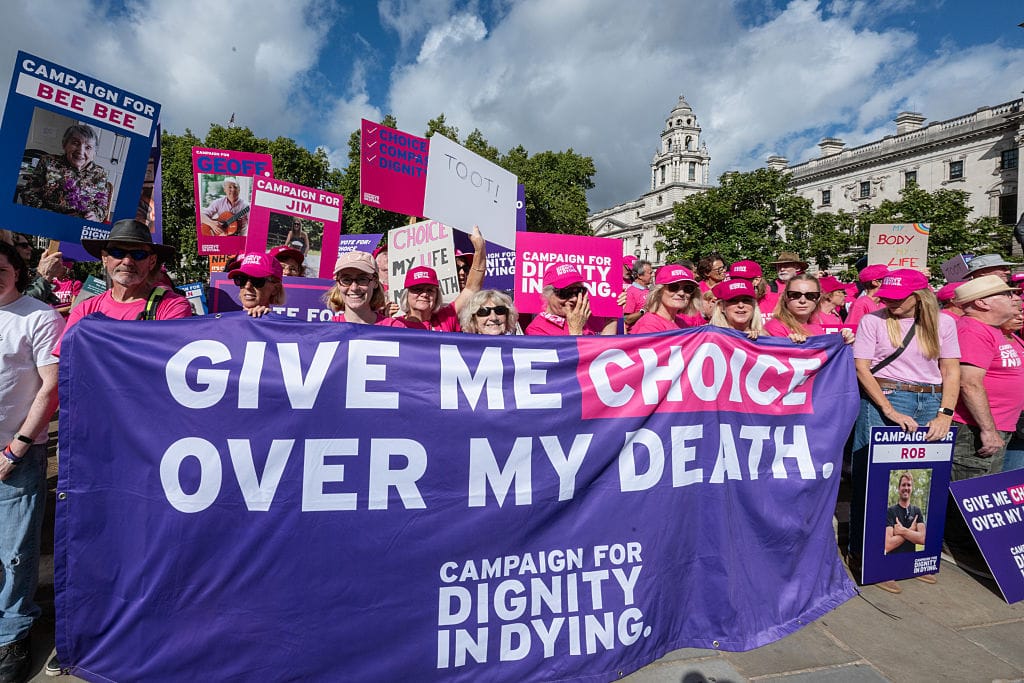
In fact, 13 other countries—including Canada, Colombia, Germany, Spain, the Netherlands, and Australia—have legalized euthanasia in some form, and mostly within the past decade. In the United States, physician-assisted suicide or medical aid in dying is legal in 14 states and the District of Columbia. In addition, the United Kingdom, Ireland, and Portugal have taken significant institutional steps toward this goal, which is part of a larger trend of euthanasia being legalized throughout the West.
As Samuel P. Huntington understood it, this cultural sphere includes the areas of Europe historically influenced by Catholic and Protestant Christianity, as well as the Anglo-Protestant settler colonies in North America and the South Pacific. The only exception is Colombia, which belongs to the closely related Latin American civilization and has a Westernized judicial elite that imposed euthanasia against the wishes of the broader society. Moreover, France’s recent conversion to the cause means that nearly the entire Western world has now legalized euthanasia: the most significant holdouts at present are the U.K., the Nordic countries, and post-Communist states in Central and Eastern Europe.
Of course, euthanasia is only one manifestation of broader social practices particular to the West. Joseph Henrich famously argued that people from WEIRD countries—“Western, Educated, Industrialized, Rich, and Democratic”—have a weird psychology that is peculiar by the standards of human history. He specifically notes, “WEIRD people are highly individualistic, self-obsessed, control-oriented, nonconformist, and analytical.”
While Henrich is most concerned with celebrating the economic and political benefits produced by the Western worldview, including industrialization, free markets, and constitutionally limited government, others emphasize its moral commitment to “expressive individualism”: that is, the belief that human happiness can be attained by discovering and expressing one’s innermost, authentic self against external constraints and conventions.
The theme of this form of individual autonomy, familiar to any student of American constitutional jurisprudence, was perhaps best invoked by Justice Anthony Kennedy in Planned Parenthood v. Casey: “At the heart of liberty is the right to define one’s own concept of existence, of meaning, of the universe, and of the mystery of human life.” Critics of the sexual revolution have made the case that much of what has ailed the West since the Swinging Sixties arises from these cultural commitments.
It might therefore appear that the current vogue for euthanasia, much like the one for pronouns in e-mail signatures, is a logical consequence of the Western world’s unusual devotion to the value of individual self-expression.
Rearing Its Ugly Head
To be sure, the first serious advocates of euthanasia in the modern West—the Social Darwinists—had little to do with expressive individualism. In addition to practices such as compulsory sterilization, they endorsed euthanasia for reasons of supposed social utility.
The prominent New York attorney Madison Grant, an early supporter of what would become the Euthanasia Society of America, wrote, “The laws of nature require the obliteration of the unfit and a human life is valuable only when it is of use to the community or race.” Such opinions waned in the aftermath of World War II, as information about the eugenics programs administered by the Nazis discredited the Social Darwinist movement among Americans and Europeans alike.
Nevertheless, the push for euthanasia revived in the 1960s and 1970s, as traditional morality came under question throughout the Western world. As observed by Neil Gorsuch (well before his elevation to the Supreme Court), “Euthanasia advocates sought to take advantage of this changing cultural climate and began to argue their position less in terms of social or biological progression, as they had done previously, and more in terms of individual autonomy and privacy.”
An excellent illustration of the autonomy-based argument for euthanasia can be found in the context of two 1997 Supreme Court cases, Washington v. Glucksberg and Vacco v. Quill, where the respondents claimed that the Constitution protects a right to voluntary euthanasia. Six socially liberal academic philosophers—Ronald Dworkin, Thomas Nagel, Robert Nozick, John Rawls, Judith Jarvis Thomson, and T.M. Scanlon—submitted a self-styled “Philosophers’ Brief” as amici curiae in support of the respondents’ position. Although the Court unanimously ruled against the respondents in both cases, these philosophers’ arguments illustrate how the legalization of euthanasia became bound up with the cultural ideal of expressive individualism. According to the brief,
Denying that opportunity [to hasten one’s death] to terminally ill patients who are in agonizing pain or otherwise doomed to an existence they regard as intolerable could only be justified on the basis of a religious or ethical conviction about the value or meaning of life itself.
In the philosophers’ view, this is morally unacceptable: “decisions [which] are momentous in their impact on the character of a person’s life—decisions about religious faith, political and moral allegiance, marriage, procreation, and death” should be made by every person “for themselves, out of their own faith, conscience, and convictions.”
The trouble with the autonomy-based argument for euthanasia is that it fails to make sense of two prominent features of contemporary euthanasia discourse.
First, most legal euthanasia regimes restrict eligibility to individuals who meet certain objective medical criteria. Even the section quoted from the “Philosophers’ Brief” above limits its argument to a specific type of patient. Terminal illness is entirely outside the affected individual’s control, while the remaining requirements seem to combine objective and subjective dimensions. However, all of these conditions would appear to be illegitimate from a purely autonomy-based perspective.
If euthanasia is justified by the individual’s supposed right to vindicate deeply held, subjective convictions about the meaning of his life, then it stands to reason that such convictions ought to be respected, even when they are not connected to terminal illness, serious pain, or any other medical condition. Of course, some academic philosophers—even Ronald Dworkin when not writing for the Supreme Court—have been willing to abandon these criteria. But legislators and judges have not followed suit in any jurisdiction.
Even the Federal Constitutional Court of Germany, while claiming that the state should not require individuals to justify their suicidal decisions by reference to any criteria of “objective rationality” (that sound you hear is Immanuel Kant rolling in his grave), adds quickly—if incoherently—that medical professionals involved in euthanasia must verify that the patient has conducted “a reality-based weighing of the pros and cons” of his decision.
Second, many euthanasia regimes that were publicly justified on the ground of autonomy, and initially allowed only voluntary requests made by competent adults, quickly expanded to accept certain instances of non-voluntary euthanasia: that is, euthanasia performed on human beings who lack the legal capacity to make autonomous requests, such as children or adults who are unconscious.
For example, Belgium legalized euthanasia for competent adults in 2002; legislative amendments passed in 2014 removed all age limits. In 2016, following a court ruling, the Canadian Parliament legalized euthanasia for competent adults, while excluding those suffering solely from mental illness and those who are unconscious. Only five years later, Parliament amended the legislation to expand eligibility to unconscious patients who have left advance instructions and, beginning in March 2027, adults suffering solely from mental illness. (It is worth noting that Parliament has so far ignored a committee report recommending eligibility for “mature minors.”)
When it comes to non-voluntary euthanasia, the decision to terminate a human life is often made by a proxy decision-maker, such as a family member or doctor, when certain medical criteria are met. It is commonly said that the proxy’s task is to measure the affected individual’s “quality of life” and to opt for euthanasia when this has fallen below a certain threshold. The very expression “quality of life” reveals the utilitarian rationale for this practice.
As the utilitarian bioethicist Jonathan Glover contends, “[K]illing is not intrinsically wrong, but is only wrong because of its implications for happiness and misery.” While it is wrong to kill someone with a “life worth living,” it is right to kill someone whose life is not worth living—a determination that ought to be made by “appealing to our own independent beliefs about what sorts of things enrich or impoverish people’s lives.” When it comes to competent adults, Glover is certainly happy to adopt a “common policy” with the proponents of autonomy, as the individual’s opinion whether he has a high or low quality of life constitutes “evidence of an overwhelmingly powerful kind” on this matter. Nonetheless, the utilitarian is willing to countenance euthanasia for other kinds of human beings as well.
The result is that many of the contemporary laws governing euthanasia are both under- and over-inclusive from the perspective of expressive individualism.
They are under-inclusive because they tether eligibility to medical criteria, excluding individuals who wish to end their lives for deeply personal reasons that have nothing to do with medicine, such as existential fatigue or unconventional spiritual beliefs.
They are over-inclusive to the extent that they include certain individuals who cannot express any convictions (including very young children in the Netherlands, Belgium, and Colombia), as long as the medical criteria are met. It is easy to detect a current of utilitarianism beneath the rhetoric of autonomy. Though, unlike the Social Darwinists, the partisans of euthanasia today are not concerned with increasing the utility of society by eliminating the so-called unfit. Rather, they purport to increase the utility of individuals suffering from a so-called low quality of life.
Nihilism, Postmodern Style
The liberalization of euthanasia laws not only offends the West’s pre-modern moral and religious traditions but also cannot be justified on the uniquely modern idea that euthanasia is a rational means of enhancing the individual’s willful control over his body and life. The deeper problem, however, is that this development is best understood as an expression of the radically skeptical postmodern spirit, which seeks cultural disruption for its own sake.
By annihilating the conviction that human life is valuable and worth preserving, euthanasia stands as a powerful addition to what Philip Rieff calls the “deathworks” of our anti-culture, whose inversions and negations of our civilizational inheritance ultimately lead to the negation of the human being. Indeed, shorn of any higher meaning, human life is readily reducible to the lowest common denominator—a bare pain/pleasure calculus that plays one of two roles in existing euthanasia regimes: either a restriction on voluntary cases or a requirement for non-voluntary ones. Were the spirit of nihilism to gain greater momentum, one should expect that the former role will eventually be abandoned, even if the latter is retained as the last available guardrail against wanton killing.
One might object that the causes of legal change should not be sought in nebulous metacultural theories but instead in material, socioeconomic reality. However, the material explanation offers no rosier picture in the case of euthanasia. The countries that have legalized it tend to have aging populations, below-replacement fertility rates, and unsustainable health care spending.
In this context, it would not be fanciful to suggest that our modern governing elites might be interested in legalizing and normalizing euthanasia for reasons of social utility—thus coming full circle to the worldview of the Social Darwinists, though our elites are more likely motivated by cost-cutting than genetic purification. Whether this explanation is more compelling (or comforting) than the cultural explanation is left to the reader, with the reminder that the two are not mutually exclusive.
The American Mind presents a range of perspectives. Views are writers’ own and do not necessarily represent those of The Claremont Institute.
The American Mind is a publication of the Claremont Institute, a non-profit 501(c)(3) organization, dedicated to restoring the principles of the American Founding to their rightful, preeminent authority in our national life. Interested in supporting our work? Gifts to the Claremont Institute are tax-deductible.
Suggested reading


We can’t count on the Supreme Court.
A qualified victory for republicanism in its removal power decisions.

The plaintiffs’ bar ignores its clients to fund left-wing activism.

Our silence made Charlie Kirk a target.
We are rapidly becoming post-civilized.

