

Democrats are laying the groundwork for revolution right in front of our eyes.
What Trump Should Learn from Old Hickory’s Succession Plan
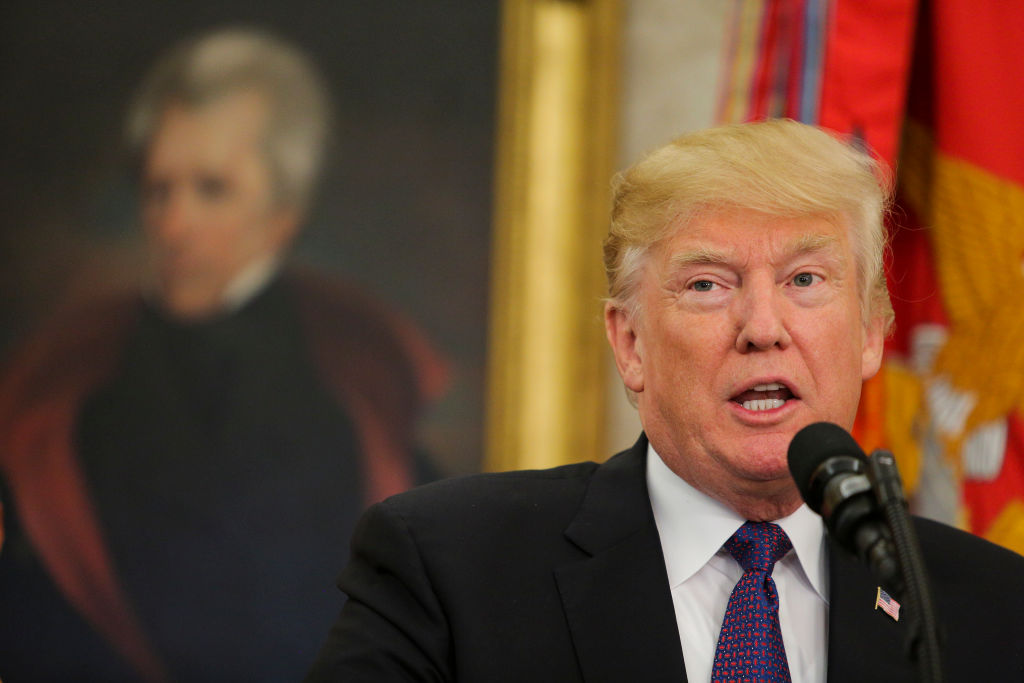
Andrew Jackson’s legacy—and Donald Trump’s.
Almost immediately after he came down the golden escalator in 2015, Donald Trump was being compared to Andrew Jackson. From his anti-establishment tenor to his breaking of norms to his raucous times in office, media observers and even the president himself have highlighted their similarities. “It was during the Revolution that Jackson first confronted and defied an arrogant elite. Does that sound familiar to you?” Trump asked in 2017 during a speech marking Jackson’s 250th birthday.
But less discussed is the comparison between Jackson’s own revolution and Trump’s, particularly the endings. While this is understandable—Trump has in many respects served as America’s past, present, and political future for the last decade, and an ending to his time at the center of American life is difficult to fathom—as 2028 draws near, those who wish for Trump’s revolution to extend past his presidencies should look to how Jackson handled his own movement after he exited the White House.
Though Jackson left office in 1837, he did not leave the political scene. In fact, his political revolution was only half over. In managing the second half, Jackson would go on to become the most powerful former president in American history—and would see his revolution through to its conclusion.
Same as the Old Boss
Most modern two-term presidents do not endorse a successor before the primaries are essentially over. Ronald Reagan waited until George H. W. Bush was the presumptive nominee. Bill Clinton did not endorse his vice president, Al Gore, until the Democratic National Convention had already begun.
Andrew Jackson, however, took an entirely different tack. Jackson made clear that his vice president, Martin Van Buren, was going to be his successor as the nominee of the Democratic Party, which Jackson had founded. Van Buren went on, of course, to win the nomination and the presidency. He understood his role as carrying on Jackson’s political revolution, lauding his “illustrious predecessor” in his inaugural address while lamenting “that I can not expect to perform the arduous task with equal ability and success.” Van Buren then became the first and only elected president to keep every single member of his predecessor’s cabinet. Francis Preston Blair, a Jackson confidante, continued to run The Washington Globe, the newspaper that had been the Jackson Administration’s mouthpiece.
Policy-wise, Van Buren continued in Jackson’s stead. Shortly before leaving office, Jackson had signed the specie circular, an executive order that mandated payments for federally owned lands to be made in hard currency. Its stringent terms contributed to an economic slump that came to be known as the Panic of 1837. Van Buren, who was politically aligned with Jackson but had not been initially supportive of his war on the Second Bank of the United States, had every reason to issue an executive order repealing the circular. But Jackson, perhaps sensing waffling on Van Buren’s part, quickly wrote to Van Buren, demanding he hold firm. The order was ultimately repealed—but over a year later, and by Congress, not by Van Buren.
Van Buren lost in 1840 to the Whigs’ version of Jackson, General William Henry Harrison, due to the economic aftereffects of the panic. Jackson, however, cried foul, believing there was no way the Whigs could have won fairly. He bemoaned “corruption, bribery, and fraud.” “The democracy of the United States,” he continued, was “shamefully beaten.”
The Whigs, run behind the scenes by Jackson’s longtime opponent, Henry Clay, finally had their chance to undo the entirety of Jackson’s revolution. But they immediately ran into a problem: their victor, Harrison, died only after a month in office, and his vice president, John Tyler, turned out to be something of a pseudo-Democrat who would go on to block all major Whig policies for the duration of the term.
Jackson—who was never truly usurped by Van Buren as leader of the party, unlike most presidential successors—understood that the election of 1844 would be his, and his revolution’s, final battle. The Whigs unsurprisingly nominated Henry Clay. If he won, Clay would do what Harrison’s premature death had stopped him from doing: undoing the entirety of Jackson’s revolution, most notably by bringing back the Bank of the United States.
There were two major roadblocks to Jackson seeing his vision restored to the White House. The first was that his previously chosen successor, Van Buren, had announced he would oppose the annexation of Texas, a major priority of Jackson’s. The second was that John Tyler was rumored to be planning on running on his own ticket.
Jackson acted quickly to dispatch both threats to his legacy. Writing to individuals around Tyler, he stressed the need for a Democratic victory. Jackson pointed out that Tyler would either be remembered fondly for selflessly backing out or negatively if he stayed in and gave Clay the win. He also ordered Blair to stop attacking Clay in the press. It worked: Tyler agreed to end his run.
Meanwhile, Jackson publicly renounced Van Buren for opposing Texas’s annexation. He called the little-known Tennessean James K. Polk to his home outside of Nashville and told him directly that he, instead of Van Buren, would be the party’s nominee. Polk was nominated shortly thereafter and beat Clay in one of the closest elections in American history.
Jackson passed away the next year, knowing that—thanks in large part to his political savvy and machinations—his 20-year political revolution had won out. No former president in American history before or after has wielded such power. Six presidents served between 1825 and 1845: John Quincy Adams, Jackson, Van Buren, Harrison, Tyler, and Polk. Jackson personally determined the political fates of all but one.
Leaving a Legacy
Jackson’s story, while not repeating Trump’s, certainly rhymes with it. Both Jackson and Trump fought what would today be called a “uniparty.” Both railed against a biased bureaucracy and fired large swathes of federal workers. And both energetically used the letter of the law—as opposed to its spirit—which had been passed by establishmentarians who never imagined someone would come along who thought differently.
And the parallels between the Whigs and Henry Clay and the Democrats and Barack Obama—both of whom had a chance to stop their usurpers but fumbled thanks to presidents who were unable to seize the moment and poor vice presidential choices—are obvious.
The main question is how Donald Trump’s revolution will end. America is now ten years in, and though Trump’s time in the White House will end in 2029, it is clearly incomplete.
Jackson too left the presidency after two terms in office. But he did not leave the political fight. Doing so would likely have meant the end of his revolution. Without Jackson’s subsequent interventions, Van Buren may have strayed from hard money politics or, if he won in 1844, deviated far from Jackson’s vision. Tyler may have run in 1844, guaranteeing a Clay victory.
If Trump wishes for the MAGA movement to remain in his image and not be frittered away, history demands he choose a successor. The most obvious candidate is his vice president, JD Vance, who was chosen in part because of his youth and ability to carry the movement into 2028 and beyond. Already, potential competitors such as Secretary of State Marco Rubio have confirmed they will support Vance should he run.
Jackson, even midway through his presidency, did not strike anyone as someone who would be deciding the fate of presidencies ten years hence. But the realization that his legacy was on the line, and his devotion to his principles, led him to more aggressively take control of the revolution he birthed.
To ensure his movement doesn’t go off the rails, Trump should do the same.
The American Mind presents a range of perspectives. Views are writers’ own and do not necessarily represent those of The Claremont Institute.
The American Mind is a publication of the Claremont Institute, a non-profit 501(c)(3) organization, dedicated to restoring the principles of the American Founding to their rightful, preeminent authority in our national life. Interested in supporting our work? Gifts to the Claremont Institute are tax-deductible.
Suggested reading


Even Trump’s haters ought to consider the benefits of shielding him from prosecution.

Loving everyone equally means loving no one in particular.

Romanticizing direct democracy leads to pandemic anarchy.

Whoever wins, we’ve got work to do.

The regime isn’t embarrassed by its violation of cherished liberal principles.

