

Meet this moment, Mr. President, before it’s too late (and it’s almost too late)
We Shall Not Fight on the Beaches
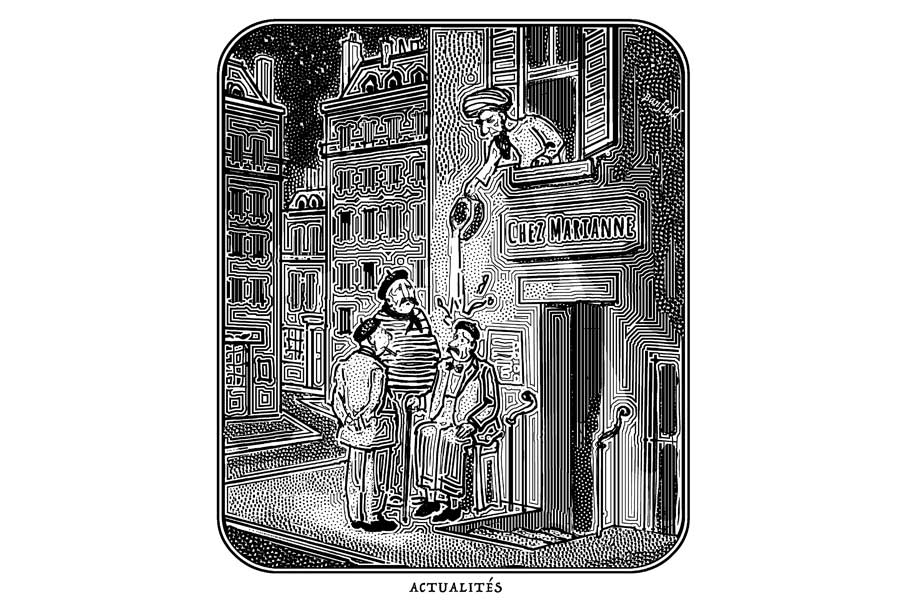
Jean Raspail was visionary, even if he did not correctly identify the source of the greatest threat.
Editors’ Note
What follows is an excerpt from Theodore Dalrymple’s book review, “We Shall Not Fight on the Beaches,” from the Spring 2026 issue of the Claremont Review of Books.
Dystopian novels are not predictions but projections: they imagine what the world will become if a current trend continues uninterrupted. The difference between prediction and projection is vital but often overlooked. The former is a call to fatalism, the latter a call to action.
In a sense, dystopian novels are both optimistic and conservative. They are optimistic in that they do not hold the future they describe to be inevitable and unavoidable. They are conservative in that they imagine a world very much worse than our own, and therefore are an encouragement to political virtues such as prudence and realism. They remind us that, short of extermination camps or other complete disasters, we always have something to lose as well as to gain and that progress often has a dark—even a very dark—side. Perfection is not of this world.
In 1973, Jean Raspail, who died aged 94 in 2020, published his dystopian novel The Camp of the Saints, for which he is now mostly remembered (certainly outside of France, though he was the author of many other well-considered novels and travelogues, and narrowly missed election to the Académie française). The Camp of the Saints is a book that refuses to lie down, so to speak, despite attempts to render it invisible or make it go away.
The plot is simple. A huge armada of rotting hulks, bearing a million impoverished and half-starved Bengalis desperate to reach Europe, which they suppose to be a land flowing with milk and honey, sets out from Calcutta and eventually reaches the south coast of France. The local population flees before this invasion, no official efforts having been made to repel it. French society collapses; the success of the armada spells the downfall of Europe, and the whole of the West, as a civilization.
***
This is a new and excellent translation by Ethan Rundell of the 2011 edition of Raspail’s novel, published by Vauban Books (whose name is a reference to the great 17th-century defensive military engineer and architect, the Marquis de Vauban). It is reasonable to conclude, therefore, that the re-translation and re-publication of the book is conceived by both its publisher and translator as an act of civilizational defense against the dangers of which Raspail warned.
In the book’s preface, Nathan Pinkoski compares it to both Aldous Huxley’s Brave New World and George Orwell’s Nineteen Eighty-Four, but I don’t think it can be put in their class. It is very badly written, too long, verbose, and frequently boring. There is always a danger that a roman à thèse will become more thèse than roman, and this is precisely what happened with Raspail’s book. Quite often, one feels on reading it as if one had been cornered at a cocktail party by a fanatic determined to get his point across who will not let you go until he has succeeded in doing so. One is buttonholed, cajoled, harangued by the narrator (who never makes his role quite clear), or by the characters, who stand for ideas rather than emerge as real human beings. The Camp of the Saints is a fictionalized essay, whose ideas could have been expressed in 20 or 30 pages.
***
From the first, the book was attacked as racist and even white supremacist. Its author spent a lot of his life describing and sympathizing deeply with remote non-white populations, so the charge against him personally cannot stick. But it is not difficult to understand why his book should have been attacked in this fashion. The desperate emigrants are dirty, foul-smelling, superstitious, concupiscent, fatalistic, heathen, unthinking, and without apparent scruple. They are not individuals, they are a mass, a vast herd, like wildebeest during their transhumance in the Serengeti. They are more biological phenomena than human beings. If I were Bengali, I would not much care to have had my compatriots depicted in this way.
But Raspail is an equal-opportunity deprecator, and his true target is the French intelligentsia and, by extension, that of the whole Western world, which he depicts as cowardly, sentimental, opportunistic, dishonest, shallow, vain, and self-satisfied. Although the intellectual class is supposed to live by ideas, it has its herd instincts, and it is of some historic interest to read how far Raspail thought political correctness and wokeness (which, of course, he did not name as such) had ravaged intellectual life as early as 1973.
Read the rest here.
The American Mind presents a range of perspectives. Views are writers’ own and do not necessarily represent those of The Claremont Institute.
The American Mind is a publication of the Claremont Institute, a non-profit 501(c)(3) organization, dedicated to restoring the principles of the American Founding to their rightful, preeminent authority in our national life. Interested in supporting our work? Gifts to the Claremont Institute are tax-deductible.
Suggested reading

Ireland’s leaders are inviting disaster.
The philosopher’s focus on citizenship is consistent with Donald Trump’s message.
We need to send them elsewhere.

The largest COVID fraud case yet reveals systemic blind spots.

The Franco-American alliance after Davos and Munich.

