

Choose wisely, get married, and stick it out.
The Swifties Face a Reckoning
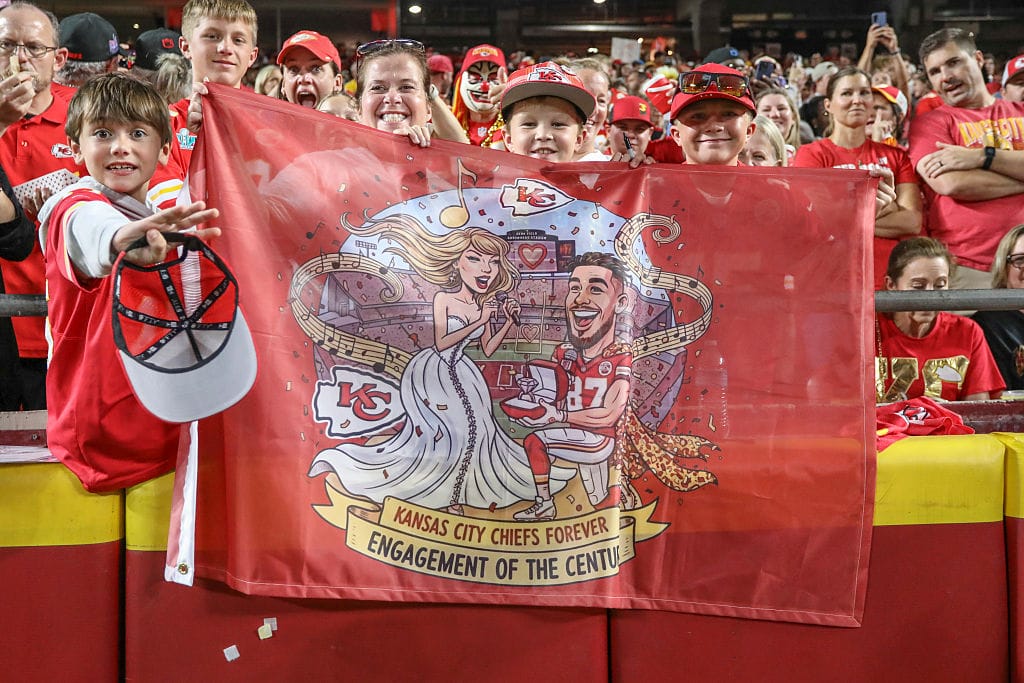
From girlboss to wife to...mother?
Taylor Swift’s recent hit album The Life of a Showgirl was characteristically catchy yet ideologically confusing. It’s a picture of a woman being torn between the life of a girlboss and the life of a wife—and possibly mother.
Deeply in love with her fiancé, Travis Kelce, Swift’s album unsurprisingly features her most sexual song to date, while other tracks reflect on her time in show business, with a mix of triumph and tragedy. Recorded during the European leg of her wildly successful Eras Tour, the album is in many ways an ode to the career she loves. But it is also a love letter filled with lyrics that are equal parts profound and a little corny, pointing toward a life in which Swift could leave the showgirl era behind altogether.
Take this set of stanzas from Wi$h Li$t, a song that mocks the soulless hustle of Hollywood and the music industry, contrasting it with the quiet happiness of family life in the suburbs.
They want that yacht life, under chopper blades
They want those bright lights and Balenci’ shades
And a fat a*s with a baby face
They want it all
They want that complex female character
They want that critical smash Palme d’Or
And an Oscar on their bathroom floor
They want it all
And they should have what they want
They deserve what they want
Hope they get what they want
I just want you, huh
Have a couple kids, got the whole block looking like you
We tell the world to leave us thе f**k alone, and they do, wow
Got me drеaming ‘bout a driveway with a basketball hoop
Boss up, settle down, got a wish (Wish) list (List)
I just want you
When Swift lets herself reflect on what truly matters, her desires are in the right place. But is she prepared for the fact that this couple of kids may require her career, her body, her youth? She may very well be. Or she may, like many celebrity mothers, hire a nanny, a surrogate, and a night nurse so her children can be seen and not heard. But Swift doesn’t strike me as that type. More likely, she will watch her past life slip away, astonished that she can do so happily. Many a girlboss’s career has fallen victim to the chubby cheeks of her irresistible 6-month-old.
In the title track of the album, Swift dons her feminist cap, romanticizing the industry that has left her with a long list of nasty exes, a history of eating disorders, and a set of backbiting friends.
Thank you for the lovely bouquet
I’m married to the hustle
And now I know the life of a showgirl, babe
And I’ll never know another
Pain hidden by the lipstick and lace (Lipstick and lace)
Sequins are forever
And now I know the life of a showgirl, babe
Wouldn’t have it any other way
It’s pointless to obsess over a stranger’s romantic and family life, least of all a celebrity’s. But Swift’s personal life in particular is worth analyzing because of the catatonic hold she has over young girls aged 16 to 35, and even beyond. Her engagement to Travis Kelce had millions of girls “screaming, crying, throwing up,” just as her breakups had her fans plotting revenge and boycotts. An artist doesn’t get that kind of support simply by writing good music. Something about her life speaks to multiple generations about what is possible for them.
To her young fans, Swift is like the successful big sister who lives in the big city and visits every Christmas, bringing the best presents and stories with her, only to vanish elusively in a week, leaving only memories and an example to live up to. If you think I’m exaggerating, you haven’t met a true Swiftie yet. And if you’re tempted to mock it, I would encourage you to seriously engage with the cultural phenomenon Swift represents. If her popularity was simply due to parroting the feminist line, Hillary Clinton would be packing stadiums, not selling books only read in airports.
Swift’s appeal is complex in the same way every reflexively feminist young woman’s wishes for life are. We all know the kind of girl who identifies as a feminist because she believes women are equal to men in virtually every way, thinks women make less than men because of sexism, and jokes that “all men are trash” after every breakup, no matter the part she played in the romance’s untimely death.
But this type of woman is also not attending any political rallies, despite voting for Democrats in the elections when she actually remembers to vote. She thinks Trump is a sexist pig but doesn’t know, or care, that her best friend is a Republican. She likes being a woman, especially the feminine niceties of makeup, skincare, fashion, and nails, all of which your typical blue-haired Women’s March feminist would decry as patriarchal trappings.
She endlessly opines that we don’t make real men anymore—the kind who open doors for her, pay the bill, and take the initiative in planning the date. She wants a masculine man who’s emotionally intelligent in the same way women are, and who will gladly be the breadwinner but find it attractive that she got that promotion at the office. She’s looking for a man who can literally and figuratively sweep her off her feet with one hand, yet is secure enough in his masculinity that he sees no problem with the guy friend who hangs out in her friend group’s bar crawls.
More than likely, this kind of woman either stays single (becoming a more obnoxious and outspoken feminist as her single years drag on) or marries a nice guy who’s very supportive, does 50% of the chores, and makes 50% of the household income. He doesn’t look very masculine in that stereotypical way that women love, no matter how liberal they are, but she tells herself that, again, that’s because he’s secure in his masculinity.
The idea of a man who is feminist, sensitive, seduced by his lady’s career success, and acts and looks in a stereotypically masculine way is the absolute jackpot for your average nice village feminist. That’s what Swift seemed to get in Kelce, and fans are both inspired and a little jealous.
Many of Swift’s fans will confront (along with her) the realities of entering into marriage and having children. It appears to her fans that she avoided the choice between feminism and performative masculinity, bagging the bearded but vaccinated football player who gladly takes a back seat to her career.
But will Swift be able to do the same when it comes to the natural follow-up to marriage—children? The bearing and raising of children strips both mother and father of any mask they wear over their own femininity or masculinity. The mother’s very body is formed to the needs of her babies through pregnancy, birth, and breastfeeding. The father sees how necessary his natural penchant for aggression and protection is as he watches his wife take on this vulnerable and nurturing role.
Swift’s fans will be watching her closely in the coming years as she builds a family with Travis Kelce. The extent to which the singer embraces her feminine role in wifehood, and hopefully motherhood, will signal to at least two generations of women what they can hope to expect from these roles themselves.
The American Mind presents a range of perspectives. Views are writers’ own and do not necessarily represent those of The Claremont Institute.
The American Mind is a publication of the Claremont Institute, a non-profit 501(c)(3) organization, dedicated to restoring the principles of the American Founding to their rightful, preeminent authority in our national life. Interested in supporting our work? Gifts to the Claremont Institute are tax-deductible.
Suggested reading


We should have seen this coming!

How Call Her Daddy made bank off of lost young women.

Radical ideologies have disfigured our home life. Here’s how to make us whole again.
Paleogals weren’t the hunter/girlbosses contemporary anthropologists want them to have been.

