

Or, How to (Posthumously) Conquer the World from Your Desk
The Renegade Academy
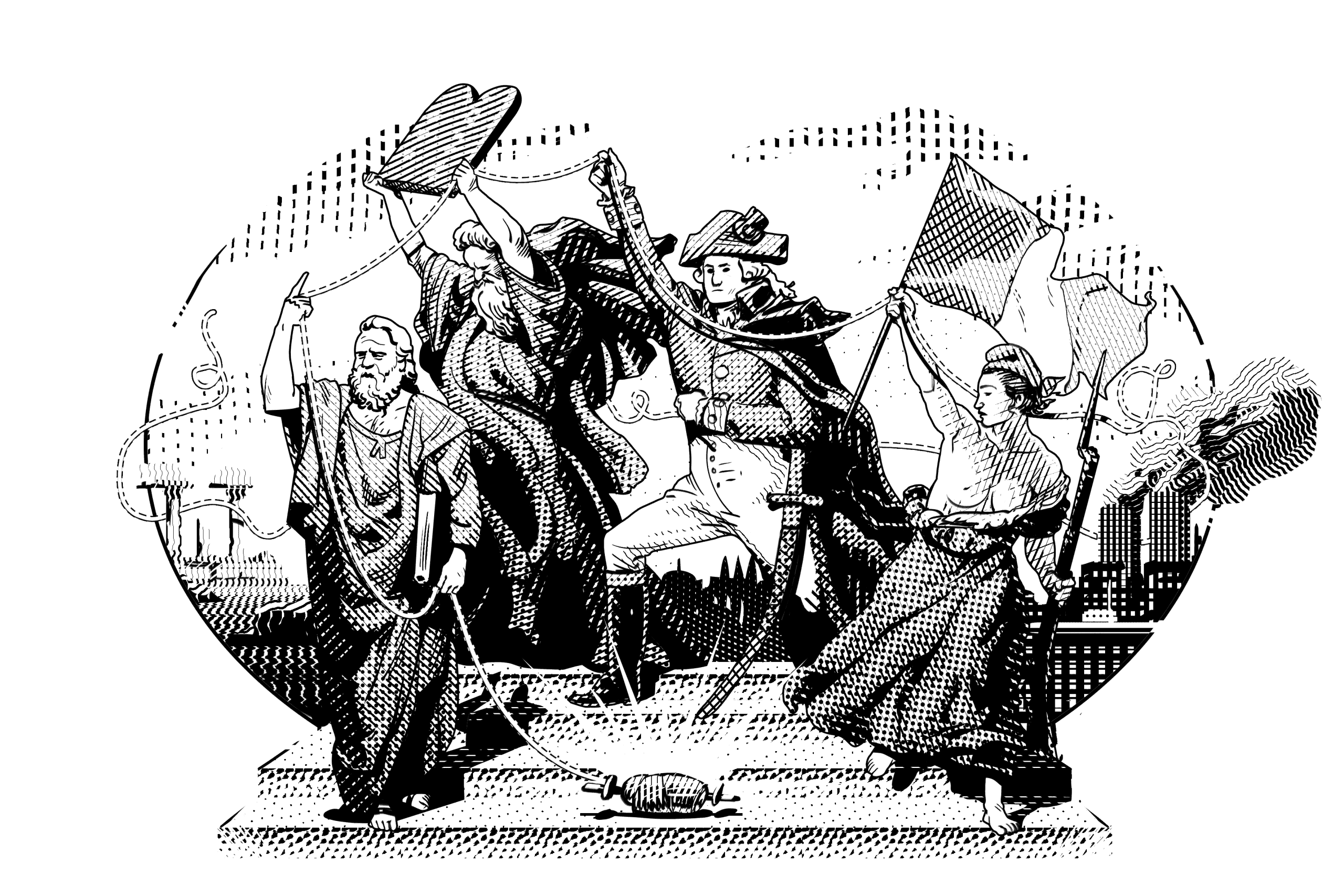
A landmark event in the history of American letters.
Editors’ Note
What follows is an excerpt from Spencer Klavan’s book review, “The Renegade Academy,” from the Spring 2026 issue of the Claremont Review of Books.
When Allen C. Guelzo and James Hankins began writing The Golden Thread, their two-volume History of the Western Tradition, they were both Ivy League professors. By the time it was published, neither of them was. Hankins, whose first volume on The Ancient World and Christendom sweeps from Greco-Roman and Jewish antiquity to the European Renaissance, gave his last lecture as a history professor at Harvard late last year. Guelzo, whose second volume on The Modern and Contemporary West begins with the Protestant Reformation and ends hauntingly with images of the World Trade Center shortly before its destruction, left Princeton last fall. Both authors are now faculty members at the University of Florida’s Hamilton School for Classical and Civic Education, established in 2022. The Golden Thread is a momentous achievement. It’s also a landmark event in the history of American letters. Its appearance signals that the country’s most prestigious universities have all but given up on maintaining the intellectual foundations of the West. For the time being, perhaps, the stewards of civilization will have to do their work outside the gates of the old academy. They will have to build something new.
***
“Few students or teachers have retained a sense that they are inheritors of a great legacy handed down via the classical and Christian traditions,” wrote Hankins last December in Compact magazine, in an article titled “Why I’m Leaving Harvard.” “When you don’t teach the young what civilization is, it turns out, people become uncivilized.” Maybe the simplest way of explaining what this means is to point out that civilization, among other things, is a kind of belonging. A civis, in Latin, is a citizen. To become civilized is to become a member of a society and a participant in a shared history. People who become uncivilized, then, become enemies. They are set in opposition to each other and to their ancestors. As Guelzo and Hankins put it in their introduction to Volume II of The Golden Thread, “Voices from outside and inside the Western tradition have condemned Westerners as oppressors, imperialists, colonizers, and appropriators.”
The term “Western civilization” encompasses the combined cultural inheritance of “Athens”—shorthand here for the pagan literary and philosophical traditions of antiquity—and “Jerusalem”—meaning the Scriptural and theological traditions of Israel and Christendom. This, at least, is what Leo Strauss argued in “Jerusalem and Athens: Some Introductory Reflections” for Commentary magazine in 1967: “Western man became what he is, and is what he is, through the coming together of biblical faith and Greek thought.” Guelzo and Hankins are well aware that this account of things took shape fairly recently. In 1869, when the English critic Matthew Arnold identified “Hebraism and Hellenism” as the twin wellsprings of European thought, he was already defending them both against what he called “the disparagers of culture” who “make its motive mere exclusiveness and vanity.” It was amid the catastrophic turmoil of the First World War that the German philosopher Oswald Spengler foretold in The Decline of the West. In some sense, then, the West only became fully self-aware when its inheritors were already worrying about its demise and laboring to shore up a common identity.
***
“It is true,” write Guelzo and Hankins in their joint introduction to The Golden Thread, “that the expression ‘Western civilization’ was hardly used before the twentieth century. It became popular in the era of the two world wars as a way to draw North Americans and overseas Britons closer to Europe and to encourage them to take responsibility for their common heritage.” All the same, “the thing denoted by the term ‘Western civilization’ was, emphatically, no invention.” In his chapter on “The Birth of Europe,” Hankins quotes the 12th-century historian Otto of Freising’s judgment that “learning was transferred from Egypt to the Greeks, then to the Romans, and finally to the Gauls and the Spaniards.” Otto may not have used the phrase “Western civilization,” but he was aware of himself as passing down the thing that would later travel under that name. “The great intellectual lights of the twelfth century,” writes Hankins, were “convinced that human reason, illuminated by revelation, was capable of building a world of order and justice, a world pleasing to God.” Like a proprietary house wine made by blending elements that can be found elsewhere—a little Grenache from over here, a little Mourvèdre from over there—the West can be seen as a set of disparate traditions fused in a unique combination. The searching reason of the Greeks and the blazing revelation of the Jews together informed the Christian faith, which in turn animated the Roman Empire’s successor states and fed the cultures that eventually produced—among other things—America.
Read the rest here.
The American Mind presents a range of perspectives. Views are writers’ own and do not necessarily represent those of The Claremont Institute.
The American Mind is a publication of the Claremont Institute, a non-profit 501(c)(3) organization, dedicated to restoring the principles of the American Founding to their rightful, preeminent authority in our national life. Interested in supporting our work? Gifts to the Claremont Institute are tax-deductible.
Suggested reading

Don't bend the knee to wokeism.

Oklahoma could make a giant leap for K-12 education.
Woodrow Wilson and his ilk need to be left in the dustbin of history.

The Franco-American alliance after Davos and Munich.

The Biden Administration holds up illiberal icon Kendi as a model of civic education

