

Remarks accepting the Claremont Institute’s Henry Salvatori Prize in the American Founding, Washington, D.C., October 27, 2018.
The Problem of the Veto State
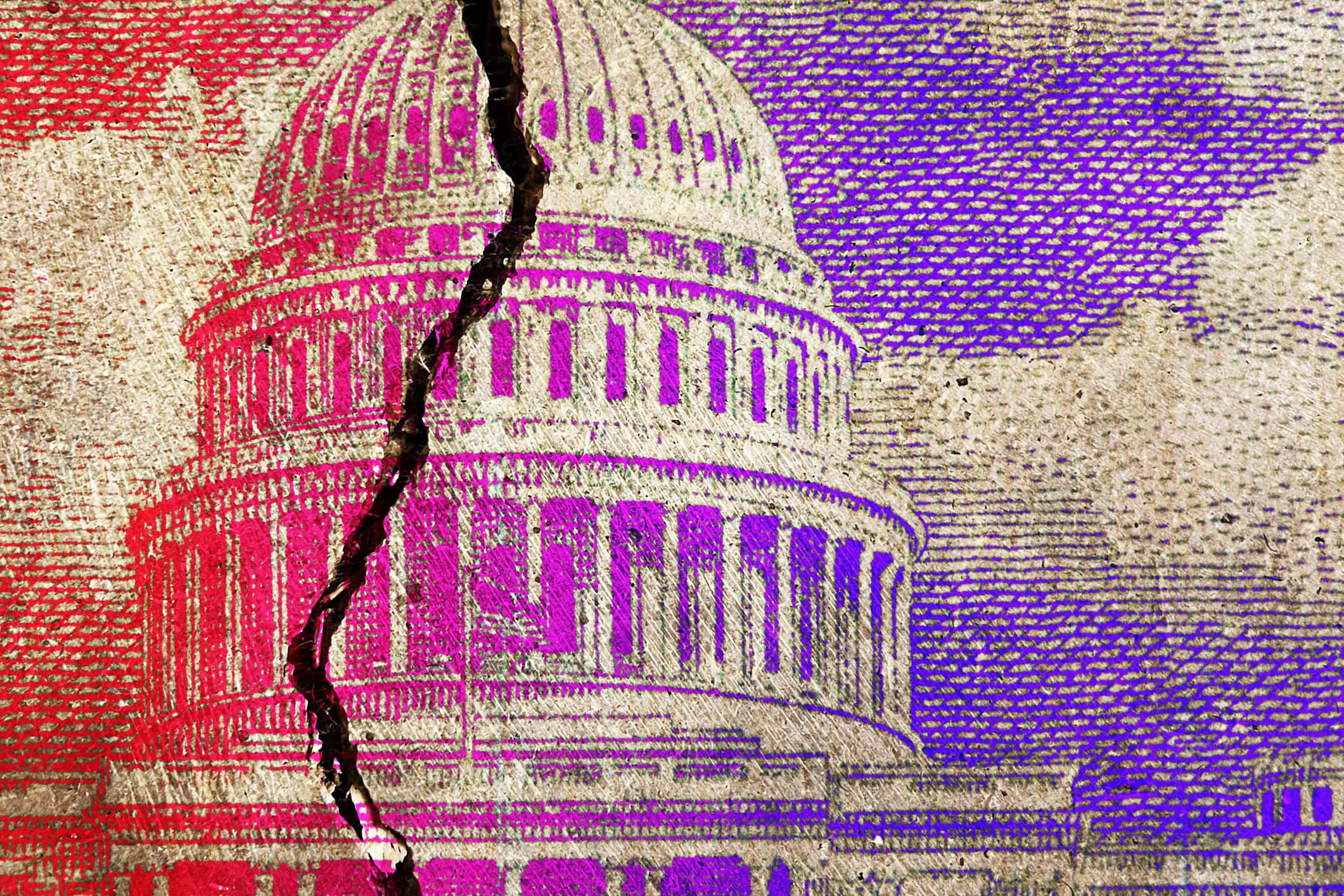
Managerialism is the culprit behind the SAVE Act’s struggles.
The Senate’s failure to pass the SAVE Act, which would require documentary proof of citizenship to vote in federal elections, is a testament to the power of the managerial regime. The bill does not attempt to remake the constitutional order, abolish federalism, or nationalize election administration in any comprehensive sense. It addresses a narrower, more elemental question: whether the American people, acting through their representatives, may insist that those who vote in American elections are in fact American citizens. The answer under the present regime appears to be no.
This is one more instance of a now-familiar pattern: the American people express a preference through elections, their representatives assemble a legislative response, and the legislature proves incapable of translating that preference into law. The constitutional machine, once praised for its capacity to refine and elevate popular judgment through its aristocratic elements, now increasingly appears to dissolve judgment altogether into a diffuse and unaccountable veto.
What is a republic (in the classical sense) if it cannot act on matters essential to its own political existence? And what becomes of constitutional forms when the ends for which they were designed can no longer be secured through them?
The Mixed Regime and Its Assumptions
The American Founders did not conceive of their Constitution as a simple democracy, nor even as a purely republican form in the modern sense. They understood themselves to be constructing what the classical tradition had long called a mixed regime, combining democratic, aristocratic, and monarchical elements into a single constitutional order. The House of Representatives would reflect the people in their numerical plurality; the presidency would supply unity and decisiveness; and the Senate would furnish a stabilizing aristocratic element—deliberative, elevated, and comparatively insulated from the passions of the hour.
In Federalist 63, James Madison describes the Senate as an institution designed to introduce a “cool and deliberate sense” into the councils of the nation. Its longer terms, smaller size, and originally indirect election were instruments intended to produce a distinct type of statesman, one capable of taking a longer view of the common good. Alexander Hamilton’s “necessary fence” was to be constructed not only of rules but also of character.
As the aristocratic element, the Senate was to be the refining body, not simply a delaying one. It was meant to supply substantive excellence, or what Aristotle would call aretē, a quality of prudence and seriousness oriented toward the common good. The Senate’s task was to elevate and perfect the judgments emerging from the more democratic branch so that they might take durable legislative form.
This structure presupposed something often left unstated in contemporary discussions: a fundamental unity of the political community on its own identity and ends. The mixed regime can function only where there exists a people capable of recognizing itself as a people, and an elite capable of understanding itself as responsible for the preservation of that people’s way of life. The tensions between the democratic and aristocratic elements are then fruitful rather than destructive, because they occur within a shared horizon of meaning.
It is precisely this presupposition that has come under strain in modern America. The forms remain; the offices are filled; the procedures operate. But the underlying agreement about the nature of the political community and the responsibility of its leading elements to preserve that community has weakened. Under such conditions, the mechanisms designed to refine popular judgment risk dissolving judgment altogether, instead producing only procedural indeterminacy.
Regarding legislation such as the SAVE Act, the Senate ends up neutralizing the public will through a diffuse and proceduralized veto. The result is not an improved or moderated policy, but no policy at all. Having lost its substantive orientation toward the common good, the aristocratic element has become a mechanism of managerial stasis. It neither governs nor allows governance. It delays without refining; it vetoes without taking responsibility.
In classical terms, this represents not the proper functioning of aristocracy but its corruption. Aristotle distinguished aristocracy from oligarchy by the end toward which rule is directed: the former governs for the common advantage, the latter for the advantage of a faction. A Senate that deploys its elevated position to prevent the polity from determining the boundaries of its own membership risks crossing that line. What presents itself as aristocratic restraint begins to resemble oligarchic obstruction.
The paradox is acute. The very institution designed to secure the conditions of democratic self-government—a stable and self-conscious political community—now acts in a manner that renders those conditions increasingly indeterminate. For if a people cannot define who belongs to it, then the demos itself dissolves into abstraction. And if the demos dissolves, the very object of democratic consent disappears with it.
What Hath Managerialism Wrought?
To understand why the Senate and other institutions of the constitutional order have become corrupted, one must consider the transformation of the American regime over the last century. The formal Constitution remains, but it is now part of what James Burnham and Sam Francis would describe as a managerial order: a system in which real power is increasingly exercised by administrative agencies, professionalized bureaucracies, quasi-public NGOs, and the media apparatus that mediates public legitimacy.
Within this order, elections continue, and legislation is passed, but the locus of effective decision-making has shifted. Policy is formulated, implemented, and often insulated from reversal by networks of experts, regulators, and institutional actors who are only indirectly accountable to the electorate. The visible institutions of the Constitution remain as a kind of outer shell; the inner workings of governance take place elsewhere.
In such a system, the classical functions of the mixed regime are subtly altered. The House may still express the immediate will of the people, but that will is filtered through party structures, donor networks, and media narratives before it reaches the legislative floor. The presidency retains the capacity for decisive action, but that action is constrained and often channeled by a permanent administrative state. And the Senate, rather than serving as an aristocracy of excellence, becomes a node within a broader network of institutional vetoes.
In light of this, the Senate filibuster needs to be seen as one instrument among many that allow the managerial regime to delay, dilute, or prevent legislative changes that would disrupt its settled priorities. When a measure such as the SAVE Act reaches the Senate, it encounters not simply the objections of a minority party, but the resistance of a wider ecosystem of interests: bureaucratic agencies concerned about implementation; advocacy organizations mobilized against it; media institutions framing it in particular ways; and political actors calculating the reputational costs of supporting it.
The result is a kind of distributed veto. No single actor needs to take full responsibility for blocking a measure. Each participates in a chain of objections, procedural hurdles, and political calculations that together produce inaction. The Senate, far from standing apart as an independent aristocratic body, becomes one more component in this system of diffused responsibility and perpetual deferral.
From a Straussian perspective, this raises a grave concern. The constitutional forms were designed to channel political conflict into a framework that could still produce authoritative decisions. A republic must be able to act, particularly on questions touching its own existence. If the regime’s institutional structure evolves in such a way that decisive action becomes exceedingly difficult—even on matters of basic political membership—then the regime risks losing not only its effectiveness but also its legitimacy.
From a Francisian perspective, we are witnessing not merely the malfunction of a once-healthy mixed regime, but the maturation of a new ruling class that uses constitutional forms as instruments of its own stability. The veto points of the system are not accidental; they are functional. They allow the managerial elite to absorb electoral pressures without fundamentally altering its direction.
The tension between these two interpretations lies at the heart of our present predicament.
A National Turn
At this point, a more difficult question arises—one that must be approached with caution and sobriety. The present situation does not rise to the level of civil war or global conflict. Yet it does raise, in a quieter but persistent way, the question of whether the existing mechanisms are sufficient to secure the basic conditions of political membership. If they are not, then pressure will build—intellectually and politically—for more decisive forms of national assertion.
The task of the responsible statesman, therefore, is not to call for extraconstitutional measures, but to examine the conditions under which they might be considered, and to recognize the risks they entail. Prudent statesmanship will seek to restore the capacity of the ordinary constitutional forms to act, precisely so that the resort to extraordinary measures remains unnecessary.
In the Straussian mind, the American Constitution represents a profound achievement of political reason, a modern instantiation of the classical mixed regime adapted to the conditions of a large commercial republic. Its defects are real, but they are to be addressed through statesmanship, civic education, and the recovery of an understanding of the common good among both leaders and citizens. The decay of the regime is, in this view, as much a moral and intellectual problem as a structural one. The task is therefore one of reform and renewal within the existing constitutional framework.
The Francisian analysis is more unsparing. It begins from the observation that modern Western societies have undergone a transformation in which a managerial elite has displaced both the older bourgeois leadership and the classical aristocratic element. This new ruling class governs through bureaucratic institutions, mass media, and administrative regulation. It uses the forms of democracy to legitimate its rule while insulating its core interests from popular control. From this vantage, the regime’s inability to act on questions such as the composition of the electorate is not an accidental malfunction, but a functional feature of a system designed to diffuse and neutralize popular demands that threaten the priorities of the managerial class.
The SAVE Act episode can be read through either lens. The Straussian might see it as a failure of political courage and prudence from those who are working in the institutions that are still capable of functioning properly. The Francisian, meanwhile, could view it as further confirmation that those institutions no longer serve their original purpose, but have been incorporated into a different regime with different ends.
The statesman in our present circumstances must navigate between these interpretations. To adopt the Francisian view in its most radical form is to risk a premature abandonment of constitutional forms that still command deep allegiance among the American people. But to ignore the Francisian insight altogether is to blind oneself to the real transformation of power and incentives that has taken place.
The prudent course is to seek a synthesis: to recognize the extent to which the regime has been altered by managerial structures while trying to recover, within the constitutional order, a renewed sense of national purpose and responsibility. The aim should be to reestablish a genuinely national and self-governing order.
Administrative Empire
The debate over the SAVE Act will in all likelihood pass from the headlines. The bill may fail in the Senate; it may be revived in altered form; it may become a point of contention in future elections. In that sense, it is one episode among many in the ordinary course of American politics.
Yet as a diagnostic moment, it should not be dismissed. It reveals a regime that finds it difficult to act decisively even on questions that bear directly on its own political identity. It shows an aristocratic element that has lost much of its classical character, and a set of institutions increasingly embedded within a managerial order that diffuses responsibility and delays decision.
A republic in the classical sense is a public thing—a political community capable of deliberating and acting on its own behalf. However, if the political mechanisms of that community no longer reliably produce action on matters essential to its existence, then the forms of the republic risk becoming hollowed out, maintained in appearance but weakened in substance.
The choice facing Americans is not between constitutional government and open authoritarianism. It is more subtle, and therefore more dangerous: a choice between a renewed republic capable of recovering its capacity for self-government within its constitutional forms, and a gradual drift toward an administrative empire, in which decisions are made elsewhere and the people’s role is reduced to periodic ratification of outcomes they do not control.
To recognize this condition is not to despair, nor is it to counsel reckless action. It is to understand the seriousness of our political task. Preserving a free and self-governing people requires not only sound institutions, but also a clear grasp of who that people is and a willingness, through lawful means, to sustain the boundaries of our common life.
The American Mind presents a range of perspectives. Views are writers’ own and do not necessarily represent those of The Claremont Institute.
The American Mind is a publication of the Claremont Institute, a non-profit 501(c)(3) organization, dedicated to restoring the principles of the American Founding to their rightful, preeminent authority in our national life. Interested in supporting our work? Gifts to the Claremont Institute are tax-deductible.
Suggested reading


Statesmanship in a post-Constitutional moment

Voters, not private litigants, should get to decide if Trump is re-elected in 2024.

It’s time for the Supreme Court to restore property rights.
How Straussians interpret the founding.

The Democrats love to play pretend.

