

Mr. B.A. Pervert Knows Leftists Don't Believe in Democracy.
The Moral and Political Wisdom of C.S. Lewis
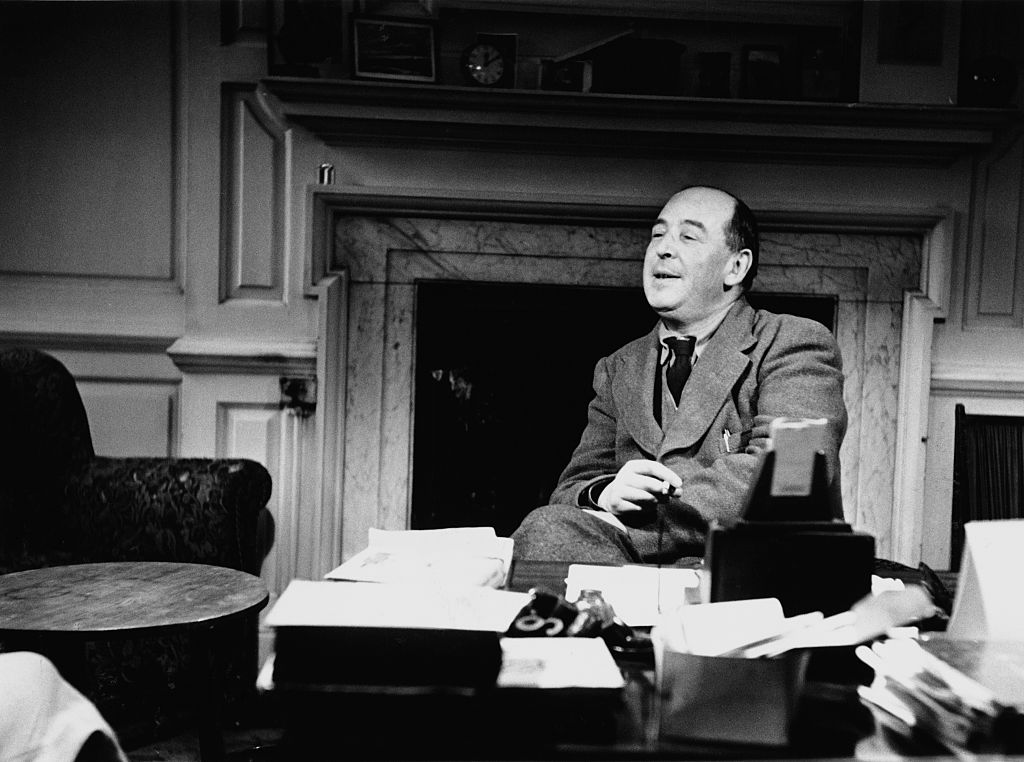
From The Abolition of Man to “Screwtape Proposes a Toast.”
The great Christian apologist and literary critic C.S. Lewis provides a surprising amount of moral and political wisdom despite not being a political thinker in any formal sense of the term. For example, the three lectures that form The Abolition of Man remain a must-read for understanding the crisis of our time, as well as the path to recovering the wisdom that will allow us to overcome it.
Without relying on divine revelation or biblical faith per se, Lewis takes aim at what he elsewhere calls “the poison of subjectivism,” and also makes a compelling defense of the existence of a moral consensus among mankind that transcends cultures, polities, and historical epochs. In the book’s final section, he provides a searing analysis of the profound tendency of the modern project “to conquer nature for the relief of man’s estate,” which leads to the temptation to conquer human nature in the name of illusory “progress”—that is, to abolish human beings once and for all.
As this example illustrates, in The Abolition of Man Lewis identifies and lays out the pathologies of the age with remarkable insight and clarity. He makes his prescience seem all too easy, precisely because it is in decisive respects the common sense of the matter. Indeed, our crisis might be defined by the very effort to expunge common sense and “right reason” about good and evil (recta ratio as Cicero called it) from the hearts and minds of modern men and women. The Abolition of Man reveals a Lewis who, while an amateur moral and political philosopher, puts his finger on essentials.
A quick perusal of Compelling Reason, a collection of Lewis’s “Essays on Ethics and Theology,” shows that The Abolition of Man does not stand alone as a contribution to first-rate moral and political reflection.
The essay “Why I Am Not a Pacifist” compellingly argues that pacifism not only has a “doubtful factual basis” but also ignores the “weight of authority both human and Divine” that stands against it, including the New Testament rightly understood. Another essay, “The Humanitarian Theory of Punishment,” takes aim at an approach that severs punishment from just “desert,” and actually subverts justice by confusing deserved punishment with mere “revenge.” The “semblance of mercy” that informs it, Lewis argues, is “wholly false,” a sentimentalized substitute for both Christianity and right reason. In a final coup de grâce, Lewis exposes the paradox we see all around us: “Mercy, detached from Justice, grows unmerciful.”
Lewis’s most classically liberal essay (although it more deeply appeals to the twin sources of honor and self-respect), “Willing Slaves to the Welfare State,” sets its sights on a new oligarchy in the form of an increasingly unaccountable bureaucratic state, one evident at the time in Lewis’s England and the Western world more broadly. It diminishes human beings in the name of taking care of their manifold (and seemingly inexhaustible) “needs.” Renewing the theme of the third and final essay of The Abolition of Man, Lewis suggests that the thoroughly “planned” society, dominated by experts who have no special claim to moral and political wisdom, will turn excessive power over to sometimes “greedy, cruel and dishonest” men, and certainly imperfect ones. The concluding lines of the essay are at once apt and disturbing: “The more completely we are planned the more powerful they will be. Have we discovered some new reason why, this time, power should not corrupt as it has done before?”
Lewis is also a great guide for distinguishing true equality, consisting of intrinsic dignity and worth, from those misplaced substitutes that are inevitably corrupt and demeaning. Like Aristotle, Tocqueville, and Lincoln before him, Lewis distinguishes a noble conception of equality from the debasement that comes with every effort to transform moral and legal equality into a leveling and homogenizing egalitarianism. Tocqueville, for example, distinguishes true equality from a debased “passion for equality” that tears down the “great” rather than elevating the disadvantaged, the weak, and those striving for a higher level. Without ever having read Tocqueville (or so it seems), Lewis completely agrees with the French thinker. His most penetrating treatment of the problem of true and false equality can be found in a gem of an essay, the brief but wonderfully discerning “Equality,” which can be found in both Compelling Reason and another Lewis collection, Present Concerns.
In the essay, Lewis identifies with the democratic cause because he believes in “the Fall of Man,” not because he has undue confidence in the political potentialities of human nature. No human beings are so virtuous, so wise, or so good that they can or should rule others without an element of consent and reciprocity, and without the requisite constraints on “unchecked power.”
With a twinkle in his eye, Lewis agrees with Aristotle that some human beings are by nature “only fit to be slaves.” But he quickly adds, “I reject slavery because I see no men fit to be masters.” Lincoln certainly agreed, and an argument can be made that Aristotle ultimately did too. The Greek philosopher defends “political rule,” or “ruling and being ruled in turn,” in contrast to despotism, the “rule of masters over slaves.” Aristotle may not have believed in original sin, but he readily acknowledged that the capacity for wickedness was inherent in human nature.
In the rest of this brief but scintillating essay, Lewis warns that equality can become poisonous when it is extended beyond its legitimate sphere. While “it would be wicked folly to restore…old inequalities on the legal or external plane,” he argues that “under the necessary covering of legal equality, the whole hierarchical dance and harmony of our deep and joyously spiritual inequalities should be” kept “alive.” In this way, Lewis deepens and enriches the best of liberalism by drawing on classical and Christian wisdom, the moral capital of the ages, so to speak. Without it, equality will readily undergo “diabolical” distortions, as Lewis makes clear in “Screwtape Proposes a Toast,” the delightful postscript to The Screwtape Letters that he finished writing in the year before his death in 1963.
In the speech that accompanies his toast “at the annual dinner of the Tempters’ Training College for young Devils,” the senior devil Screwtape reflects on the paucity of gastronomic delights—human souls!—for Satan’s minions in an age of profound spiritual mediocrity. The “lukewarm casserole of Adulterers” is hardly a culinary delight, and “great sinners” and “great Saints” are increasingly hard to find. Much of the human race, alas, has been reduced “to the level of ciphers.” But Screwtape finds solace in the promise of envy and unhinged egalitarianism in a democratic age.
Screwtape points out that democracy has become much more (and less) than a tolerably good way of organizing a political community, becoming a leveling claim that “I’m as good as you” whatever I do or say. In this connection, Screwtape reminds the young diabolic tempters never to mention Aristotle’s question from Book V of the Politics “whether ‘democratic behavior’ means the behavior that democracies like or the behavior that will preserve a democracy.” To remind democratic man of that question is to suggest to them “that these need not be the same.” Screwtape also states that while envy is as old as the human race, “the incantatory use of the word democratic” gives it a deceptive cover. The “fear of being undemocratic” saps both virtue and initiative and undermines authentic individuality.
One of Lewis’s deepest insights is that a radicalized, hyper-egalitarian democracy can more efficiently fulfill the age-old dream of the tyrant to level, flatten, debase, and tyrannize. Here too Aristotle helps. Screwtape alludes to Book V of the Politics where Aristotle gives an account of one tyrant instructing another tyrant about how to preserve his rule by lopping off heads of corn in a field to the same level. “Cut them down to a level; all slaves, all ciphers, all nobodies. All equals.” A debased democracy can do the work of tyranny through a “tyranny” all its own. Screwtape also makes clear that the ultimate goal of their diabolical efforts is not only the degradation of society but also the damnation of souls. Salvation is the true aim of all souls, including democratic souls. Via Screwtape, Lewis’s artful instruction is complete.
In delightful and charming literary forms, C.S. Lewis conveys moral and political insights that remain all the more true for being so profoundly countercultural. I recommend his writings and insights to those who are tired of the loud voices that dominate the public square and who wish to think about politics and the soul freed from contemporary blinders and distractions. C.S. Lewis the “political philosopher” remains well worth exploring, not to mention discovering, as it were, for the first time.
The American Mind presents a range of perspectives. Views are writers’ own and do not necessarily represent those of The Claremont Institute.
The American Mind is a publication of the Claremont Institute, a non-profit 501(c)(3) organization, dedicated to restoring the principles of the American Founding to their rightful, preeminent authority in our national life. Interested in supporting our work? Gifts to the Claremont Institute are tax-deductible.
Suggested reading


Will freedom survive the death of Canada’s Freedom Convoy?

We don’t need a revolution to find political redemption.


An open letter to aspiring Chads.

Christians must reclaim a robust understanding of Christianity’s role in public life.

