

At the National Conservative Conference, a vision of Christian humanism.
The Indispensable Civilizational Alliance
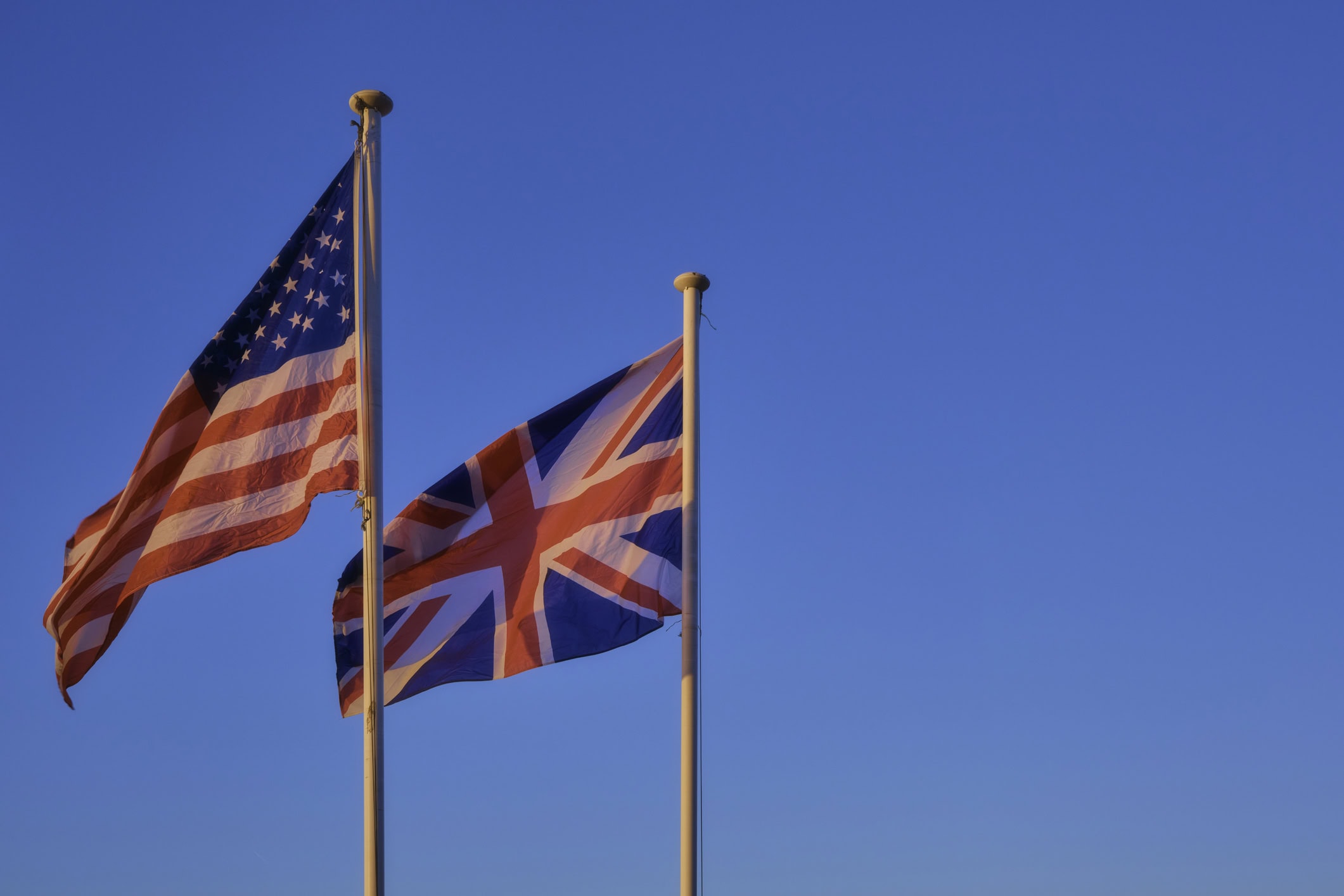
We must regain the courage to defend our nations.
Editors’ Note
This is a lightly edited version of a speech given on June 22 at a joint event in London hosted by The Heritage Foundation, The Claremont Institute, and the Conservative Partnership Institute.
A few miles from this room, 86 years ago, Winston Churchill stood in the House of Commons, with Hitler’s army right across the English Channel, and delivered a speech for the ages. We all remember how he ended: “we shall fight on the beaches…in the fields and in the streets…we shall never surrender.” But we stop one sentence too soon. Immediately following that famous line, Churchill made another assertion: that even if his island were subjugated and starving, the struggle would go on “until, in God’s good time, the New World, with all its power and might, steps forth to the rescue and the liberation of the old.”
In Britain’s darkest hour, Winston Churchill looked across the Atlantic—to a younger nation born of English stock—and staked the survival of the West on the promise that America would come.
And America did come. We joined our British brothers in arms with courage—and with steel. From the shipyards of the Clyde to the assembly lines of Detroit, we together churned out boats, guns, cars, and planes faster than the enemy could destroy them. Our industrial capacity was not accidental. It was the mark of a confident, strong alliance, built upon a shared civilization ready to defend its way of life. It was propelled onwards unto the breach by the “Anglo-Saxon courage” that President Trump hailed during King Charles’s visit in April—a unique and distinctive gift of our common inheritance, running through the veins of Americans and British alike, persisting across centuries and continents.
Now the Anglo-American alliance has never run one-way. Two days after September 11, under orders from the great Queen Elizabeth II, the guard at Buckingham Palace played not “God Save the Queen” but “The Star-Spangled Banner.” Grieving Americans heard our own anthem rise above London and understood we were not alone. We saw across the ocean not just an ally, but a brother—mourning with us on the basis of something far more fundamental and ancient than mere strategic ties. That moment was not an act of diplomacy, but of kinship.
But our bond runs deeper than wars and anthems.
“We Hold These Truths”
In 1215, in the fields of Runnymede, an English king was made to put in writing that he was not the author of the law but its servant—that the “law of the land” stands above the throne. Five and a half centuries later, a document drafted in Philadelphia opened by appealing to “the Laws of Nature and of Nature’s God,” and declared that men are “endowed by their Creator with certain unalienable Rights.” Different centuries, yet the same fundamental truth. Jefferson did not invent that truth in Virginia. He inherited it from Runnymede, from the common law, from England, and from the great Western civilization that preceded it.
Similarly, in 1535, on the scaffold at Tower Hill, Sir Thomas More—whose feast day, I just learned, we are celebrating today—called himself “the King’s good servant, and God’s first.” Not but God’s. And God’s. Saint Thomas understood that a man who serves the king contrary to the natural law is no true subject. Instead, a man who serves the king in accord with virtue and faith has a loyalty and a patriotism much more profound than anything a tyrant could erase. Thomas More was not the only Englishman to understand this: John Fisher, Edmund Campion, Thomas Becket, and many others would also give their lives as a profound witness to this truth.
Two and a half centuries later, after leading America’s own fight against tyranny, George Washington would echo Thomas More in his Farewell Address, insisting that religion and morality are the nation’s “indispensable supports,” and that no republic should expect its integrity to outlast its faith. Washington understood that no matter the political system, free people must be governed first by virtue and faith, by being the nation’s good servants and God’s first, or they would soon be overtaken by accident and force. Drawing from his Christian forebears, Washington proclaimed that faith was not ancillary to America’s system of self-government, but its lifeblood.
The West is, above all, an embodied reality, with a unique and distinctive character, visible everywhere and anywhere they appear—from the English shires to the Australian outback to the great American frontier. It is a people possessed by destiny, by the spirit of adventure; the sons of a small island kingdom that built an empire upon which the sun never set—so vast that it transcended the reach of the night itself.
It is a people with a clear-eyed vision of who man is and what he is made for—who recognize, at the core, that man is made in the Imago Dei, the image of God. From Aquinas and medieval monasteries to Runnymede and Philadelphia—our ancestors held to this fundamental truth.
And this is why the Trump Administration cares so deeply about Europe, and about Britain.
Our Difficult Task
Yet our civilizational alliance is precisely what so many today seek to erase. There is a movement across the West that treats our great inheritance as a source of guilt and shame, as something to atone for rather than to hold sacred. It calls tradition backward, faith antiquated, patriotism extremism, the family oppressive, and borders xenophobic. In this new religion, rights are not the recognition of God-given dignity but the whims of governments, NGOs, and bureaucratic institutions. Disagree, and you are flagged, fined, de-banked, disqualified, and in some cases prosecuted.
Now, unfortunately our friends in Great Britain know this reality best of all. A mother arrested for praying silently on a sidewalk. An entire generation of young British girls subjected to unspeakable forms of abuse by savage foreign gangs, not merely because they were girls but because they were British. A political class that not only refuses to acknowledge such crimes but persecutes and criminalizes those who do. An ever-expanding content moderation regime drafted by unelected bureaucrats and enforced by threat of fines against those who do not comply. This is not the defense of democracy; it’s an offense against it.
If you hollow out the West’s anthropology, you do not get a neutral, frictionless order. You get a “gray goo” society that no longer believes it has anything worth defending and a people without the confidence or clarity to defend against shared external threats. And make no mistake: every measure of strength we surrender only empowers our true adversaries around the world.
This is a threat to all of us: Americans, Britons, Europeans alike. Under President Trump, America has been given something of a reprieve—a chance to recover our borders, our industry, our faith, and our founding ethos. However, we have no illusion that this reprieve is permanent. And it is precisely because we have been given a little room to breathe that we now turn back toward our friends, and toward the special relationship with the United Kingdom first and foremost.
Our common project is one of restoring civilizational self-confidence. Yet this is not merely an academic exercise. Confidence that lives only on social media or in lecture halls is not confidence, but nostalgia. A civilization sure of itself builds things. It defends its people. It leads in the industries that decide the future. It keeps its hand on the supply chains that sustain it, not out of selfishness, but for the common good.
This confidence was once the backbone of the Anglo-American alliance: shared defense, shared invention, shared industrial might. We all let it wither. We deindustrialized in the name of efficiency and in the process offshored our sovereignty. We routed the supply chains for our medicines, our microchips, and our minerals through the territory of our principal rival and called it free trade. We let our shipyards close and our defense industrial base thin to the point where the arsenal of democracy could not, today, do what it did in 1943.
This confidence demands meeting our defense commitments, not merely as lip service to an alliance but as a primary duty that a nation owes its own people. It demands rebuilding sovereign capacity in the industries that matter—shipbuilding, energy, technology, and advanced manufacturing. It demands a Western supply chain for critical goods that no adversary can switch off. It demands that we once again traverse the frontiers of space and human excellence, instead of regulating ourselves into ineptitude. A West that cannot make its own steel, its own ships, its own chips, and, importantly, its own patriotism is not sovereign.
And now the hardest matter: mass migration.
Mass migration, pursued without limit and without consent, is not one issue among many. It is the leading edge of civilizational erasure. A people is not an interchangeable population, and the West is not a set of “ideas” that anyone can simply adopt by stepping across a border. It is a particular inheritance sustained by those who belong to it. Mass migration is charitable to neither migrants nor citizens—and is rife with human trafficking, sexual violence, and the replacement of native populations. To admit large numbers of alien peoples is not to enrich Western civilization but to dissolve it. This is an existential crisis facing all of us. Yet too many Western leaders have abandoned civilization in service of their own oikophobia—guilt, self-hatred, and all-consuming hostility toward one’s own homeland—often against the direct wishes of their people. And yes, we also see this concerning movement in America as well.
Against this crisis, our shared tradition—our special relationship—should answer with clarity: sovereignty is not the enemy of human rights but their precondition. Law and order is not injustice, but necessary to human flourishing. Virtue is not repression, but the road to true freedom. Our civilization is not something to be embarrassed by, but something deeply good and true.
Rebuilding Civilization, Together
Let me close where I began.
This year America marks its 250th birthday, and we know we have good roots. We were English before we were American. Our liberties were the Magna Carta’s before they were the Declaration’s. Even our defiance in 1776 was, in no small part, an attempt to rediscover the “Laws of Nature and of Nature’s God” that England once taught to us.
But America’s gratitude cannot be passive. Churchill did not say the New World would merely wish the old well. He said it would step forth. This is what America is doing now, and as we do so, we ask you, our friends in the United Kingdom, to join us. As our ancestors did as they mapped an untamed North America and charted untraveled waters under the Union Jack, what Americans and Britons on both sides of the Atlantic must do is step forth together and execute a deliberate effort of civilizational renewal. We must rediscover our shared history, our common faith, and our core virtues, and manifest those realities in strong and sound public policy that defends borders, dominates in industry, protects our freedoms, and leads together on the global stage. We must regain the courage to build nations worth defending—and defend them without apology.
Our shared history has been one of stepping forth time and time again in the interest of and in the aid of the other. I am confident we can do so once more, together.
The American Mind presents a range of perspectives. Views are writers’ own and do not necessarily represent those of The Claremont Institute.
The American Mind is a publication of the Claremont Institute, a non-profit 501(c)(3) organization, dedicated to restoring the principles of the American Founding to their rightful, preeminent authority in our national life. Interested in supporting our work? Gifts to the Claremont Institute are tax-deductible.
Suggested reading

Volker Türk is the face of everything that has gone wrong in international affairs.

Keep America Great Alive
Can we change course before disaster hits?

We celebrate the civilization he carried into the New World.

The Right should reclaim the populist ground that enabled its biggest victories.

