

Why African Americans should be very, very mad at the Democratic Party
The Disparity Obsession
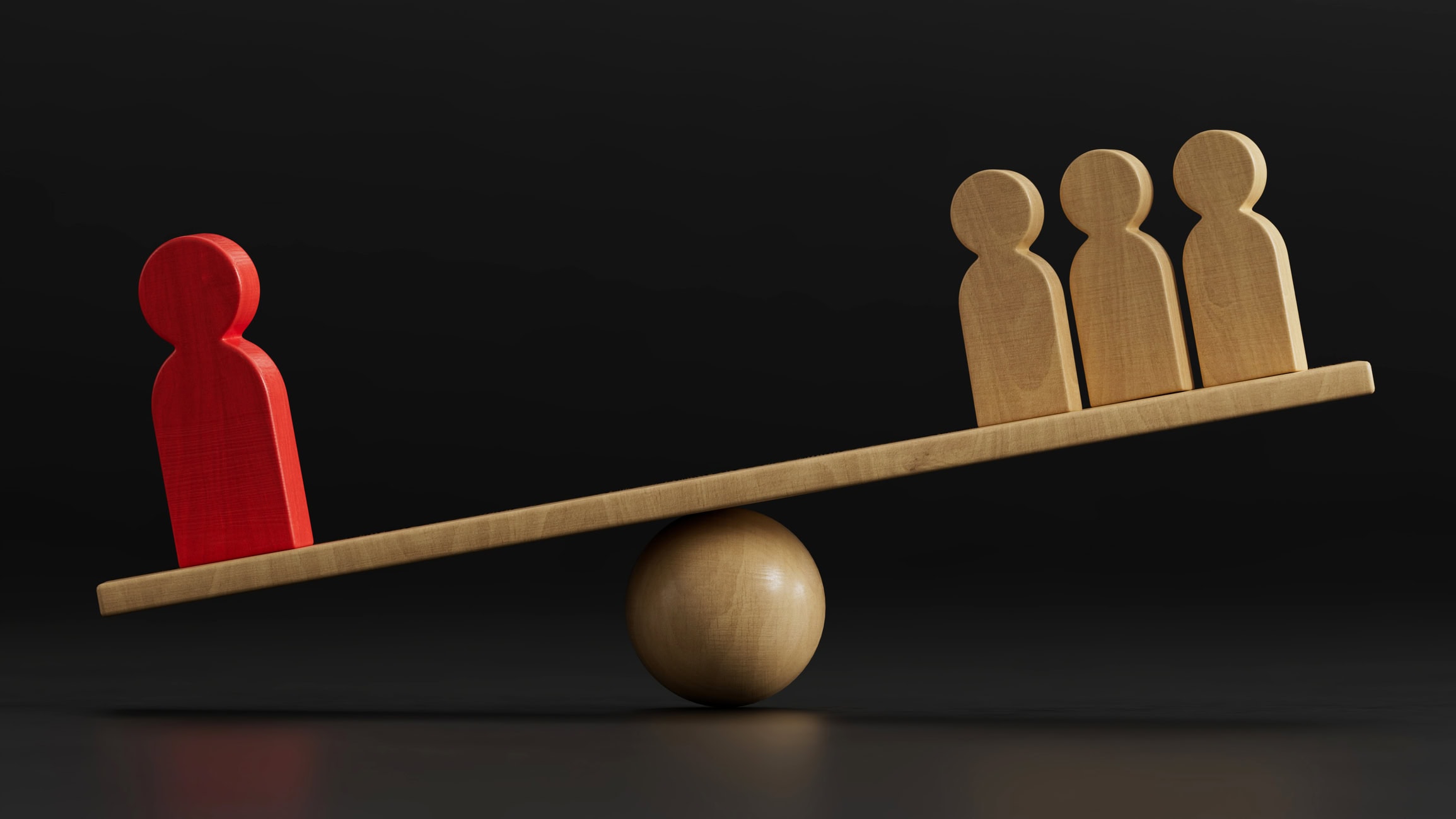
Attempting to eliminate every unequal outcome inevitably produces discrimination.
Dozens of “gap” statistics have become so deeply embedded in our political discourse that we hardly question whether unequal outcomes are actually evidence of discrimination. “Women make 77 cents on the dollar compared to men.” “Hispanic students make up a disproportionately small percentage of university graduates.” “Black women must work into the following July to catch up to what white men made the previous year.”
In our equity-obsessed age, each one of these “gap stats” has a grimy underbelly, made up of individuals who are unfairly denied the fruits of their talents because institutions have tried to force equal outcomes: men who work longer hours on average; Asians who have higher SAT scores on average; Millennial and Gen Z white applicants who get passed over at work because they don’t add to Diversity, Equity, and Inclusion.
We are living through a decade of wokeism in which racial favoritism has graduated from an ostensibly temporary thumb on the scale for the almost-qualified to the kind of unqualified frenzy that attracts grifters and con artists. And, correspondingly, the discrimination against the disfavored has gone from ambient to so intense as to bar advancement in culturally prestigious industries. Contra to dismissive talking points from purveyors like AOC, Woke 1 has done real damage to many lives.
Think, for example, of the nameless crowd of people denied the sinecures, positions, and honors bestowed on Cambridge’s former “youngest black professor,” Jason Arday. He was a serial fabulist and plagiarist, and tragically died by suicide earlier this month. In addition to the coveted position from which he resigned, Arday had a lucrative book deal in an industry in which just three of the 70 National Book Awards nominees in the past decade were white men, a shift that happened far too suddenly to have occurred naturally.
The Arday debacle shows that the quest to eliminate disparities has turned hiring into a de facto racial spoils system. Despite every remedy applied against them, disparities persist everywhere—in every profession, school, boardroom, prison, scientific award category, sports field, and socioeconomic tier for reasons that are cultural, political, family-based, genetic, religious, and natural.
Sometimes the reasons are even historically arcane. The majority of nail technicians in the United States are Vietnamese, even though they make up just 0.75% of the population. It turns out that this particular disparity can be traced to a single American actress, Tippi Hedren of The Birds fame. She visited a refugee camp near Sacramento after the Vietnam War and paid her manicurist to provide training, which then spread like wildfire throughout that community.
Disparities of a thousand hues are the norm. As Thomas Sowell wrote in Discriminations and Disparities back in 2018, “Neither in nature nor among human beings are either equal or randomly distributed outcomes automatic. On the contrary, grossly unequal distributions of outcomes are common, both in nature and among people.” Though no example exists anywhere of a world without disparities, it seems that most American institutions—government agencies, universities, and corporate workplaces—cannot tolerate the reality of their existence, even where there is no evidence that they arise from discriminatory practices.
University of San Diego School of Law professor Gail Heriot, an experienced civil rights lawyer and author of the aptly titled article “Title VII Disparate Impact Liability Makes Almost Everything Presumptively Illegal,” regularly challenges audiences to come up with a single hiring criterion that does not produce disparate outcomes on the basis of some protected characteristic—that is, race, sex, religion, or national origin. She’s never received a satisfactory answer, even after offering a cash reward.
The ubiquity of disparities allows government agencies to choose their victims at will. No government body tasked with enforcing laws against workplace discrimination has ever investigated whether requiring a bachelor’s degree for entry-level office work causes disparities among different demographic groups. Instead, the government seeks to root out all disparities against protected classes.
During the Biden Administration, the EEOC sued the grocery store chain Sheetz for screening out potential employees with certain kinds of criminal records. The government admitted that Sheetz had no intention of discriminating against black and Native American job applicants. But because a higher percentage of job seekers from those backgrounds had criminal records, it had the effect of constituting illegal discrimination. Welcome to disparate impact liability, a branch of the law now declared dead for the time being—and potentially unconstitutional—by the Trump Administration’s Office of Legal Counsel.
When the law presumes that these gaps exist because of discrimination, it places defendants in an impossible position: when the inevitable disparities appear in your organization, you can either accept them—and open yourself to litigation—or discriminate against unprotected classes to make the numbers even out—and open yourself to litigation.
As I testified before the House Oversight Committee in July, our universities, corporations, and public institutions have been “at war with the reality of disparities” for decades. In their effort to vanquish them, often under shapeshifting terms, they’ve turned to actual discrimination against “overrepresented” groups in a way that is both deeply unjust and illegal under U.S. law.
For too long, even those on the Right were defensive about the existence of these disparities. They went beyond the laudable goal of reforming the K-12 education system to make it function better for all students to promising that their reforms would “close the gaps” and selling them as a way to render affirmative action at the university level unnecessary.
But the problem with DEI, and before that, affirmative action, is simple: it tries to impose a Harrison Bergeron dystopia of equitable outcomes at mass scale. But doing that in a real world full of disparities requires discrimination against individuals.
As a multi-ethnic republic, we can no longer tolerate a system that institutes a legalized hierarchy of favored and disfavored classes. We can either enforce civil rights laws equally for everyone, which the Trump Administration has done an admirable job of pursuing, or we can continue to degenerate into Balkanized bloc politics marked by increasing resentment.
For the good of everyone, we must kill the god of the gaps: equality under the law for all, special favor for none, and let the disparities fall where they may.
The American Mind presents a range of perspectives. Views are writers’ own and do not necessarily represent those of The Claremont Institute.
The American Mind is a publication of the Claremont Institute, a non-profit 501(c)(3) organization, dedicated to restoring the principles of the American Founding to their rightful, preeminent authority in our national life. Interested in supporting our work? Gifts to the Claremont Institute are tax-deductible.
Suggested reading

The California Reparations Task Force is trying its best to skirt a landmark Supreme Court ruling.

It sacrifices readiness and cohesion for leftist goals.

It shows why the Right has a long way to go.
The injustice collectors pick up another pet indignation.

Our silence made Charlie Kirk a target.

