

Martin Luther King, Jr.’s “I Have a Dream” speech casts a golden thread across three centuries, connecting us to the source of the American dream.
The Declaration’s God
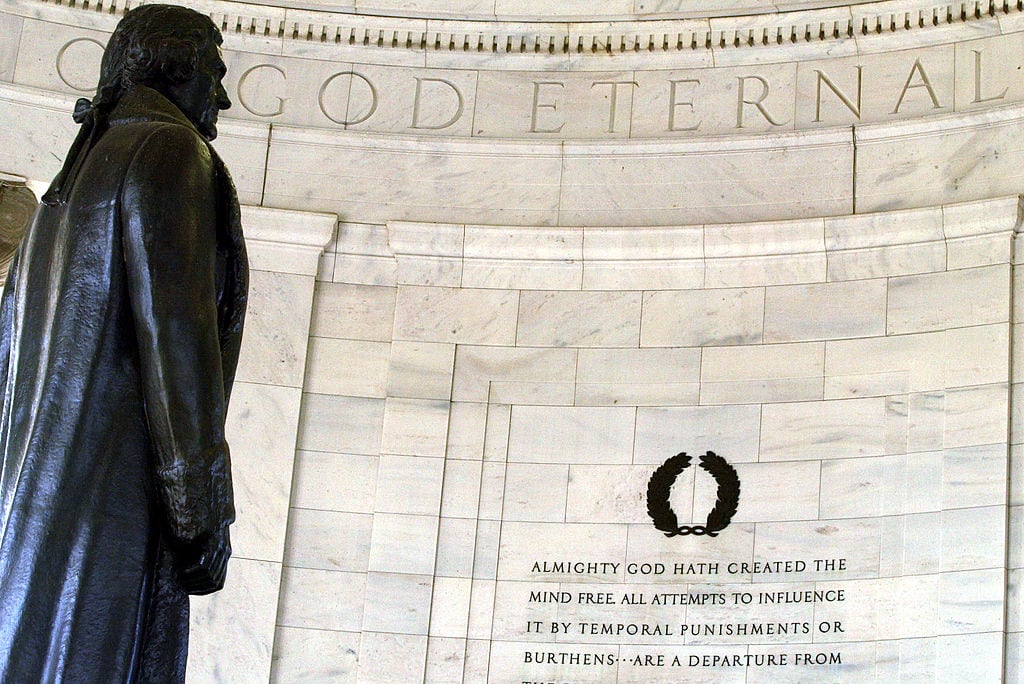
America was founded on natural theology, but it is not limited to it.
Editors’ Note
As we continue to celebrate the 250th anniversary of the American Founding, we will keep publishing reflections on the meaning of the Declaration of Independence, some by Claremont scholars and others by learned friends. In this piece, Professor Owen Anderson of Arizona State University offers his view of the theological and philosophical significance of the Declaration’s stirring opening paragraphs. Read all the entries in our “Declaration at 250” series here.
As we approach the 250th anniversary of the American Founding, it’s important to point out that the Declaration of Independence does not begin with politics. Before it speaks of rights, consent, or government, it makes a claim about the structure of reality itself. The rights it asserts are not the product of historical circumstance or collective will. They are grounded in a prior truth: that human beings are created by God.
The Declaration’s appeal to “the Laws of Nature and of Nature’s God” is not ornamental or rhetorical—it is the foundation on which its entire argument rests. The founders believed they were obligated to explain to mankind the reasons for their separation, and those reasons started with God and his law.
With this foundation, we can then proceed to the Declaration’s most famous sentence—“We hold these truths to be self-evident, that all men are created equal.” Though it is often treated as a moral flourish or a proto-democratic slogan, it is in fact a tightly ordered philosophical claim that proceeds in three stages, each dependent on the one before it.
First, it makes an epistemological assertion: these truths are “self-evident.” They are not established by deduction, tradition, or positive law, but are known by reflecting on the observable world. Truths about God, human beings, and the good must be knowable if human beings are to be responsible for ordering their lives and laws accordingly. To deny that such truths can be known is not merely to revise political theory, but to undermine moral accountability itself.
Second, the Declaration makes a metaphysical claim: human beings are created and therefore possess a given nature. Equality is not asserted as a political preference but affirmed as a consequence of creation. It follows from the reality of a shared human nature, which exists because God created it. Human equality is intelligible only if there is something real that human beings equally are.
Third, the Declaration draws an ethical conclusion: because human beings are created in this way, they are endowed with rights (life, liberty, and the pursuit of happiness) that no just government may rightly violate. To say that human beings are created by God is to say that they possess a given nature grounded in divine intention, not in change, appetite, or contingency.
This sequence is as decisive as it is brilliant. Remove any part of it and the argument collapses. Without a grounding in self-evident truths, claims about rights become matters of opinion or will. Without creation, equality loses its grounding in nature and becomes a political assertion to be enforced rather than an a priori truth. Without both, liberty ceases to be a moral claim and becomes a grant of the state for licentiousness. What remains is a thinner conception of freedom—one incapable of sustaining either justice or joy.
The assumptions that creation is intelligible, that God is knowable, and that human beings are responsible for acknowledging both stand at the foundation of the American experiment. They are the stress points at which its coherence either holds or fails.
At this point, the Christian reader may be tempted to object that the Declaration does not go far enough. It speaks of God as Creator but says nothing of Christ. It appeals to natural theology but makes no reference to revealed religion. Does it leave us stranded with a Deistic account of God or a thin moralism that cannot sustain the claims it makes? The concern is understandable, especially when the Declaration is contrasted with documents such as the Solemn League and Covenant that explicitly confessed allegiance to Christ the King. Yet this objection rests on a misunderstanding of both the Declaration’s purpose and the relation between natural and revealed religion.
The Declaration of Independence is precisely that: a declaration of independence. It is not a confession of faith, a catechism, or a constitution. It has a specific and limited purpose: to justify political separation from Great Britain by appealing to truths binding on all human beings as such. The absence of explicit Christological language does not indicate theological indifference, but a focus on the specific political question at hand.
It is also worth remembering that many of the founders likely assumed that explicitly Christian commitments would find expression elsewhere. Nearly every state constitution in the founding era contained explicit Christian language, often including affirmations of Christianity or requirements that officeholders affirm specific Protestant beliefs.
The Declaration was never intended to bear the full theological weight of American public life on its own. It establishes a common foundation; it does not exhaust the moral or religious commitments of the people who affirmed it. Just as Romans 1 demonstrates that there is a clear general revelation (the study of natural theology) that shows the reality of universal sin and then explains our need for Christ, the Declaration’s three-fold assertion of knowability, God, and what is good provides a basis for the path to salvation.
This points to a second consideration: the Declaration’s appeal to natural theology is not compatible with every religious or philosophical system. The Declaration’s affirmation of God the Creator excludes belief systems that deny God the Creator such as monism (all is one) and dualism (God and the world are both without beginning).
It presupposes that God is distinct from the world, that the world is created rather than eternal, and that human beings possess a knowable nature grounded in that act of creation. Natural theology, on this view, is neither trivial nor thin; it is full and clear. It tells us a great deal about God, about ourselves, and about the moral order.
At the same time, natural theology is not redemptive revelation. Scripture does not merely restate natural truths more clearly or add moral instruction where reason falters. It answers a question that natural theology cannot answer on its own: how a just and holy God redeems sinners who suppress the truth they ought to know.
The founders were well aware of this distinction. The Bible was the most frequently cited book in their writings, and most took for granted that Christianity answered the question of redemption. Yet they also recognized that this answer could not be imposed by civil authority without corrupting both church and state. They had no interest in adjudicating disputes among Protestants, much less between Protestants and Roman Catholics. The Declaration’s silence on these matters reflects not skepticism about Christian truth, but a judgment about political competence.
In this light, the Declaration’s appeal to natural theology appears not as a theological retreat, but as a principled boundary. It affirms all that reason can and must know about God and human nature, while leaving the work of redemption where it belongs: in the proclamation of the gospel and the ministry of the church. The coherence of the American experiment depends on honoring both truths. Confuse them, and politics becomes a counterfeit religion. Separate them rightly, and both church and state are free to pursue their proper ends. This can serve as a call back to American Christians to remember the need for evangelical work if they hope for lasting positive change in America.
The American Mind presents a range of perspectives. Views are writers’ own and do not necessarily represent those of The Claremont Institute.
The American Mind is a publication of the Claremont Institute, a non-profit 501(c)(3) organization, dedicated to restoring the principles of the American Founding to their rightful, preeminent authority in our national life. Interested in supporting our work? Gifts to the Claremont Institute are tax-deductible.
Suggested reading

Why we remember Thomas Jefferson but have forgotten John Dickinson.
A new illustrated collection gives Americans a mythology worth loving.
Reverence for great ideas and great men.

Christian colleges in a pagan culture
How radical relativism leads to ideological fanaticism.

