

Democrats are laying the groundwork for revolution right in front of our eyes.
The Cuban Mirage: A Revolution Exposed
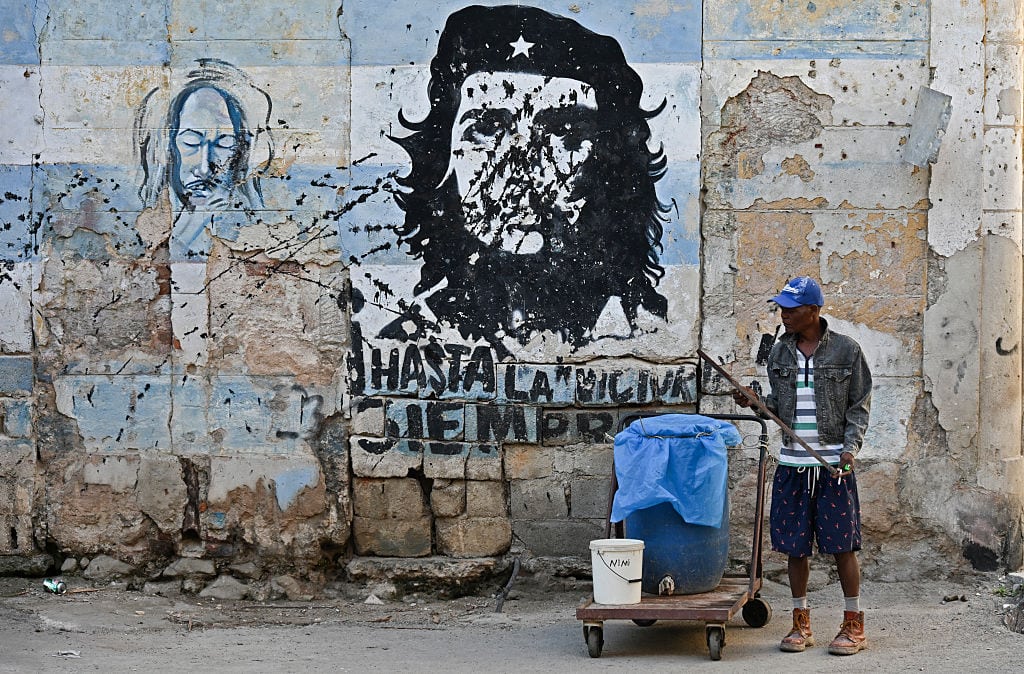
Fidel Castro and his Communist epigones have brought only misery and despair.
The much-vaunted Cuban revolutionary model is on the verge of unceremonious collapse: the economy is in shambles, the electric grid is only occasionally functional, and the supposed achievements of the Cuban Revolution have culminated in near-universal penury and misery. As of 2024, 89% of Cubans lived in poverty, sometimes of an abject kind—and things have only gotten worse over the last two years. Revolutionary Cuba is a model only of what is to be avoided.
In Cuba, growing crowds denounce Communism and the dictatorship that has enslaved the island nation since 1959. Anti-regime voices bang pots and pans in public demonstrations, demanding freedom for Cuba for the first time in 66 years. Yet, Western leftists continue to express solidarity with the Cuban people’s oppressors and blame Cuba’s problems on an American embargo that is often flouted. More absurdly, they insist that the oil embargo imposed by the Trump Administration after its defenestration of the Maduro dictatorship at the beginning of this year is the cause of Cuba’s present discontents. Somehow, the administration is responsible for the deep-seated structural problems that confront a Cuba immiserated by decades of unaccountable Communist rule.
The dark empirical realities about Cuban Communism are finally making the revolutionary mirage look like the delusory wish-to-believe—or outright lie—that it has always been. A 2024 report from the Madrid-based Cuban Observatory of Human Rights, along with a useful summary published at VOZ News, made clear just how far the Cuban dictatorship has impoverished the Cuban people. As of the summer of 2024, 72% faced significant food shortages, with “seven of 10 Cubans” having “stopped eating breakfast, lunch or dinner due to lack of money or food shortages.” Western progressives (most egregiously and pathetically, the leftist propagandist Michael Moore) praise the Cuban health care system to the hilt even as 89% of Cubans “view Cuba’s public health system negatively.”
Cuba has long suffered under medical apartheid, with shiny state-of-the-art facilities for the party elite in Havana camouflaging the lamentable state of medical clinics that cater to ordinary Cubans—where even bandages and other minimal essentials are in desperately short supply. Thirty-three percent of Cubans “were unable to acquire the medicine they needed due to price or scarcity,” according to the report. Meanwhile, poorly paid Cuban doctors—many of whom defect when given the opportunity—were used as pawns by the regime and sent abroad, along with secret police and military personnel, to countries like Venezuela in exchange for oil and political influence. A tawdry exchange and hardly “social justice” at work. And draconian repression remains in place in Cuba, with a full-scale, if hated, secret police apparatus and omnipresent Committees in Defense of the Revolution spying on ordinary people.
However, the regime has been challenged in recent years in ways that would have been unimaginable during the heyday of Fidel Castro’s Leninist-Stalinist dictatorship. Massive demonstrations rocked the island in 2021 but were severely repressed. One million Cubans—10% of the population—fled the island/prison between 2022 and 2024 alone (to give some perspective, one million Cubans left between 1959 and 1980).
Having lost its Soviet sponsor in 1991, and now its vitally important Venezuelan ally and supplier of massively subsidized oil, the Cuban dictatorship has lost its shine and any real claim to legitimacy.
Fidel Castro, who died in 2016, himself fades with the revolutionary mirage itself, looking more and more like a brutal, megalomaniacal totalitarian tyrant, with his multiple mansions, cult of personality, and habitual hours-long speeches, as well as his contempt for common sense and the basic needs of the Cuban people. The bearded tyrant, too, now has no clothes. Not surprisingly, the 2024 survey found that 91% of Cubans disapprove of the political, economic, and social management of the country by a party dictatorship increasingly run by—and benefiting—the military (upwards of 70% of the economy is controlled by Raúl Castro and his minions in the armed forces). Four percent of Cubans had a positive judgment of figurehead president Miguel Díaz-Canel, and just 2% saw the present Communist system as a model for Cuba going forward.
Meanwhile, the report from the Cuban Observatory of Human Rights notes that in Latin America and the Western world more broadly, “not a few politicians and academics have uncritically accepted the Cuban government’s propaganda about its idyllic social model.” When it came to Cuba, the Ideological Lie (as Solzhenitsyn called it) has long reigned supreme. In contrast, Cuban public opinion is now dominated by what VOZ News calls an “absolute rejection of the dictatorship.” If only that were true among our Western elites.
An article by Darío Alemán in the Madrid newspaper El País aptly sums up the state of affairs:
The Cuban Revolution was more successful at exporting its epic narrative than any other tangible narrative…the face of Che Guevara transformed into left-wing merchandise, the stoic image of Fidel Castro with a cigar in his mouth defying the 600 assassination attempts orchestrated against him by the CIA, and the slogan that Cuban education and healthcare are the best in the world have been an important part of the global progressive ideation from 1959 to the present. Sartre, Beauvoir, Maradona, and García Marquez are just some of the renowned figures who succumbed to the heroic myth of an island, that along with its bearded leader, built a precarious but socialist and happy paradise right under the nose of the Yankee empire.
Alemán goes on to show that many Cubans were caught up in the farcical “Guevara legend”—the man was a Stalinist thug with much blood on his hands whom Castro abandoned to die in the Bolivian highlands in 1967. And they also became part of the “cult of Fidel Castro,” who “declared atheism constitutional” until 1992, and who outlawed Christmas until 1998, only to declare himself the undisputed “eternal leader” of a revolution on the road to nowhere.
At first, Castro offered the Cuban people what Tocqueville called “equality in servitude,” justifying the absence of political, economic, personal, and civil and religious liberty in the name of “social justice” and nonexistent “moral incentives.” Alemán adds that without elementary “economic freedoms, among others, it was impossible for ‘Cuban-style’ socialism to produce enough to maintain its economic sovereignty and its ideological war against the United States.” Equality in servitude inevitably became a uniquely Cuban form of absolute totalitarian immiseration. Unwilling to liberalize the economy beyond some largely cosmetic reforms that allowed private property on the margins, Cuba remained economically dependent first on the Soviet Union, then on Communist China, and finally on Chávez’s and Maduro’s Venezuela. Despite his volcanic anti-imperialist rhetoric, the impetuous Castro presided over what was essentially a vassal state and sugar colony.
For all of his bravado, Castro was a liar, a thug, and a self-anointed revolutionary tyrant. My late friend Irving Louis Horowitz was one of the few academic authorities on Cuba who saw through the mirage from the beginning. As he put it in his magisterial 2008 book, The Long Night of Dark Intent: A Half Century of Cuban Communism, Castro always blamed Cuba’s problems on “traitors,” “enemies,” or simply those who had the temerity to disagree with him. His self-righteousness was deeply immoral. At the end of 60 years of unchallenged rule and limitless “opportunism and self-promotion,” Fidel faced, in Horowitz’s elegant words, “the problems of a (once) Christian society without Christianity, of a supposedly advanced society without modernization, of a dedicated civil population, but one ruled by a military-police force that permeates every part of the system, in short, a civil society without civil rights.”
Castro’s 26th of July Movement fought the short-lived Batista dictatorship (which lasted only six years, from 1952 to 1958, and tolerated an independent Communist Party and free labor unions) in the name of restoring constitutional republicanism in Cuba. But that was never his intention.
In the first months of 1959, after moving into the top three floors of Havana’s Hilton Hotel, he drove the anti-Communist president of Cuba, Manuel Urrutia Lleó, out of the country after denouncing him on television for treason. Castro subjected one of his own key military commanders, the equally anti-Communist Huber Matos, to a Stalinist show trial followed by 20 years of prison, torture, and degradation. As Horowitz, then a man of the independent Left, exposed “The Stalinization of Fidel Castro” in a 1964 article in New Politics, others in much greater number lauded a revolution and country about which they knew little.
The leftist sociologist C. Wright Mills championed revolutionary justice and denounced American imperialism in Listen Yankee, published in 1960. Jean-Paul Sartre would soon follow suit, publishing a glowing paean to Castro and his revolution. Some would become disillusioned in the late 1960s when poet Heberto Padilla was persecuted by the Castro regime for criticizing the stifling restrictions on intellectual and artistic freedom. Sadly, it took these littérateurs a good ten years to notice the totalitarian face of the Cuban revolution, and only for a moment at that. Later, a more establishment-oriented “Cuba lobby,” mixing ideological illusions with pseudo-foreign policy realism, tried to both “normalize” Cuban-American relations and float the preposterous claim that Cuba was unfairly treated by the outside world, even as Castro sent 70,000 troops to Ethiopia and Angola and promoted revolution throughout the Americas.
In February 2002, the singer Carole King, undoubtedly a sweet woman but a woeful political naïf, accompanied a California delegation to Cuba and sang “You’ve Got a Friend” to the tyrant on his birthday. Visiting Cuba in 2015, Pope Francis, who habitually saw no enemies to the Left, could find in Castro only a defender of social justice and a man with deep ecological concerns—despite his ongoing persecution of the Catholic Church. In the pages of First Things, the eminent Yale religion scholar and Cuban exile Carlos Eire aptly wrote of a “preferential option for dictatorship” on the part of the misguided Argentinian pontiff.
The Cuban mirage has dissipated, and the dictatorship is thankfully on the verge of collapse. Prudently, Secretary of State Marco Rubio is negotiating with Castro’s supposedly pragmatic grandson a possible transition period and off-ramp for Cuba’s Communist elite. The New York Times reports that the Cuban regime has officially opened talks with the United States, supposedly based on “respect for the political systems of both countries.” That is perhaps a useful fiction for getting the dictatorship to come to terms with reality. But a change of leadership must happen sooner rather than later. Cuba’s oppressed people have already suffered for far too long.
The Castro and Guevara myths have been exposed for the egregious lies and exercises in self-deception they have always been. Now is the time to remember Cuba’s heroes: Armando Valladares and Huber Matos; Oswaldo Payá—assassinated by the regime in 2012 for initiating the Varela Project to bring free elections to Cuba; the Ladies in White—brave Catholic wives of political prisoners who bore witness in white dresses outside of Catholic churches every Sunday; and a Catholic Church that is regaining her voice and her courage. And let us not forget Irving Louis Horowitz, a brave scholar who told the truth about Cuban tyranny for many decades when it was fashionable to lie with impunity about Fidel Castro and all his works.
The American Mind presents a range of perspectives. Views are writers’ own and do not necessarily represent those of The Claremont Institute.
The American Mind is a publication of the Claremont Institute, a non-profit 501(c)(3) organization, dedicated to restoring the principles of the American Founding to their rightful, preeminent authority in our national life. Interested in supporting our work? Gifts to the Claremont Institute are tax-deductible.
Suggested reading

Detractors of nationalism indulge in dreamcasting over statesmanship.
Moralism, utopianism, and denunciations of all things Russian are not the answer in the present fight.

How the left usurped our language—and the Right let it happen.

Academic sociology is a workshop for professional leftists.

Mahmoud Khalil, Jane Fonda, and a case for the Trump Administration.

