

The divide between church and state doesn’t separate religion from public education.
Saving Civil Rights From Itself
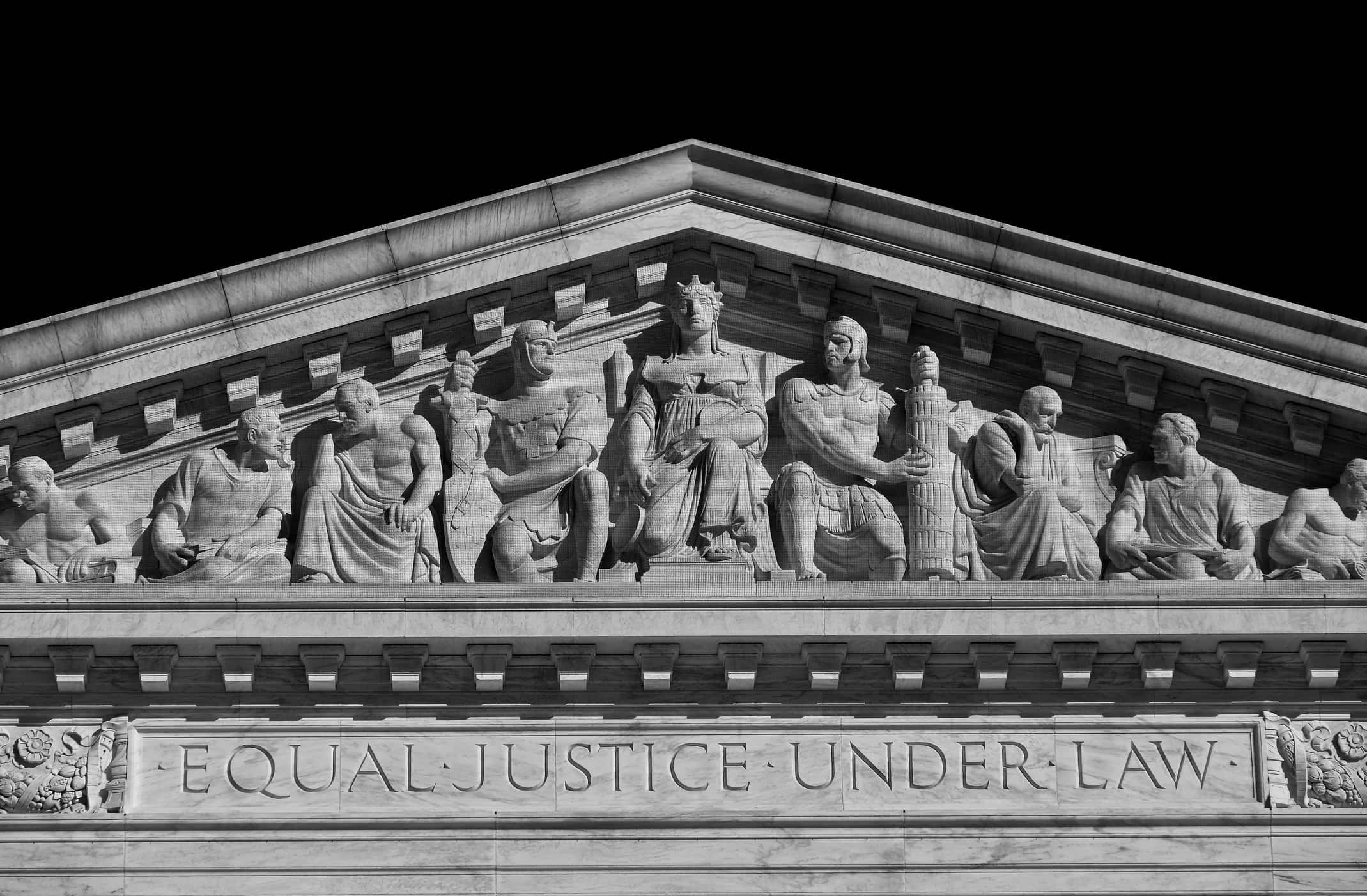
A momentous ruling from the Office of Legal Counsel.
Even those who strongly support the Trump Administration can grow frustrated with the pace of change. Sometimes that frustration is justified. But other times, moving deliberately is essential, particularly when it comes to the law. A shoddy or rushed legal opinion may grab headlines, but if it changes nothing or is overturned in the courts, it’s just a long, noisy out. And judges are fickle and self-regarding creatures, especially on the Supreme Court, the ultimate adjudicator of many of these disputes.
Given that reality, the recent opinion from the Department of Justice’s Office of Legal Counsel (OLC) declaring the vast majority of disparate-impact uses—a cornerstone of the civil rights regime for over half a century—effectively unconstitutional is a legal earthquake. It won’t get the sort of headlines of border walls or banning boys from girls’ sports, but in terms of its potential impact on America, it is vastly more important.
Removing disparate impact was one of the six core recommendations I outlined in The Unprotected Class for an administration determined to eliminate anti-white policies in the federal government. The OLC’s disparate impact opinion is the product of a strong team, led by talented Assistant Attorney General Elliot Gaiser and his equally able deputy Joshua Craddock. They waited for the right moment and wrote the opinion in the right way. And when the right time came, they acted swiftly.
The opinion makes it much easier for defendants to fight back against disparate impact claims brought against them by the Equal Employment Opportunity Commission (EEOC) or another federal agency, as they need to show only a “business necessity.” Plaintiffs, by contrast, now need to show both causality—that the particular test caused the disparate impact—and that an alternative practice could be pursued that would reduce disparate impact while still serving the employer’s business purpose. This is a very high bar and will almost certainly lead to a substantial slowdown in new cases.
Gaiser and Craddock clearly anticipated where the Supreme Court is heading on civil rights jurisprudence. There have been a number of recent hints, but on June 2 in Allen v. Milligan, the Court allowed the Alabama GOP to redistrict in a way that made black voters less likely to elect a Democratic representative, so long as race was not the determining factor—and it was not.
As the attorneys for Alabama successfully argued, their concerns were partisan (a legal method), not racial. As a thought experiment: if a majority of African American voters began supporting Republicans, the GOP would be more than happy to draw them a majority-black Republican district. The fact that an election case paved the way for an employment ruling indicates the far-ranging nature of the Court’s disparate impact ruling.
According to University of Richmond Law Professor Kurt Lash, “This single paragraph from an emergency docket opinion issued one week ago (Allen v. Milligan) is likely to be the most important paragraph the Court has written since Dobbs.” Lash notes that this is the first majority Supreme Court opinion to reference “our colorblind Constitution.” And a colorblind Constitution on its face cannot sustain the panoply of racially preferential programs the civil rights industrial complex has created over the last six decades.
To understand the import of the OLC’s action, a brief history of disparate impact is in order.
Change, Change, Change
Disparate impact grew out of a 1971 Supreme Court case, Griggs v. Duke Power, in which the North Carolina-based electric company issued an aptitude test as a condition of employment or job transfer. There was no suggestion the test was designed to discriminate by race, but because a significantly higher percentage of white employees passed than black employees, the latter sued. The Supreme Court found that even without any intent to discriminate, an employment practice could be found unlawful if a particular group was significantly underrepresented relative to a given reference population. This case launched the disparate-impact industry.
The Court eventually recognized its error and essentially gutted Griggs in Wards Cove v. Atonio. But civil rights leaders, sensing their gravy train was at risk, cried foul. The key provisions of Griggs were signed into law via the 1991 Civil Rights Act by a cowardly and capitulating President George H.W. Bush, who was desperate for a “civil rights” victory.
In the decades since, disparate impact has been deployed across employment, school discipline, and housing to punish whites (and to a lesser degree Asian Americans) and reward non-white groups. Policy analyst Inez Stepman correctly called it the “legal enforcement arm of the DEI empire.”
The DOJ Office of Legal Counsel’s opinion could bring this entire edifice crashing down. Gaiser and Craddock correctly argue that the previous way of determining disparate impact was more likely to produce racially discriminatory outcomes. “EEOC’s Title VII guidelines are unconstitutional because they contemplate liability based on disparate effects alone, without regard to an employer’s likely intent, and pressure employers to engage in race-based decision-making,” the opinion states.
Or as acting Attorney General Todd Blanche put it, the new guidance would “allow businesses to hire based on performance, restoring equal opportunities in the American workplace.” Blanche got immediately to the heart of the matter. “Despite trying to promote equality, EEOC’s disparate impact liability interpretation under Title VII actually fosters the very discrimination its guidelines seek to address.” Factually, this was obvious. Politically, it is revolutionary.
In the famous words of Chief Justice Roberts, “The way to stop discrimination on the basis of race is to stop discriminating on the basis of race.” The Allen ruling simply extends that logic.
Notably, “Workplace requirements and selection procedures—such as background checks, aptitude tests, and SAT scores—are presumptively job-related,” the Office of Legal Counsel said. Only “irrational and arbitrary” practices serving no business purpose are exempt. An entire universe of rational selection practices, previously off-limits, is now available to employers. This opinion also has the potential to disrupt the college cartel, as college completion has become a proxy for many things employers want to test for but feel legally barred from doing so directly.
Putting the Democrats on Defense
Unsurprisingly, the Democrats are not taking this legal counter-revolution lying down. The Illinois legislature has just approved a bill (still pending Governor Pritzker’s signature) that bans so-called “disparate impact discrimination”—the exact policy being declared unconstitutional by the Trump Administration. New Jersey has also recently enshrined disparate impact in state law.
One commentator wrote that “it marks a pivotal moment in the ongoing struggle over who controls human rights enforcement in America: state governments or the federal executive branch.” Is this a case of states simply offering additional protections that the federal government does not? Or do these so-called protections themselves constitute discrimination, as the federal government will presumably argue?
New Jersey’s law gives a sense of the scope involved. “Covered entities” in New Jersey now subject to disparate impact “include housing providers, employers, labor organizations, employment agencies, real estate professionals, places of public accommodation, [and] contractors.” The law puts at risk the ability to deny applications based on credit scores, criminal history, income cutoffs, or other common-sense standards.
States like New Jersey that are entrenching their disparate impact regimes face an additional hurdle. Almost immediately after the Supreme Court’s disparate impact ruling, the Small Business Administration proposed a rule to end anti-white race-based discrimination in its contracting and loan programs. This new ruling was responsive to 2023 and 2024 court cases, Ultima Servs. Corp. v. United States Dep’t of Agriculture and Mid-America Milling Company v. U.S. Department of Transportation, which for the first time challenged the fundamental presumptions of racial disadvantage that had governed SBA conduct for decades.
The proposed rule states: “Under the new rule, individuals will no longer be considered ‘socially disadvantaged,’ and therefore eligible for the 8(a) program [a major government lending program with over $40 billion in government contracts dispersed in 2024 alone], simply because they are a member of a racial minority group. Likewise, no individual may be barred from the 8(a) program simply because they are white.”
“The Biden Administration weaponized the 8(a) program as a vehicle for partisan and DEI preferences in federal contracting, using race to steer exclusive opportunities to favored groups while shutting out other deserving Americans,” said SBA Administrator Kelly Loeffler. The new requirement will compel recipients to show actual social disadvantage rather than inferring it from skin color.
“It will restore equal treatment under clear, objective criteria and help ensure the program serves legitimate job creators instead of political friends, shell companies, or bad actors.” Under the previous guidance, loans to fake “disadvantaged” contractors who simply took a cut of the profits but did none of the work had become an epidemic. Under Trump, for the first time, major loan programs became available only to U.S. citizens rather than foreigners, a decision now being challenged by Democratic legislation in the Senate and House.
Senate Small Business Committee Ranking Minority Member Ed Markey made clear he intended to propose additional legislation distributing even more funding based on skin color to his minority constituents at the expense of his white ones.
Civil Rights for All
These two new developments are momentous, especially when considering the broader context of President Trump’s actions on civil rights and race. The Trump Administration, under the leadership of a number of outstanding political appointees, has taken unprecedented steps to restore civil rights law to its original intent—equal opportunity for Americans regardless of race. The Democrats continue to fight these efforts tooth and nail at both the federal and state levels.
But they may not find the administration’s actions so easy to undo, even should they retake power in the wake of 2028 elections. Through its aggressive actions, the Trump Administration has made the anti-white, anti-male, and anti-American-citizen character of the previous regime fully visible.
The Democrats would also be trying to go against a highly unsympathetic Court that is likely to rule against them. If they choose to challenge or change Trump’s executive orders on civil rights, the Supreme Court could rule in ways that would give them far more durable legal sanction than they have today.
Regardless, this is the last chance for the American government to correct the vast wrongs perpetrated under the guise of civil rights. If the Democrats insist on re-enshrining racially discriminatory policies, civil rights in the 21st century will have revealed themselves as nothing more than a vehicle for the Democrats’ anti-white policies. There is no reason for the GOP to indulge them in such efforts. We can either have equal civil rights for every American, or we can abandon the concept entirely. There is no third way.
By ending racially discriminatory civil rights policies, the Trump Administration is providing the only justification for having civil rights policies at all. And in attempting to save them, the Democrats may bring about the demise of the entire civil rights edifice by unveiling to Americans what it has become.
The American Mind presents a range of perspectives. Views are writers’ own and do not necessarily represent those of The Claremont Institute.
The American Mind is a publication of the Claremont Institute, a non-profit 501(c)(3) organization, dedicated to restoring the principles of the American Founding to their rightful, preeminent authority in our national life. Interested in supporting our work? Gifts to the Claremont Institute are tax-deductible.
Suggested reading

We can’t count on the Supreme Court.

Civic formation in an era of unlimited birthright citizenship.
Our “news media” tell us when to care about racial representation.

The collapse of academic standards is a function of racial preferences.

Attempting to eliminate every unequal outcome inevitably produces discrimination.

