

One dose will erase your whole political mind.
President Trump Renews JFK’s Forgotten War Against Subversion
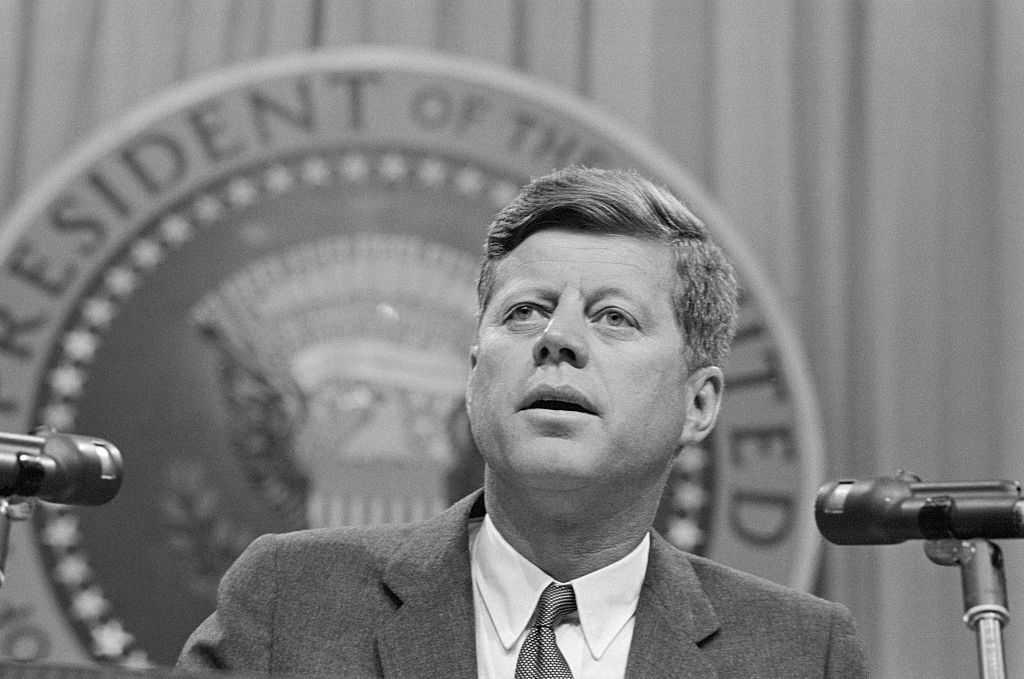
The 35th president took ideological warfare seriously.
When President Trump reposted a video featuring President John F. Kennedy warning about subversion in America, he renewed focus on a threat we have long ignored at our peril.
Spotlighting JFK’s admonition is part of the administration’s all-out attack on foreign subversion—an effort that has no presidential precedent. Its designation of Antifa and certain Muslim Brotherhood chapters as terrorist organizations was a first. The revocation of visas for foreign subversives, if carried out on a larger scale, will be unmatched in scope. During the July 16 Ministerial on the Resurgence of Political Terrorism, Secretary of State Marco Rubio, Treasury Secretary Scott Bessent, and other officials made clear that the Trump Administration would use every tool of statecraft to dismantle the decades-old subversive networks operating in the U.S.
This effort has also refocused attention on an older—but no less potent—enemy: Communist subversion.
The State Department published a 100-page report, “Cuba: The Capital of 21st Century Communism,” detailing how Cuban Communists have worked for decades to overthrow the United States. It names names, past and present.
Cuba, of course, brings us back to President Kennedy. Despite his failed effort to remove Fidel Castro’s Communist regime, Kennedy frequently pointed out how Communists abused constitutional protections and infiltrated U.S. institutions—the news media, labor unions, academia, and the government itself. JFK’s words still apply today to surviving Soviet spinoffs like the Cuban regime, critical theory and critical race theory, cultural Marxism, and democratic socialism.
John F. Kennedy spoke passionately of the problem of Communist subversion from his earliest moments as a senator to the last days of his presidency.
As a new senator, at the height of fellow Senator Joseph McCarthy’s investigative hearings, he warned in successive speeches that the greatest foreign threat would rely on “the weapons of subversion, economic disintegration and guerrilla warfare to accomplish our destruction, rather than the direct assault of an all-out war.” Kennedy warned every possible audience—schoolteachers, university professors, community leaders, newspaper editors, women’s clubs, union leaders, military personnel, veterans, business groups, political fundraisers, civil liberties leaders, church groups, and the general public—about the Communist threat right up to the last day of his life.
Kennedy recognized the danger posed by American traitors who sought, through subterfuge and collaboration with the foreign enemy, to corrode Americans’ belief in their country and the principles of their nation’s founding. He praised some American labor unions for ridding themselves of Communist subversion.
Defending President Eisenhower’s countersubversion approach in 1957, Kennedy nonetheless chided his fractured and squabbling Republican opponents. Republicans, he said, “found that their chief concern was with questions of disloyalty and subversion—not within the Federal Government but within the Republican Party.”
That was just three weeks to the day after Joe McCarthy’s death. JFK never publicly criticized McCarthy, who had been a welcome guest of his father at the Kennedy Compound on Cape Cod. “Half my people in Massachusetts look on McCarthy as a hero,” he once said.
Infiltration and Subversion
Kennedy repeatedly warned of what he called “non-military avenues of Soviet advance”: “I fear our emphasis on the dangers of missile attacks may cause us to forget. For their thrust is more subtle,” and “the task of opposing them more formidable.” Among those threats were “economic and political penetration, intimidation and subversion,” he said in 1958. “There is little value in rushing new billions in defense expenditures to fight total wars…if we are unprepared to prevent continued Soviet advances through…subversion and intimidation.”
As he was preparing his presidential run, Kennedy mused during a speech at a civil liberties conference that the public had been so subjected to subversive attacks that they no longer shared the civic principles that once united them.
On the campaign trail in 1960, Kennedy raised the topic of subversion even before audiences asked about it. As the Democratic nominee for president, Kennedy became more critical of the Eisenhower Administration for focusing on massive military buildups at the expense of a predictable pattern of Communist ideological conquest made easier by America’s weakness in countersubversion.
In other words, there is every chance that the pattern of conquest of the Communists will not be military action, but will be by subversion, by fear, by persuading the people of those countries and their leaders that the Communist system represents the way of the future. I don’t believe the administration has recognized that danger…. I don’t believe that our influence has increased as fast in recent years abroad as that of the Communists.
In his last weeks of campaigning, Kennedy even called the Communist threat more challenging than dealing with the Nazis. “I must say that the problems we will face in the next ten years are far more complex than any that Franklin Roosevelt or Harry Truman faced, particularly in the field of foreign policy,” he said to supporters in Ohio. “What has happened in the last two years in the field of foreign policy indicates a whole technique of subversion and infiltration which will be extremely hard to counter.” That subversion, he continued, “will require a far great[er] subtlety, far more constant vigilance, far greater personnel, far greater foresight than we have ever shown before.”
Unaware of President Eisenhower’s plan for toppling the new Fidel Castro regime that he would inherit, Kennedy tore into U.S. unpreparedness that led to Cuba becoming “a base from which to carry Communist infiltration and subversion throughout the Americas.”
Kennedy was alone in bringing up subversion during his fourth debate with Vice President Richard M. Nixon, which was striking since Nixon had become a national political figure while serving on the House Un-American Activities Committee.
What You Can Do to Oppose Communism
Kennedy hammered away at the threat of Communist subversion in the first minutes of his presidency. In his inaugural address, he vowed “to oppose aggression or subversion anywhere in the Americas”—the same speech in which he said, “ask not what your country can do for you—ask what you can do for your country.”
He warned in a 1961 emergency address to Congress that “nuclear weapons cannot prevent subversion.”
He and his brother, Attorney General Robert F. Kennedy, had no love for FBI Director J. Edgar Hoover, but worked closely with him to investigate and disrupt Communist infiltration of the civil rights movement. JFK, like Eisenhower before him and Lyndon Johnson and Nixon afterward, treated it properly as a counterintelligence problem.
On the day of his assassination in Dallas, President Kennedy was ready once again to warn about subversion. The president’s remarks as prepared read,
I want to discuss with you today the status of our strength and our society because this question clearly calls for the most responsible qualities of leadership and the most enlightened products of scholarship. For this Nation’s strength and security are not easily or cheaply obtained, nor are they quickly and simply explained. There are many kinds of strength and no one kind will suffice. Overwhelming nuclear strength cannot stop a guerrilla war. Formal pacts of alliance cannot stop internal subversion.
Kennedy understood that peace through strength was broader than deploying military power or international diplomacy.
But he never had the chance to deliver that warning. More than six decades later, President Trump and his team have fortunately picked up where he left off, reviving a neglected part of Kennedy’s legacy. It’s time to follow President Kennedy’s lead and uproot domestic subversion in America once and for all.
The American Mind presents a range of perspectives. Views are writers’ own and do not necessarily represent those of The Claremont Institute.
The American Mind is a publication of the Claremont Institute, a non-profit 501(c)(3) organization, dedicated to restoring the principles of the American Founding to their rightful, preeminent authority in our national life. Interested in supporting our work? Gifts to the Claremont Institute are tax-deductible.
Suggested reading

Our dark hour calls for a recovery of the statesman’s virtues.
A politics of revolutionary resentment.
Jack Smith’s indictments of Donald Trump are unconstitutional because he was already tried in the Senate.

The positives and potential pitfalls of the Trump coalition’s approach.
The curious case of an incoherent amicus brief.

