

Trump’s call to end birthright citizenship is a necessary corrective.
Nehemiah’s Republic
What Pope Leo XIV’s encyclical on AI means for republican government.
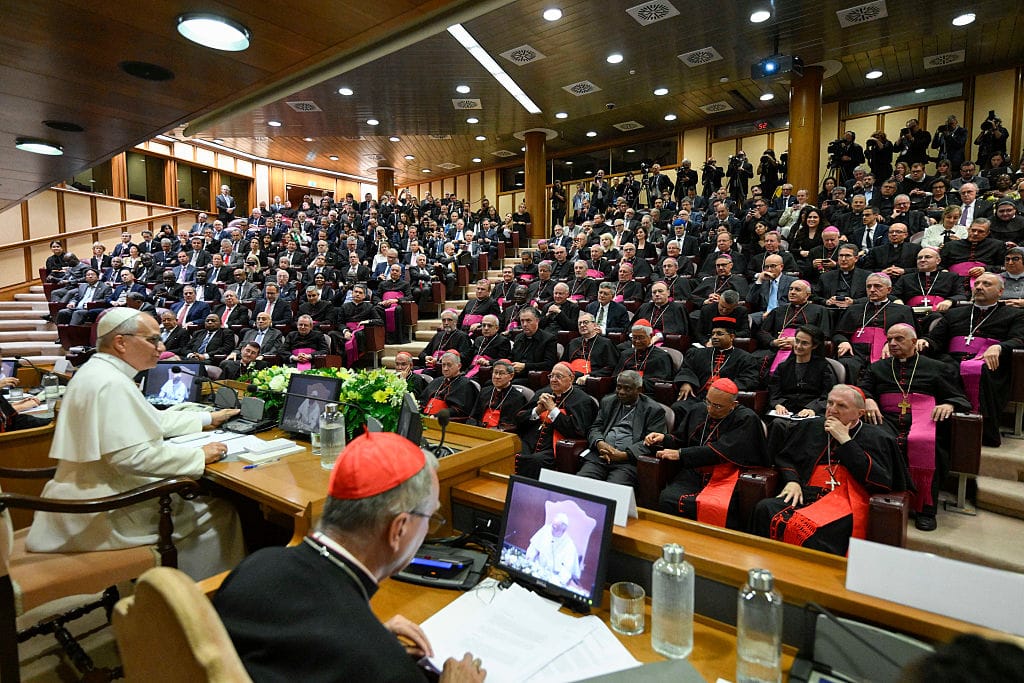
With the release of Pope Leo XIV’s encyclical Magnifica Humanitas, mankind’s foremost moral authority—a Chicago-born priest and the absolute monarch of the longest-running institution in history—addressed a technology so advanced that even its creators struggle to comprehend it.
One of those creators appeared alongside the Holy Father: Chris Olah, co-founder of Anthropic, the leading AI model provider and a company publicly feuding with the government of the pope’s home country over battlefield use of its algorithms.
The remarks of both men were scrutinized the world over by public officials, executives, theologians, technologists, believers, and non-believers alike. The consequences of their attention remain to be seen. For now, as historian T.R. Fehrenbach said of the Korean War, the lesson of Magnifica Humanitas’s unprecedented release is that it happened.
The lessons of the document itself, however, are harder to summarize.
A Servant, Not a Master
Magnifica Humanitas runs close to 40,000 words. The gravity and complexity of its subject preclude any summary from doing it full justice, just as its novella length deters all but the most disciplined from finishing it. There is also an uncomfortable irony that most people who engaged with the seminal treatise probably ran it through their preferred LLM rather than reading it themselves.
This abdication of judgment is the greatest danger AI poses to citizens in a republic, and one to which we will shortly return. But first the imperfect summary.
At the highest level, Magnifica Humanitas draws on Catholic social teaching to safeguard human dignity in the age of AI. The Holy Father released it on the 135th anniversary of Rerum Novarum—the landmark encyclical on the Industrial Revolution authored by his predecessor and namesake, Pope Leo XIII. As has been widely noted, the current Pope Leo seeks to hearken back to the former, while charting a path for the future.
He begins by contrasting two projects from the Old Testament: the Tower of Babel and the rebuilding of the walls of Jerusalem by the prophet Nehemiah after the Babylonian exile.
With Babel’s tower, fearful human beings “sought to guarantee stability and power for themselves, and above all to ‘make a name’ for themselves” by creating “a single language, a single technology, a single direction.” The pope writes that their project was “conceived without reference to God,” and centered on “uniformity” and “homogenization over communion.” The result was disaster.
Nehemiah’s rebuilding of the walls of Jerusalem provides the contrast:
Before taking action, [Nehemiah] fasted, prayed and interceded for the people. He then asked the king for permission to return to Jerusalem and, upon arriving, examined the destroyed areas in silence. He did not impose solutions from above. He convened the families, assigned each of them a section of the wall to rebuild, listened to their concerns, coordinated their efforts and addressed any opposition…. It is an undertaking with God at the center, which rebuilds relationships before rebuilding with stones.
After presenting the two roads humanity can travel with regard to AI, Pope Leo articulates certain tensions now coming to light: the tension between private, technological power and accountable political authority; between the ability of a few to wield AI for their own ends and a shared duty to the common good; and between an acceleration of technological achievement and the sober restraint so necessary for the exercise of “the better angels of our nature.”
The Holy Father mentions “citizenship” only once, in the context of the dignity of work and dangers to it. Similarly, he spends a single sentence on Just War Theory—to pronounce it outdated. The line caught many in the national security space by surprise; but it is a natural continuation of the Church’s teaching on the moral use of force since at least the 1960s. By no means an absolution from the duty of acting justly in combat, it is rather an acknowledgment that the theory has become a mechanical box-checking exercise.
Let us move to the salient issue of those private interests the pope identifies as being “endowed with resources and the capacity to intervene that surpass those of many Governments.” In the age of AI, the Holy Father writes, “Technological power thus takes on an unprecedented, predominantly ‘private’ aspect, which makes it even more challenging to discern, govern and direct such power toward the common good.”
He further warns:
[T]hose who control AI will impose their own moral vision, which will become the invisible infrastructure of these systems. A more moral AI is not enough if that morality is determined by a few. What is needed is a more active political involvement that is capable of slowing things down when everything is accelerating, and of protecting the opportunities for communities still to be able to participate and ask questions.
To that “more active political involvement,” how should citizens in a republic approach AI in the light of the encyclical? A good starting point would be emulating the Holy Father and going back to his predecessor, Pope Leo XIII.
Climbing Out of the Cave
Leo XIII considered his most important encyclical not Rerum Novarum but the little-remembered Aeterni Patris—“On the Restoration of Christian Philosophy.” He advocated a return to Aristotelian and Thomistic approaches in philosophy, to inquiry grounded in objective truth. For Leo XIII, social discord is downstream of bad philosophy. As he wrote in 1879, “False conclusions concerning divine and human things, which originated in the schools of philosophy, have now crept into all the orders of the State, and have been accepted by the common consent of the masses.”
For us today, the main political implication of Aeterni Patris is that a republic cannot function well if its citizens cannot think well. Consequently, we have a duty to form our judgments on objective truth, which not only exists but is also something we can discover, understand, and live by.
This is why using an LLM to summarize Magnifica Humanitas is so problematic: it is the citizen outsourcing judgment about AI to AI itself.
It is a tale as old as time: once people lose their ability to think critically, they become easily manipulated by others. Then society’s tectonic plates begin to buckle. And no civil structures or constitutional processes can withstand the surge that follows.
Leo XIII, following Aristotle and Aquinas, argued that human beings are by nature political animals. We need well-ordered political communities if we are to achieve our highest flourishing this side of heaven. It is only within such communities that we can exercise virtues like courage, justice, prudence, and temperance.
If AI obliterates the state—or subverts or replaces it with that unprecedented private power—human beings lose this opportunity. If we need the polis to become virtuous, then whatever weakens it weakens our capacity for virtue itself.
Consequently, citizens wanting to preserve human flourishing and freedom should paradoxically strengthen the state against those private interests through a reapplication of the founding fathers’ prescription of checks and balances. Yet even as they support the state as a prudent bulwark against overly powerful private interests, they should ultimately plant themselves firmly in neither.
Instead, they should root themselves in the family.
The Pillar of Civilization
Nehemiah’s Israelites rebuilt the walls of their city with stones, but it was the coming together of families that reconstituted their society. Families today are the building blocks of republican society, with political justice as the mortar holding them together.
To safeguard the family, citizens should first take a defensive measure: ensuring AI does not erode their ability to think for themselves. The second, offensive measure is to ensure AI strengthens families—especially working families—relative to the state and private interests.
We can do this by applying AI to the kinds of projects that redound to the greater health and civic strength of families. In government, we must eliminate waste, fraud, and abuse, which artificially inflate the cost of everything from housing to food to home goods. In industry, we must equip workers with AI so they can work far more productively, allowing them to harness their “tribal knowledge.”
The third response should be to support the state in presenting a positive vision of AI. The National Design Studio recently put forward a local-first, open-source AI privacy model that scrubs personally identifiable information from electronic communications, preventing accidental sharing.
By rejecting a purely regulatory stance and by advancing a positive vision that bends AI to the needs of families, republican citizens can exercise greater influence over both the state and powerful private interests to better protect their liberty.
As Pope Leo writes, our political goal should be “slowing things down when everything is accelerating.” Here again the family is vital—for its moderating influence across society and for the capabilities it imparts to decision-makers at the highest levels of the state.
The prior century offers a paradigmatic example, when a relationship between brothers helped humanity walk back from the brink of nuclear Armageddon in October 1962. During the Cuban Missile Crisis, President Kennedy arrested a seemingly inevitable catastrophe in part through his brother, Bobby, who served as a supremely trusted confidant and backchannel to the Kremlin. It is a chilling question to ponder whether it would have been better if algorithms had been running the counsels of Washington instead of men—fathers, who like so many others, as Kennedy later said, “all cherish our children’s future.”
Strange Bedfellows?
My strongest critique of Magnifica Humanitas is not about the document itself, but rather about how it was introduced to the world—through a press conference, the first ever for any encyclical. At the event, Pope Leo XIV told Anthropic’s Chris Olah, “In the name of the Church, I accept your invitation to walk together, to listen and to speak and together to find the way for humanity.”
Find the way to where?
The walking metaphor implies a destination, and in deciding on one destination, travelers explicitly reject all others. The Latin origin of the word “decide,” after all, is the verb decidere— “to cut off.”
I will confess, as a believing Catholic, I am skeptical about the Church taking directions on humanity’s destination from anyone or any organization that does not share in its mission to lead souls to a right relationship with the person of Jesus Christ. The Church’s mission directly contradicts the atheistic, effective altruism worldview of Anthropic’s co-founders. No middle ground is possible if both sides hold to their fundamental beliefs.
The Church’s association would be less of a concern if the matter at hand were strictly material. But as Olah rightly pointed out, the whole debate surrounding AI now is supra-material: “AI systems are not engineered the way a bridge or an airplane is engineered. We understand an airplane because we designed every part of it and we understand the physics that act on it.” In contrast, AI systems are “a little like bringing a fictional character to life.”
For many, AI challenges what it means to have an intellect, and therefore free will, which is intrinsic to being human. What the world needs from the Catholic Church is not a companion on the journey, but a shepherd who sets the course, who reminds us that we always have free will, and who teaches that, for all our agency and all AI’s power, the final story is ultimately written by our loving Father.
Some may read this critique as a gripe over tone. But as any parent knows, tone matters—especially when a child encounters something new and potentially dangerous. The authority of the speaker matters, too. The whole world did not stop to listen to the thoughts of a septuagenarian Chicagoan on AI; it stopped to hear a man with spiritual authority handed down via an unbroken succession from Jesus Christ himself. That authority, speaking confidently and never doubting its right—its duty—to speak because it comes from the Son of God, is essential now.
In the pope’s defense, there is a subtle but significant distinction between speaking in public with someone and speaking in public to someone. It is possible the Holy Father was doing both when he released his encyclical with an Anthropic co-founder at his side, saying, “Artificial intelligence needs to be disarmed.”
The pope has his authority; the rest of us also have our own over the tools we use and permit to shape us. For all their capability and mystery, AI systems remain the tools of human beings. Christ did not become man, suffer death, and rise from the dead for AI systems. He did these things for human beings—for us—in all our wretchedness and all our magnificence.
The American Mind presents a range of perspectives. Views are writers’ own and do not necessarily represent those of The Claremont Institute.
The American Mind is a publication of the Claremont Institute, a non-profit 501(c)(3) organization, dedicated to restoring the principles of the American Founding to their rightful, preeminent authority in our national life. Interested in supporting our work? Gifts to the Claremont Institute are tax-deductible.
Suggested reading

Classical ed is the answer to left-wing protest culture.
Hillsdale’s revamped American history and civics curriculum.
A startling technocratic vision for the digital age.

A strategy to beat China in the tech race.

The routine operations of government shouldn’t be hamstrung by a minority.

