

How Trump should respond to lawfare.
Leaving the Postwar Myth Behind
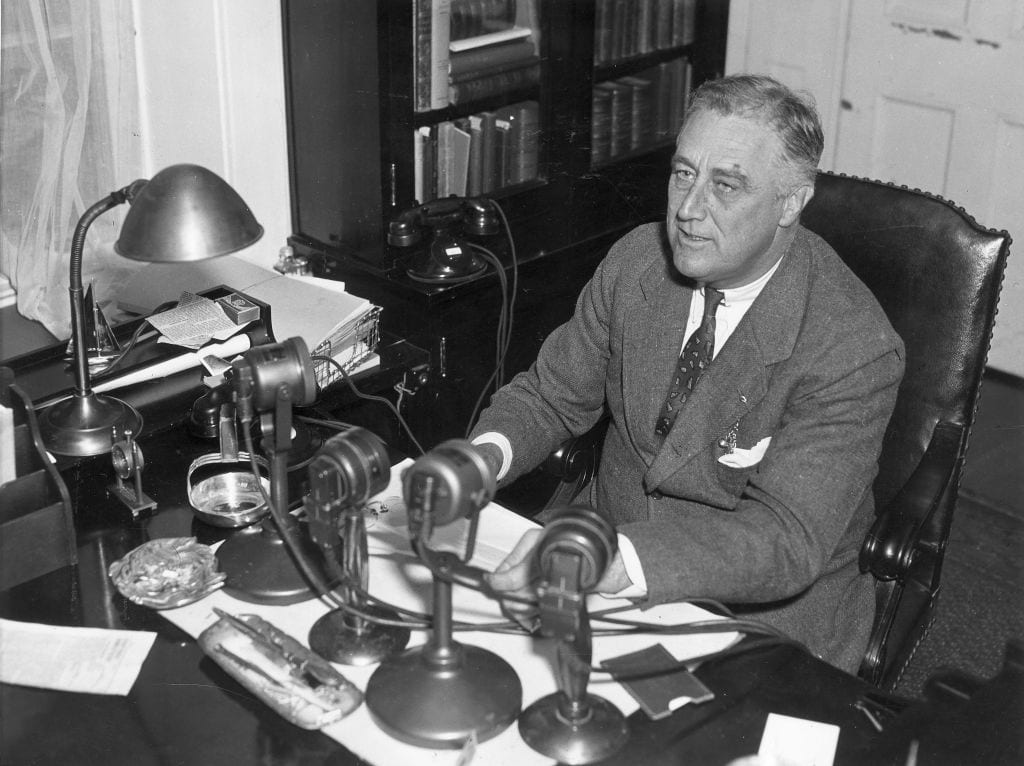
We can honor the past without trapping ourselves inside it.
Every political community needs its story. It needs an account of itself, its heroes and villains, its founding wounds and saving deeds. The public does not merely remember these things but also reinforces them by making them a template for education, teaching the young what is noble, what is shameful, what must be revered, and what must never be permitted to return. This is not simply propaganda. It belongs to political life. No polity can live by disembodied ideals alone, and no people can endure without memory, piety, gratitude, and shared attachments.
The difficulty begins when people start to forget that their sacred story, however reflective of the truth it may be, is nevertheless a parable or a narrative about justice, not justice itself.
The American postwar consensus is such a story, and one that has been generating a fair amount of controversy of late. This consensus is not merely the historical fact that the United States and its allies defeated Nazi Germany and Imperial Japan, or the moral fact that this was a good thing. Nor is it merely the institutional settlement that followed the war: Bretton Woods, the United Nations, NATO, the national security state, the administrative welfare state, and the open-ended commitment to upholding the liberal international order. At its deepest level, the postwar consensus is how America came to understand itself under Franklin Roosevelt.
According to this myth, America passed through the Depression and World War II to emerge not simply victorious, but purified. The older constitutional republic, with its local attachments, constitutional restraints, inherited moral habits, and suspicion of centralized power, was reinterpreted through the drama of 1945. The new America would be universal, managerial, egalitarian, therapeutic, and global. It would secure freedom from want and fear at home while defending democracy, rights, and openness abroad. It would not merely preserve an inherited republic. It would carry forward the moral meaning of history.
This is why World War II became more than a war in American memory. It became a second founding, or more precisely, a new founding myth. The Axis became not merely defeated enemies, but symbols of metaphysical evil. The American-led order became not merely the victor’s settlement, but the institutional negation of fascism itself. To be loyal to the postwar order was to stand with democracy against tyranny, openness against hatred, equality against hierarchy, and progress against barbarism.
The power of such a myth is obvious. It gave moral coherence to a nation emerging from economic depression, total war, and global responsibility. It honored real sacrifice, named real evils, and helped explain why America should assume burdens that older republican prudence might have avoided.
The danger might have been less obvious, or less imminent, at the time. But it is becoming clearer, and more present, almost 81 years on.
Once a regime identifies its own institutions with the defeat of evil, opposition to those institutions becomes morally precarious. Dissent is no longer merely dissent. It can be recoded as reaction, extremism, disloyalty, hatred, or latent fascism. The regime’s preferred policies become signs of civic righteousness, while its opponents become symptoms of a disease the regime believes it was born to cure.
World War II did not create every idea later associated with the postwar order. Wilsonian internationalism, progressive humanitarianism, New Deal economics, liberal Protestant universalism, racial egalitarianism, anti-colonial rhetoric, and suspicion toward inherited local attachments all had older roots. But the architects of America under FDR gathered these older ideas, dramatized them, baptized them, and placed them beyond ordinary dispute.
Roosevelt’s 1941 “Four Freedoms” speech to Congress looked toward a world founded upon freedom of speech, freedom of worship, freedom from want, and freedom from fear, each extended “everywhere in the world.” His “Second Bill of Rights” in 1944 proposed a new economic understanding of citizenship, including claims to employment, housing, medical care, education, and material well-being.
These were not casual policy proposals but cornerstones of a refounding in which liberty would increasingly be understood not as ordered freedom under constitutional restraint, but as security administered by the modern state. The Hobbesian bargain was no longer promised safety from a violent death, but from discomfort itself.
A serious critique of this refounding must avoid two temptations. The first is vulgar revisionism, which imagines that because the postwar myth is false, the Axis regimes must somehow become defensible. That is morally unserious. Imperial Japan was a brutal expansionist empire, and Nazi Germany was a monstrous regime. These orders emerged due to the particular histories of their respective societies, and those histories are worthy of open study. Their obvious guilt need not be diminished in order to criticize what the victorious liberal order made of the war.
The second temptation is pious submission to the official myth, which says that because the enemies were evil, the victors’ order must be sacred. This allows every later project of centralization, social reconstruction, global management, and ideological discipline to borrow sanctity from the sacrifices of the dead.
The truth is harder. World War II was a terrible war against guilty enemies, fought with courage by millions of ordinary men, and concluded in a world where even the victors crossed moral lines that should never be treated lightly. Japan illustrates the problem. Pearl Harbor was an act of war, and Japan’s conduct in Asia was brutal. But the Pacific War did not erupt without context.
The United States had placed Japan under severe economic pressure through asset freezes, embargoes, and restrictions that threatened the strategic life of the Japanese Empire. The State Department’s historical account of the road to Pearl Harbor notes that these measures created serious shortages and that Japanese leaders concluded they had to act swiftly. This does not justify Pearl Harbor. But it does complicate the innocent mythology of passive America assaulted by inexplicable barbarism.
The end of the Pacific War is equally difficult. By August 1945, Japan was strategically finished. Its navy was broken, its cities were burning, and its economy was strangled. Soviet entry had shattered what remained of its diplomatic position. The question was no longer whether Japan could win. It was whether its ruling class could be forced, shocked, or permitted to accept defeat. The atomic bombings were not the simple moral necessity of the postwar catechism. They were part of a larger total-war campaign in which civilian population centers had become instruments of coercion.
The United States Strategic Bombing Survey later concluded that Japan probably would have surrendered before November 1, 1945, and certainly before the end of that year, even without the atomic bombs, Soviet entry, or invasion, though that judgment has remained contested. The firebombing of Tokyo in March 1945 in Operation Meetinghouse should haunt the American memory as much as Hiroshima. It killed roughly 100,000 civilians, left about 1,000,000 homeless, and destroyed vast sections of the city.
Military necessity may explain some things. It does not transfigure all things. The older Christian and classical mind understood this better than the modern ideological mind. It did not assume that the enemy’s guilt made the victor innocent. It knew that war endangers the soul, not only the bodies of soldiers. It knew that even in a just war, victory itself can become a temptation. The city that triumphs may come to believe that its triumph has revealed its innocence.
Rewriting History
In time, if the postwar myth becomes calcified enough, the key political and philosophical question—“What is justice?”—becomes displaced by another question: “What must we affirm in order to remain faithful to the saving event of the regime?” That is the decisive corruption. The city’s memory becomes the measure of the good. The regime’s survival story becomes a moral standard. The defeated enemy becomes a kind of negative revelation, defining evil so absolutely that the victorious regime is tempted to define goodness as whatever is most unlike him.
This is why the postwar mind so often reasons by inversion. Fascism was nationalist, therefore nationalism is suspect. Fascism was hierarchical, therefore hierarchy is suspect. Fascism appealed to blood and soil, therefore rootedness is suspect. Fascism subordinated the individual to the collective, therefore every inherited corporate form becomes suspect. Fascism was militaristic, therefore martial virtue must be supervised by liberal humanitarianism. Fascism invoked destiny and peoplehood, therefore any thick account of nationhood must be watched for signs of relapse.
But the opposite of evil is not necessarily good. The opposite of tyranny may be license. The opposite of racialism may be deracinated universalism. The opposite of militarism may be therapeutic pacification. The opposite of domination may be administrative dissolution. Political wisdom requires more than inversion.
Among the reasons this reflexive inversion becomes more dangerous as it becomes more unthinking is that it discredits the very moral truths it seeks to defend by associating them in the minds of the young with empty sloganeering. To portray healthy patriotic sentiment as fascism or racial animus has the unintended but inevitable effect of making real opposition to real fascism look like reflexive gatekeeping. It turns the very objects of taboo—including ethnic hatred—into something secret, forbidden, and therefore exciting to young people.
Sacralized war memory also bears a dangerous kinship with eschatological nationalism. The war becomes more than an episode in the nation’s history; it becomes a revelation of the nation’s mission. The nation becomes more than a people under laws; it becomes the bearer of history’s redemptive purpose. In this form, even an anti-nationalist liberal order can become nationalist in structure. America is imagined as the nation that must transcend ordinary nationhood in order to redeem the world from fascism, hierarchy, exclusion, and war.
Such a politics cannot remain prudential for long. If the nation bears history’s saving mission, then limits become betrayals, compromise becomes appeasement, and dissent becomes heresy. The domestic opponent is no longer merely wrong; he is resisting the future. The foreign enemy is no longer merely dangerous; he is an obstacle to redemption. In this way, sacralized memory turns politics apocalyptic and transforms the regime’s survival story into a permanent mandate for moral emergency.
Once a nation treats its victory as History’s verdict, questions of justice by nature are displaced by the judgment of the age. The regime no longer has to ask whether its principles are true; it need only say that history has rendered its decision. “The right side of history” becomes providence without God, eschatology without revelation, and political theology without transcendence. It supplies judgment, election, condemnation, and final vindication while insulating the regime from the Socratic question it most fears: What is justice?
This is the historicism against which Leo Strauss warned in Natural Right and History (1953) and The City and Man (1963). The postwar consensus is historicist not merely because it emerged after a great historical event, but because it treats that event as morally revelatory. It allows 1945 to function as a substitute for nature, providence, and philosophy. Justice is no longer sought as what is true always and everywhere. It is received as the verdict of History, certified by victory, institutionalized by the regime, and enforced against those who refuse to accept the lesson.
This is why the postwar myth is hostile to philosophy even when it speaks in moral language. It allows citizens to feel serious without thinking seriously. They do not ask, “What is justice?” They ask, “Who threatens democracy?” They do not ask, “What is the good regime?” They ask, “Who is on the right side of history?” They do not ask, “What is man by nature?” They ask, “Who has failed to overcome the past?” That is not philosophy. It is catechesis.
This points to the enduring problem of politics. Every political order depends on a settled story about justice, legitimacy, and the past. In that sense, politics cannot help but be hostile to philosophy, which asks whether those stories are true. Leo Strauss spent much of his life exploring this ancient tension.
Political communities need stories. But the soul needs truth. Politics needs settlement, but philosophy asks whether the settlement is just. The city needs closure, while philosophy reopens. The city needs pious memory, while philosophy asks whether the memory is true. The city needs citizens educated into loyalty, while philosophy asks whether loyalty remains subordinate to justice or has usurped its place.
The America that emerged from World War II was not simply the old republic vindicated. It was increasingly a new regime consecrated by victory, armed with universal moral claims, and willing to remake the nation in Franklin Roosevelt’s image. The founding of 1776 endured, but it was reinterpreted in light of the moral consensus that emerged in 1945. The Declaration became a universal equality charter. The Constitution became a procedural vessel for expanding rights. Lincoln became the prophet of the unfinished egalitarian project. Roosevelt became the architect of the administrative welfare-security state. World War II became the altar on which the new order was blessed.
That altar is now cracking. The regime still speaks in the language of 1945: democracy, freedom, human rights, equity, inclusion, international order, security, and anti-fascism. But these words now sound less like the language of a confident civilization than the incantations of an exhausted one. They are repeated not because they explain reality, but because the regime does not know what remains if they fail.
Socrates would ask the forbidden question: What is justice? Not what does the regime call justice, not what does the postwar order require justice to mean, and not what words preserve the legitimacy of those who rule, but what is justice itself?
A serious conservatism should therefore be neither iconoclastic nor servile. It should not sneer at the American soldier. It should not deny the evil of the Axis. It should not pretend that political communities can live without memory, piety, or inherited stories. But it must refuse to let any regime turn its story into an idol. We can honor the dead, tell the truth about the enemy, and acknowledge the necessity of political order. But we must refuse the final lie of every sacralized regime myth: that because the city has suffered, survived, and defeated evil, it may now identify itself with the good. No earthly city has that privilege of claiming right by sacralizing history.
The American Mind presents a range of perspectives. Views are writers’ own and do not necessarily represent those of The Claremont Institute.
The American Mind is a publication of the Claremont Institute, a non-profit 501(c)(3) organization, dedicated to restoring the principles of the American Founding to their rightful, preeminent authority in our national life. Interested in supporting our work? Gifts to the Claremont Institute are tax-deductible.
Suggested reading


A quick and dirty guide to regime propaganda
Joe Biden and the dangers of posterity.

The choice of what to let go is no longer yours.

War: What is it good for?
Restoring pride in the military will require a massive effort.

