

How globalization became sinicization
The Crackup of the Boomer Truth Regime
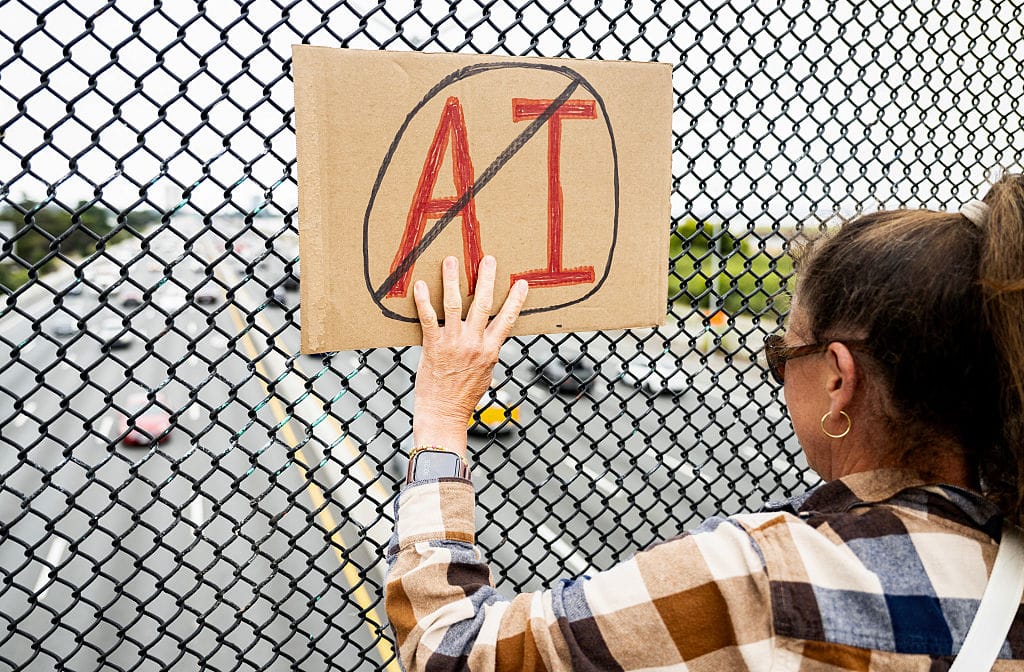
Outcry over data centers points to a larger issue.
I live in Loudoun County, Virginia, about a mile from the largest concentration of data centers on earth, which has given the online discourse around them a vaguely odd character. At worst, they are large concrete squares that are indistinguishable from any other industrial park, except that they produce less noise or pollution. My utility bill is ordinary, if slightly below the national average, and my roads are as nice as any in the country. But to hear online activists talk, my community should be on the verge of running out of water.
Loudoun County hosts roughly 200 operating data centers; Northern Virginia’s cluster draws some 4,140 megawatts, more than double Beijing’s, the world’s second-largest market. Since the data centers began being built in the late 1990s, Loudoun County has been able to spend lavishly on infrastructure and public schools, all while cutting its real property tax rate. In fact, the county calculates that every dollar of services it provides the industry returns some $26 in taxes.
When I noticed the glaring difference between this reality and the online discourse, I realized that this is a recurring pattern I have seen my entire life. When I was growing up in the early 2000s, there was a set of beliefs in American society that were viewed as non-political and weren’t debated by either side. They acted as an ideological background radiation of sorts. I like to call this the “Boomer Truth Regime,” after both the Boomer generation and the boom time after World War II.
You can take the American 20th century as one huge emotional and moral arc. Starting in 1900 and continuing for the ensuing 45 years, our country had its optimism for the future hammered out of it. It was in this era that Jim Crow intensified, the Depression battered the country, and we fought two world wars.
But beginning in the 1940s, American society, and to a lesser extent the whole world, began a process of upward movement—and as a result acquired a feeling of almost inevitable, rapid, transformative salvation. Start with almost any evil, real or perceived, of that century—sexism, colonialism, segregation—and trace it forward, and you will find a satisfying narrative conclusion by 1999.
In Zero to One, Peter Thiel called the resulting mood “indefinite optimism”: the belief that things simply get better without anyone having to decide how. And so we bundled all the changes of that era together and sanctified the whole package. For decades, it has been taken for granted that basically all societal and cultural shifts in the second half of the 20th century were good—and that they existed as a single, inseparable package.
Among the sanctified conclusions was not only indefinite optimism for the future but also a deep fear of the dangers of new technology. In short, the Boomer Truth Regime permanently fused the word “machine” with the word “gun,” as they were in the world wars. This was largely a traumatic response to the misuses and abuses of the cornucopia of technology by tyrants during that era.
In the early 20th century, the world had at its fingertips an inventory of wonders such as nitrogen fixation, airplanes, automobiles, submarines, rockets—and every one of them was first used at scale for murder. So when our society looks at a new power, what we see is the face of the murderer. We see Hiroshima, or the tank, or the B-2. It is this same reflex that has killed the creation of new nuclear or hydroelectric power, because we have been taught to be more afraid of the side effects than excited about the potential.
The Boomer Truth Regime decided that anything capable of doing huge things is, on its face, terrifying and must be vigorously opposed.
You can see the degree to which this belief is highly influential in America and other Western countries in the polling data around AI. In Ipsos’s 2026 global survey, 83% of Chinese respondents and 79% of Indian respondents say AI products make them excited; in the United States, the figure is only 33%, compared with 29% in Britain. Or take, for example, that when asked whether AI’s benefits outweigh its drawbacks, 85% of Chinese respondents and 80% of Indians say yes, compared to only 38% of Americans. Pew also finds that about half of Americans are more concerned than excited about AI, and only one in ten is the reverse.
It is possible that the data centers in Loudoun County will begin to drive up costs. Virginia’s own legislative auditors project that data-center growth could add $14 to $37 a month to a typical residential bill by 2040—but the size of the effect is nowhere near the emotional reaction you see in American society right now. The same report found that data centers currently pay their full cost of service and have no history of cost-shifting to households.
For decades, doubting any piece of the Boomer Truth Regime package was the equivalent of a kid complaining about his bedtime. Dissidents could say whatever they wanted, in whatever register they wanted, precisely because there was no chance the thing they were calling for would ever be implemented. Every critique of the Boomer Truth Regime was essentially powerless. But that era will soon end as the generation raised in the 21st century inevitably takes over. It isn’t that younger generations stopped believing in pieces of the package, but that the idea of viewing it as a sanctified whole is dissolving.
And when the sanctity eventually falls away, everything will be reexamined at once—not just the parts you dislike. The whole package, from nuclear power to civil rights law, will be on the table in our lifetime. It is up to us to defend the parts we value and reject the parts we don’t.
One part I reject is the idea that we can no longer, and should no longer, do incredible things. AI is one such thing. It of course has dangers, but it also has almost incalculable potential—and I know which side I’m betting on.
The American Mind presents a range of perspectives. Views are writers’ own and do not necessarily represent those of The Claremont Institute.
The American Mind is a publication of the Claremont Institute, a non-profit 501(c)(3) organization, dedicated to restoring the principles of the American Founding to their rightful, preeminent authority in our national life. Interested in supporting our work? Gifts to the Claremont Institute are tax-deductible.
Suggested reading


The military’s existing framework answers the hardest questions about autonomous lethal force.

A marriage more of convenience than love.

There is nothing manly in throwing up your hands.

Silicon Valley’s disastrous dance with psychedelic drugs.

What Pope Leo XIV’s encyclical on AI means for republican government.

