
Justice Thomas’s Declaration
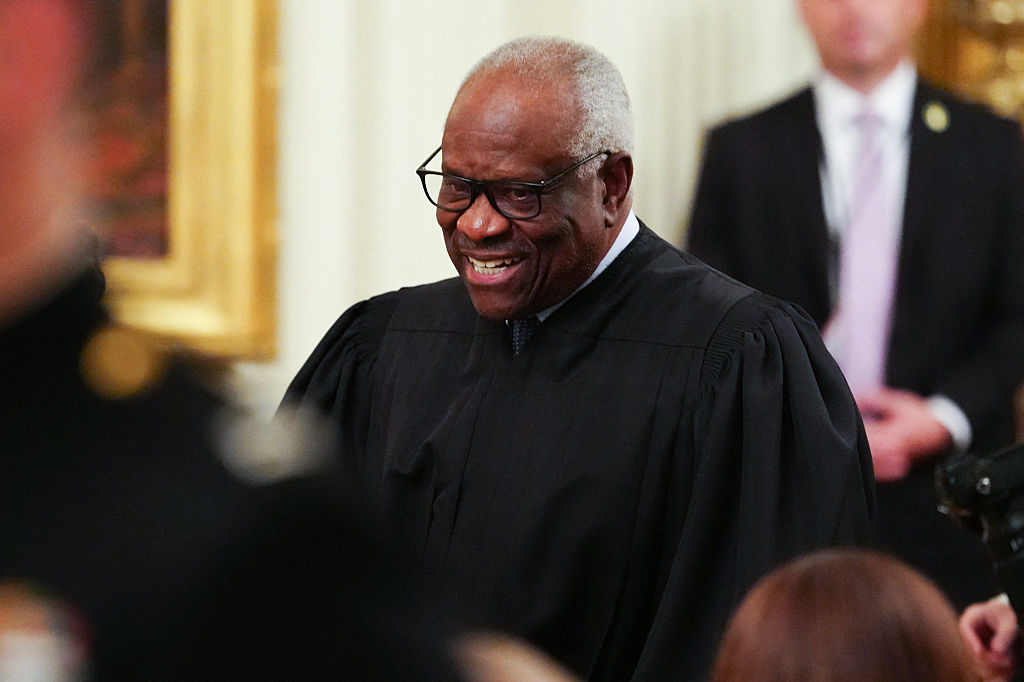
The making of an American.
As we continue to celebrate the 250th anniversary of the American Founding, we will keep publishing reflections on the meaning of the Declaration of Independence, some by Claremont scholars and others by learned friends. In this piece, Professor Lucas E. Morel discusses the brilliant speech Justice Clarence Thomas recently gave at the University of Texas at Austin. Read all the entries in our “Declaration at 250” series here.
As the Fourth of July approaches in this semiquincentennial year of the Declaration of Independence, the best commemorations will contain some element of civic education—a reflection on the words and deeds of the American Founding. In advance of celebrating what Frederick Douglass called “the first great fact” in our nation’s history, Justice Clarence Thomas delivered a civic cri de coeur at the University of Texas at Austin on the principles of the Declaration and the character necessary for maintaining the American way of life.
Exhibit A was the black American community in which he was raised. Identifying himself as “American by birth and Georgian by the grace of God,” Thomas showed his affection for a country where the black residents of Pin Point, Georgia, affirmed the nation’s “promised ideals” even as they experienced “the indelible mark of segregation and its companion evils.” Their moral fiber in the face of Georgia’s segregation laws and customs taught him his worth as a human being and his rights as an American. As Thomas put it, “At home, at school, and at Church, we were taught that we were inherently equal…. [T]hat you did not get your rights or your dignity from those governments, but from God.” That moral self-understanding, shaped by the ideals of the American Founding and a culture shaped by Christianity, was central to Thomas’s message about the Declaration of Independence.
The venue for Thomas’s civics lesson was UT’s new School of Civic Leadership (SCL), established, as he noted, to teach students about “Western civilization and the American constitutional tradition.” While applauding their efforts to “rejuvenate our fellow citizens’ commitment to the principles of the Declaration of Independence,” he pointed out that SCL’s mission was to offer civic education “as part of a larger quest for wisdom about how to live and how to lead.”
Where critics of these new civic centers view them as ideological silos, Thomas sees SCL as reclaiming the university’s mission as a truth-seeking institution. That means not just presenting answers—like the self-evident truths of the Declaration—but also having debates and arguments about them. “Indeed,” Thomas observed, “your School of Civic Leadership was created to host such arguments.” Foremost among the arguments against America’s Founding principles are those associated with the progressivism championed by Woodrow Wilson, which Thomas identified as bad for both America and the world.
On the domestic front, Thomas contrasted the principles of equality, individual rights, and government by consent of the governed with progressivism’s rejection of the founders’ natural rights philosophy and elevation of rule by experts. Faith in historical progress to determine the proper relationship between the citizen and the state replaced God and nature as the ground of human equality, civil liberties, and legitimate government. The result was a federal government that racially segregated its workforce and eugenics policies that supported the sterilization of persons deemed unfit to reproduce. Thomas demonstrated how a rejection of “the transcendent origin of our rights” led the government to violate equality under the law and basic human dignity.
As bad as these policies were in America, their effects internationally were far worse. Thomas identified Stalin, Hitler, Mussolini, and Mao as the political monsters of the 20th century who claimed to rule in the interest of the masses but served the interests of the few. As Thomas soberly recounted, “Fascism—which, after all, was a national socialism—triggered wars in Europe and Asia that killed tens of millions.” He added, “The socialism of the Soviet Union and the People’s Republic of China proceeded to kill more tens of millions of their own people.” Thomas didn’t spend much time proving his case; he simply stated his conclusions, inviting any doubters to prove him wrong by considering the available evidence.
With so few college courses required in American history, let alone world history, it’s no surprise that students lack even a passing awareness of the human devastation resulting from the real-world application of theories claiming to supplant the self-evident truths of the Declaration.
To counter Wilson’s philosophic faith in progress, Thomas quoted another American president, Calvin Coolidge. On the 150th anniversary of the Declaration of Independence, Coolidge praised its enduring legacy:
If all men are created equal, that is final. If they are endowed with inalienable rights, that is final. If governments derive their just powers from the consent of the governed, that is final. No advance, no progress can be made beyond these propositions. If anyone wishes to deny their truth or their soundness, the only direction in which he can proceed historically is not forward, but backward toward the time when there was no equality, no rights of the individual, no rule of the people.
Coolidge believed that progressivism was anything but progressive. He thought it was “reactionary…not more modern, but more ancient, than those of the Revolutionary fathers.”
Moreover, because progressivism “has coexisted uneasily with the principles of the Declaration,” Thomas argued, “it is not possible for the two to coexist forever.” By alluding to Lincoln’s 1858 “House Divided” speech, Thomas suggested that America is undergoing an identity crisis, one that will have to be resolved for the house not to fall. In 2026, a year of reflection on the nation’s founding truths, Americans must decide whether to follow those who sought to create “the supposedly enlightened world of Hegel, Marx, and their followers,” or return to the faith of our fathers, the Spirit of ’76.
Thomas’s speech was an attempt to help Americans see that despite their failures to live up to their noblest professions, they nevertheless produced “the freest, wealthiest, and most powerful nation in the history of the world.” Most importantly, he sought to inspire Americans to emulate the courage of their forbears in defense of their self-governing way of life, a courage Thomas has exhibited in his own life as a man and as an American citizen. In so many ways, Thomas’s speech declared his personal independence from elite society’s opinion of him, demonstrating the kind of character that produced the country of his birth and to which he has devoted his career as a justice of the Supreme Court.
Thomas closed by quoting the last sentence of the Declaration of Independence, which is not as familiar as the passages containing the fundamental truths justifying American independence. He argued that Americans must not only believe what their forefathers believed, but also act as they acted in its defense. Memorizing the words to their political creed won’t perpetuate their constitutional way of life. For every generation, the “land of the free” must be the “home of the brave” to remain a beacon of freedom and equality at home and abroad.
In sharing his past as a way to understand the nation’s history, Justice Clarence Thomas gave a civics lesson on how to become an American. May his words lead all Americans to have the same gratitude for their country, recognize the threats to its survival, and strengthen their resolve to defend it.

The American Mind presents a range of perspectives. Views are writers’ own and do not necessarily represent those of The Claremont Institute.
The American Mind is a publication of the Claremont Institute, a non-profit 501(c)(3) organization, dedicated to restoring the principles of the American Founding to their rightful, preeminent authority in our national life. Interested in supporting our work? Gifts to the Claremont Institute are tax-deductible.

Or die waiting for a narrative to save you.

A response to Christopher Rufo’s critics, both serious and unserious.
A qualified victory for republicanism in its removal power decisions.
The cure for what ails America.
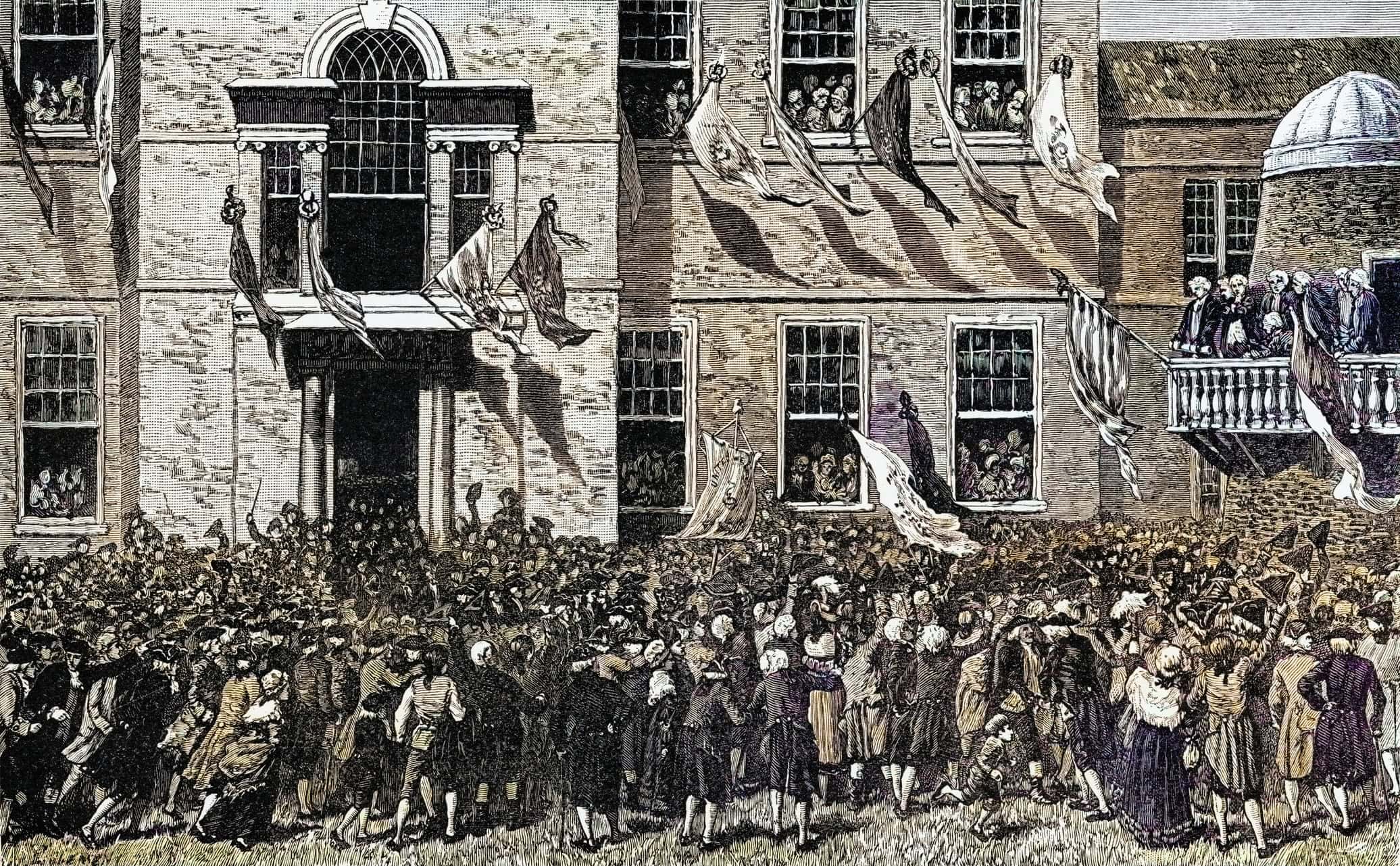
Letting the world know of American independence.

